
From the Specialists at Parlay Hair and Beauty, Jensen Beach, Florida
It is one of the most genuinely frustrating experiences in hair care. A friend gets a balayage and it looks effortless and sun-kissed for months. You get the same service at the same salon and yours fades to a different tone within weeks. Someone else air-dries to a beautiful wave. You air-dry to something that requires a name other than a wave. A product is recommended by everyone and does nothing useful for your hair at all.
This is not bad luck. It is not the salon. It is the specific, biological, structural reality that hair is among the most individually variable features the human body produces – and that the factors determining how your hair behaves are layered, specific, and genuinely different from the person sitting next to you.
Understanding why your hair does what it does – specifically, not generally – is the most practically useful hair knowledge available. It is what makes every product choice, every service decision, and every at-home practice more specifically appropriate and more consistently effective.
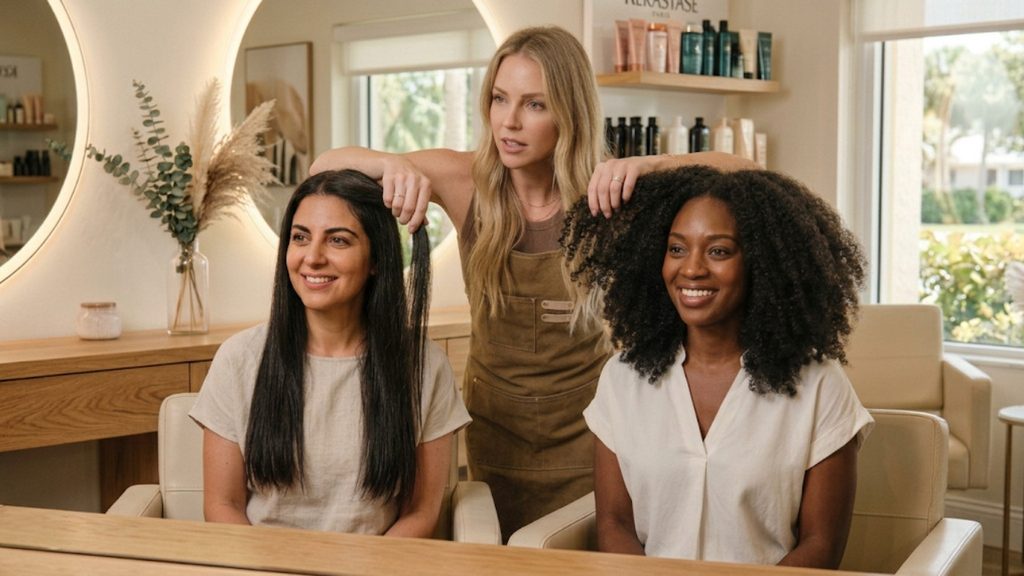
The Factors That Make Hair Individual
Hair Texture and Density
These two qualities are the most commonly conflated and the most importantly distinct.
Texture refers to the diameter of each individual hair strand – fine, medium, or coarse. Fine hair has a smaller diameter. It responds to product differently, holds color differently, and requires a completely different cut approach than coarse hair of the same length. Fine hair is more easily weighed down by product, more quickly affected by humidity, and more immediately responsive to heat styling – both the benefits and the damage.
Density refers to how many individual strands exist on the scalp – the fullness or sparseness of the overall hair. A person can have fine individual strands but high density – creating hair that appears full but behaves delicately. Or coarse strands at low density – creating hair that appears thinner but withstands heat and chemical processing more robustly.
The combination of texture and density is the most fundamental variable in how hair responds to everything – products, cuts, color, treatments, and daily styling. Two women can have what appears to be similar hair and have completely different texture and density profiles that create entirely different product needs, cut requirements, and styling behaviors. This is why the product that works brilliantly for one person does nothing for another – the formula that is correctly weighted for fine low-density hair sits too heavily on fine high-density hair, and is entirely inadequate for coarse high-density hair regardless of the results its fan base reports.
Porosity – The Variable Most People Have Never Heard Of
Porosity is the hair’s ability to absorb and retain moisture – and it is the most consistently underappreciated factor in explaining why hair behaves so differently from person to person in response to the same products and treatments.
Low porosity hair has a tightly packed cuticle that resists moisture absorption. Products sit on the surface rather than penetrating. Color takes longer to deposit and often processes unevenly. Deep conditioning masks do not deliver their full benefit without heat assistance to open the cuticle. Low porosity hair can feel dry despite regular conditioning because the moisture is not entering the hair shaft.
High porosity hair has an open, raised cuticle that absorbs moisture readily but releases it just as quickly. Color absorbs fast but fades faster than expected. Frizz in humidity is most dramatic in high porosity hair because the open cuticle absorbs atmospheric moisture immediately. Deep conditioning creates immediate results but the hair returns to dry more quickly than medium porosity hair.
Medium porosity hair sits between the two – the most balanced absorption and retention, the most predictable response to products and color. Most professional product formulas are calibrated for medium porosity as their baseline.
Porosity is partly genetic and partly acquired – UV exposure, heat styling, chemical processing, and the hard water mineral deposits from Jensen Beach’s municipal supply all progressively increase porosity over time. Two people with genetically similar porosity can have significantly different acquired porosity profiles based on their history with color, heat, and environmental exposure.
This is why K18 treatment creates such dramatically different results for different clients – the high porosity hair with significant bond damage responds most dramatically to molecular-level repair, while medium porosity hair with minimal damage shows a more subtle improvement from the same service.
Curl Pattern
The curl pattern – from completely straight through wavy, curly, and coily – is determined by the shape of the hair follicle. A round follicle produces straight hair. An oval follicle produces wave. The more elliptical the follicle, the tighter the curl.
What most people do not realize is that the curl pattern determines far more than just the shape of the hair. It determines how the scalp’s natural oils travel down the hair shaft – more efficiently in straight hair, more slowly and incompletely in curly and coily hair, which is why curly hair tends toward dryness more than straight hair of the same density. It determines how the hair responds to humidity – the same atmospheric moisture that makes straight hair limp and wavy hair frizzy can make curly hair more defined or completely undefined depending on the curl’s specific pattern and the hair’s porosity.
It also determines the most appropriate haircut approach – a fact that the cutting technique used for straight hair completely fails to account for. The curly hair cut at Parlay is designed specifically for the curl’s natural spring, its volume pattern, and its specific behavior in Jensen Beach’s humidity – not a straight-hair cutting approach applied to curly hair and expected to produce a curly hair result.
Scalp Characteristics
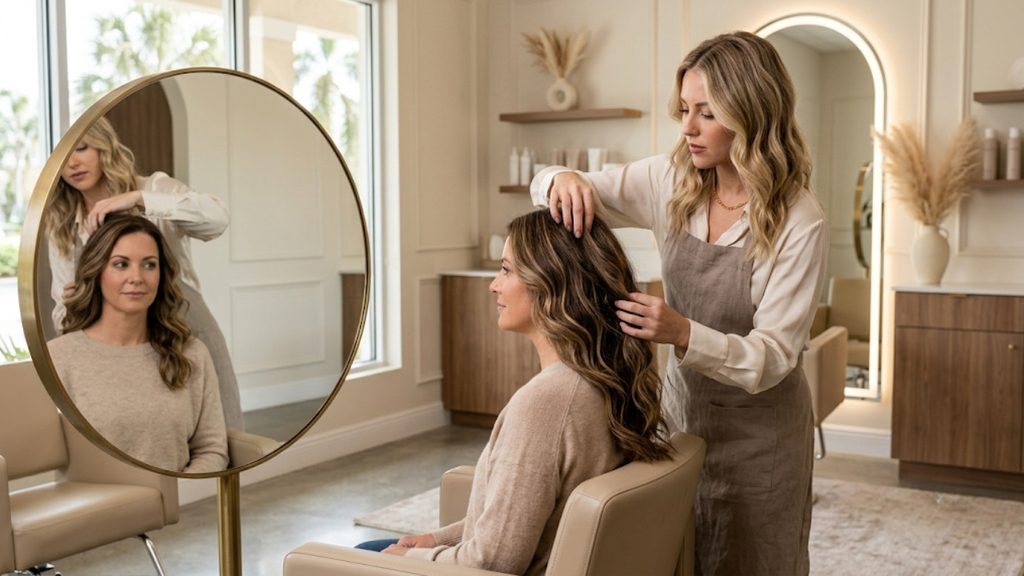
The scalp is the origin point of every hair’s characteristics – and two scalps can produce dramatically different hair even when the visible hair appears similar.
Sebum production rate is among the most individually variable scalp characteristics. A scalp that produces sebum rapidly creates the hair that looks unwashed within twenty-four hours of washing – not because the person is less clean but because the follicle is producing more oil more quickly. A scalp that produces sebum slowly creates the hair that can go four days between washes without looking unwashed – not because of any particular product or technique but because the biology is different.
This variable determines the appropriate washing frequency, the most appropriate shampoo formula, and the most appropriate scalp care approach – and it has nothing to do with habit, discipline, or hair care quality. It is simply the scalp’s individual production rate.
Scalp sensitivity varies equally. The scalp that reacts to certain chemical formulas, certain application techniques, or certain environmental conditions creates a completely different service approach than the non-reactive scalp – and the professional scalp treatment at Parlay addresses each scalp’s specific condition rather than applying a generic approach to a variable that is genuinely individual.
Chemical and Processing History
Perhaps the most immediately relevant factor in explaining why your hair behaves differently from someone else’s – because it is the factor most actively within your control and most actively creating the current hair condition.
Two people with identical genetic hair characteristics can have completely different hair behavior based on their chemical processing history. The hair that has been professionally colored with bond repair incorporated at every appointment maintains a structural integrity that the hair colored repeatedly without bond repair does not. The hair that has been exposed to years of sulfate shampoo and high heat without UV protection has a different porosity and a different cuticle condition than the hair that has been maintained with sulfate-free washing and daily UV protection since the first color appointment.
This is the factor that most directly explains why the same balayage on two people – even two people with similar natural hair – creates different results and requires different maintenance. The processing history that preceded the balayage is different. The porosity acquired through that history is different. The structural condition available to hold the color is different.
It is also the most actionable factor for improvement. The K18 treatment and Olaplex treatment that rebuild structural integrity, the deep conditioning treatments that restore cortex-level moisture, and the daily Moroccanoil Treatment that protects the cuticle from Jensen Beach’s ongoing UV and environmental stress – these practices progressively improve the acquired hair condition regardless of the genetic starting point.
The Jensen Beach Environmental Factor
Living in Jensen Beach adds a specific layer of environmental influence on top of all of the above – one that makes the hair-individuality question more complex than it would be in most other communities.
The same UV intensity, the same humidity, the same salt water and pool chemical exposure affects different hair types in measurably different ways. High porosity hair absorbs the environmental stressors most rapidly and shows the consequences most quickly. Fine hair shows UV-driven color fade more visibly than coarse hair of equivalent color. Curly hair responds to Jensen Beach’s rainy season humidity in ways that completely straight hair does not experience.
This means the routine that is most appropriate for your hair in Jensen Beach is not just individually determined by the genetic factors above – it is the intersection of those genetic factors with the specific environmental demands this community creates. Our complete guide on Florida weather and your hair covers the environmental factors in specific detail.
What This Means Practically
Stop benchmarking your hair against someone else’s. The product that works for them is formulated for their porosity, their texture, their density, and their processing history – not yours. The color result they achieve reflects their specific starting point and scalp characteristics – not a standard you should expect your hair to meet. The routine they follow is calibrated for their specific combination of all the above – not a template that transfers directly to a different set of variables.
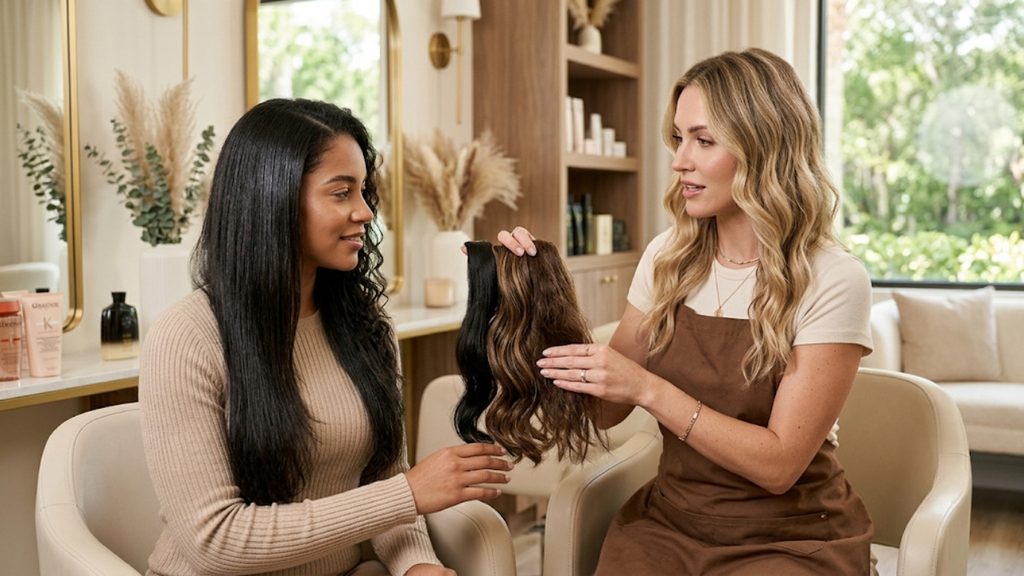
The most useful practical response to understanding why your hair is individual is to treat it individually – with the hair consultation that assesses the specific texture, density, porosity, curl pattern, scalp characteristics, and processing history that determine what your hair most specifically needs.
The consultation is not a formality before the service. It is the most important part of the service – the specific, individual assessment that makes every subsequent product recommendation, every treatment choice, and every cut and color decision most specifically appropriate for the hair that is actually in the chair.
Your hair is not difficult. It is specific. And specific is exactly what the Parlay specialists are trained to address.
Come in. Tell us what your hair does. We will tell you why – and what to do about it.
- 2250 NE Dixie Hwy, Jensen Beach, FL 34957
- (772) 261-8116
- parlayhairandbeauty.com
- Online Booking Available 24/7 via Vagaro