
The Complete Guide to Choosing Between Full Color and Highlights – From the Color Specialists at Parlay Hair and Beauty, Jensen Beach, Florida
The Question That Sits at the Heart of Every Color Consultation
You are sitting in the salon chair. Or maybe you are at home, scrolling through photos of hair color you love, trying to figure out what to ask for at your next appointment. You have a general sense of the direction you want to go – lighter, richer, more dimensional, more vibrant, just different – but you are stuck on one fundamental question that everything else seems to depend on:
Should I get a full color or highlights?
It sounds like a simple question. Two options, one answer. But the reality is that this decision sits at the intersection of several genuinely complex factors – your hair’s current state and history, your skin tone and undertones, your lifestyle and maintenance preferences, the specific look you are trying to achieve, your budget, your timeline, and the condition you want your hair to be in six months from now.
Make the right choice and you walk out of the salon with color that looks extraordinary, fits your life seamlessly, and makes you feel like the most beautiful version of yourself every day for months. Make the wrong choice and you spend those same months dealing with color that requires constant attention, does not quite look the way you imagined, or has left your hair in a condition that requires significant recovery work.
At Parlay Hair and Beauty in Jensen Beach, Florida, the full color versus highlights conversation is one of the most important consultations we have with every new color client – because getting it right at the planning stage makes an enormous difference in the quality of the result and the long-term health and beauty of your hair. Our color specialists have guided hundreds of clients through this exact decision, and this guide contains everything we know about making it well.
We are going to cover everything. What full color actually involves, in detail. What highlights actually involve, in detail. The genuine advantages and disadvantages of each. How your hair type, skin tone, lifestyle, and maintenance preferences should factor into the decision. The situations where full color is clearly the right choice, the situations where highlights are clearly the right choice, and the situations where the answer is a combination of both. The questions to ask yourself before your next color consultation. And the questions to ask your colorist once you are in the chair.
By the end of this guide, you will know which option is right for you – not just in general, but specifically, for your hair, your life, and the color you are trying to achieve. Let’s get into it.
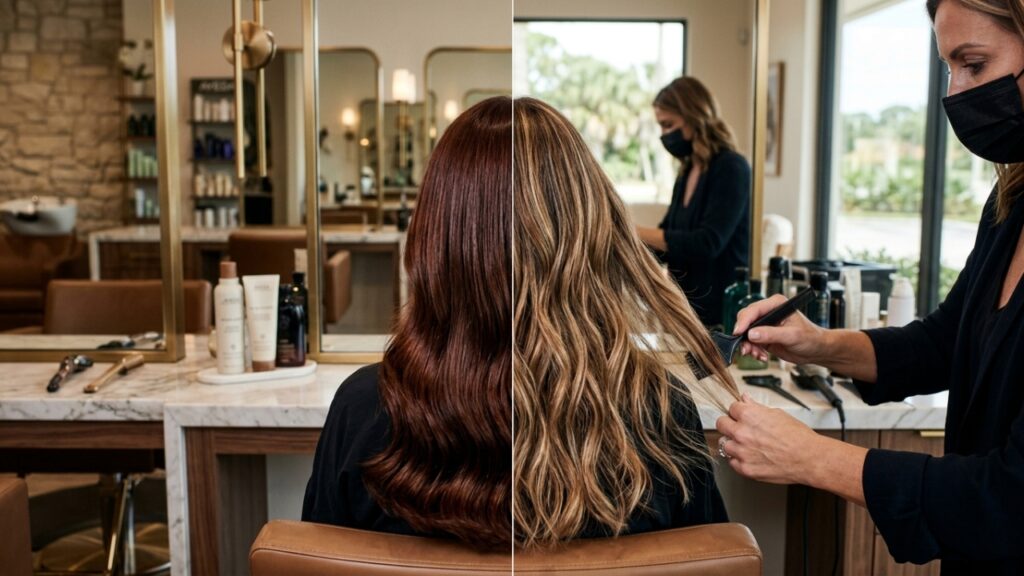
Understanding What These Services Actually Are
Before we can compare full color and highlights meaningfully, we need to make sure we are talking about the same things – because both terms are used loosely in the beauty industry in ways that can cause confusion.
What Is Full Hair Color? A Complete, Honest Explanation
Full hair color – sometimes called single-process color, all-over color, or full color – is a service in which a single hair color formula is applied to the entire head of hair, from root to end, to achieve a uniform color result throughout. The formula can be a permanent color, a demi-permanent color, or in some cases a semi-permanent formula, depending on the degree of change required and the desired longevity.
Full hair color is used in several different situations:
When going significantly darker. If you want to move from your current shade to a meaningfully darker color – from medium brown to dark brown, from blonde to brunette, from any lighter shade to a richer, deeper one – full hair color is typically the appropriate service. The darker formula is applied across the entire head to create a consistent, uniform result.
When covering gray. Full hair color is the most comprehensive and most effective approach to gray coverage – applying a single formula throughout the hair to cover gray completely and create a uniform, consistent base color. This is one of the most common reasons clients choose full color over highlights.
When making a dramatic all-over color change. When you want to completely change your hair’s color – from brunette to red, from your natural color to a fashion shade, or any other complete color transformation – full hair color delivers the most comprehensive, most even result.
When maintaining existing all-over color. Clients who have been using full hair color regularly use it as their standard maintenance service – applying fresh color to the root growth area (a root touch-up) and periodically refreshing the lengths and ends when needed.
What full hair color does not do: Full hair color applies a single, uniform shade across the hair. It does not create natural-looking variation, dimension, or the multi-tonal quality that makes hair look like it catches the light from multiple angles. A full color result is, by definition, more uniform than a highlighted result – which is its strength in some situations and its limitation in others.
What Are Highlights? A Complete, Honest Explanation
Highlights is a broad term that encompasses any service in which specific sections of the hair are lightened – or in the case of lowlights, darkened – while the surrounding hair is left at its current color, creating a multi-tonal, dimensional result with variation between the lightened and natural sections.
The highlights family includes several distinct techniques:
Traditional foil highlights. Specific sections of hair are woven or sliced and enclosed in aluminum foil with a lightener or color formula applied, creating defined, bright lightened sections with clear contrast against the base color. This is the classic highlighting technique.
Balayage. A freehand painting technique in which lightener is swept directly onto sections of the hair without foils, creating soft, naturally blended, graduated lightened sections that mimic the organic variation of sun-lightened hair. The result is softer and more natural-looking than foil highlights.
Baby lights. Ultra-fine, delicate foil highlights using sections significantly thinner than traditional foils, distributed throughout the hair to create the most natural-looking multi-tonal variation – mimicking the varied color of children’s hair.
Partial highlights. Highlights applied to a specific section of the head rather than the full head – typically the top and face-framing area.
Lowlights. Darker, deeper sections added to the hair to create depth and shadow – used to add dimension to hair that is too uniformly light or to add richness to color that has become flat.
What highlights do not do: Highlights lighten specific sections but do not create a uniform color change across the entire head. They are not the right choice for complete gray coverage, for dramatic all-over darkening, or for any situation where a single, consistent color result is the goal.
The Fundamental Difference – Uniformity vs. Dimension
At their core, the difference between full hair color and highlights comes down to one fundamental distinction:
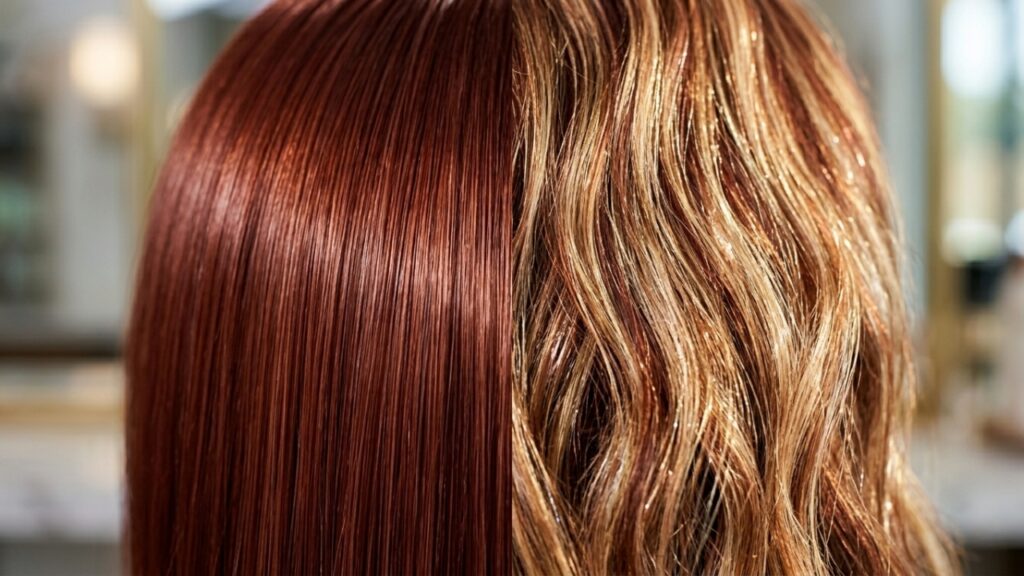
Full hair color creates uniformity. Highlights create dimension.
Full hair color gives you a single, consistent shade across your entire head – clean, precise, and uniform. Highlights give you multiple tones – lighter sections against a natural or darker base – creating the variation, depth, and light-catching quality that makes hair look multi-dimensional and naturally complex.
Neither of these is inherently better than the other. They are different tools for different goals – and choosing between them starts with being honest about which goal you are actually trying to achieve.
Full Hair Color – The Complete Breakdown
The Genuine Advantages of Full Hair Color
Advantage 1 – Complete, Consistent Coverage
If your goal is complete, comprehensive coverage of your entire hair color – including gray coverage, an all-over color change, or a dramatic departure from your current shade – full hair color is the only service that achieves this thoroughly and consistently. Highlights, by definition, leave portions of the hair at their existing color. If your goal is for your entire head of hair to be a specific shade, highlights cannot achieve that. Full color can.
This is the most compelling case for full hair color, and it is a genuinely strong one for a significant proportion of color clients. Women who want comprehensive gray coverage, women who want to dramatically change their overall hair color, and women who prefer the clean, polished, uniform quality of a single consistent color are all well-served by full hair color.
Advantage 2 – Richness and Depth of Color
Full hair color, particularly when applied in rich, deep shades, creates a richness and depth of color that is genuinely difficult to achieve with highlights alone. A deep espresso brunette, a rich burgundy red, a vibrant auburn – these colors are most powerfully expressed through a full color application that saturates the entire hair with the formula. Highlights over these shades tend to dilute the richness and intensity that makes them so beautiful.
Advantage 3 – Simplicity and Predictability
Full hair color is, in many ways, the more straightforward of the two services to plan and maintain. The result is predictable – one formula, one result, across the entire head. The maintenance is also predictable – root touch-ups at regular intervals keep the color consistent, and the grow-out pattern is uniform and manageable. For clients who prefer consistency and predictability in their color, full color offers a simpler, more controlled experience than highlights.
Advantage 4 – Fashion and Vivid Colors
For clients who want to express something bold and unconventional through color – vibrant reds, deep purples, fashion shades, vivid blues and greens – full hair color is typically the most effective approach. Vivid colors applied across the entire head create the most impactful, most saturated, most consistent expression of the color. Vivid highlights are beautiful, but they are a different aesthetic – more accent and detail than full expression.
Advantage 5 – Covering Previous Color Work
When hair has had multiple highlighting or coloring services over time and the color has become uneven, banded, or difficult to manage, a full color service can be used to reset the hair to a single, consistent baseline – creating a clean foundation from which to move forward with whatever color direction comes next.
The Genuine Disadvantages of Full Hair Color
Disadvantage 1 – Flatness and One-Dimensionality
The most significant aesthetic limitation of full hair color is that it creates a uniform result that can look flat – particularly on longer hair where the lack of tonal variation makes the color look applied rather than natural. Real hair color is never truly one color – it has natural variation, depth, and complexity that a single applied formula cannot replicate. The absence of this variation in full color results is what makes heavily colored hair look obviously colored to the trained eye.
This disadvantage is most pronounced in full color results in lighter shades – blonde full color in particular tends to look flat and artificial compared to highlighted or balayage blonde, because the absence of darker tones at the root and through the mid-lengths removes the depth that makes blonde hair look naturally complex and beautiful.
Disadvantage 2 – High Maintenance Grow-Out
Full hair color applied root to end creates a clear, distinct line of demarcation between the colored hair and the new natural growth at the root. As the hair grows, this line becomes increasingly visible – and for clients with a significant difference between their natural color and their colored shade, the regrowth line can become noticeable within three to four weeks of the service. Managing this requires regular root touch-up appointments every four to six weeks – a maintenance commitment that some clients find demanding.
Disadvantage 3 – Potential for Over-Processing Over Time
Full color applied regularly from root to end means that the lengths and ends of the hair are being recolored with every application – accumulating layers of applied color that can over time create a heavy, opaque quality in the hair’s ends. This is why professional colorists typically only apply full color to the root area during maintenance appointments and only refresh the lengths and ends when genuinely needed – a practice called “root to end color application” reserved for specific situations. Clients who apply full color from root to end at every maintenance appointment risk this cumulative over-processing.
Disadvantage 4 – Less Natural-Looking Result
For clients who want color that looks genuinely natural – that people cannot identify as colored – full hair color is a less effective choice than highlights or balayage. The uniformity of full color, and the visible grow-out line it creates, are visual cues that alert the trained eye to the presence of applied color in a way that well-executed highlights and balayage do not.
Disadvantage 5 – Lighting Limitations
Full hair color can look beautiful in some lighting conditions and flat or dull in others – because the absence of tonal variation means the hair does not catch and reflect light from multiple angles the way highlighted or multi-tonal hair does. In certain lighting, particularly artificial indoor lighting, a full color result can look less vibrant and less alive than the same shade achieved through a multi-tonal approach.
Highlights – The Complete Breakdown
The Genuine Advantages of Highlights
Advantage 1 – Natural-Looking, Multi-Dimensional Results
The most compelling advantage of highlights is the natural quality of the result they produce. When highlights are placed well – distributed organically across the head in a way that mimics the variation of naturally lightened hair – the result does not read as colored. It reads as extraordinary natural hair color. The multi-tonal quality of highlighted hair, with its variation between lighter and natural sections, creates the depth and complexity that characterizes genuinely beautiful, naturally complex hair.
This natural quality is what makes highlights the most popular color service in professional salons worldwide – because most women, when they imagine beautiful hair color, are imagining a dimensional, naturally complex result rather than a single uniform shade.
Advantage 2 – Light-Catching, Luminous Quality
Highlighted hair catches the light differently than full color hair – because the variation between lighter and darker tones means the hair reflects light from multiple angles and in multiple ways simultaneously. This creates the luminous, almost iridescent quality that makes highlighted hair look so alive in natural light – particularly relevant in Jensen Beach, Florida, where the abundant natural sunshine is one of the most beautiful features of the local environment.
Advantage 3 – More Forgiving Grow-Out
One of the most significant practical advantages of highlights – particularly balayage and baby lights – is their forgiving grow-out. Because highlights do not create a uniform color line from root to end, the new growth at the root does not create a visible, sharp line of demarcation the way full color does. Instead, the natural base color growing in at the root looks like a natural deepening of the overall color – which, in many cases, actually enhances the dimensional quality of the result rather than detracting from it.
This is the primary reason that balayage and baby lights are described as low-maintenance – not because they never need touching up, but because the touch-up interval is significantly longer than for full color. Most balayage clients return every three to five months rather than every four to six weeks, which is a meaningful difference in time and financial investment.
Advantage 4 – Skin Tone Enhancement
Well-placed highlights – particularly face-framing highlights positioned to reflect the most flattering light on the features – have an extraordinary capacity to enhance the skin tone in a way that single-process color does not. By adding lighter tones specifically in the sections of hair that frame the face, highlights create a natural-looking illumination around the face that makes the skin look warmer, more radiant, and more youthful. A skilled colorist uses face-framing highlight placement as a deliberate tool for enhancing the client’s features – and this effect simply cannot be replicated with full color.
Advantage 5 – Versatility and Customization
Highlights are infinitely more customizable than full color – because the placement, density, degree of lift, and toning of the highlights can be varied to create an enormous range of results, from the most subtle sun-kissed enhancement to the most dramatic head-turning transformation. Two clients can both receive “highlights” and leave with completely different results – because the technique is adjusted entirely to the individual. Full color, by contrast, produces the same fundamental type of result regardless of the specifics.
Advantage 6 – Hair Health Over Time
Because highlights lighten only specific sections of the hair rather than the entire head, the overall chemical exposure of the hair is lower per appointment than a full color service that affects the entire head. For clients who want color while minimizing chemical impact, highlights – particularly lower-density or partial highlight services – represent a less intensive approach than full all-over color.
The Genuine Disadvantages of Highlights
Disadvantage 1 – Cannot Achieve Complete Gray Coverage
This is the most significant limitation of highlights for a specific category of clients – those who want comprehensive, complete gray coverage. Highlights lighten the sections they are applied to but leave the surrounding hair, including gray strands, at their natural color. This means highlights are effective at blending gray into the overall color in a way that looks natural – but they cannot cover gray completely the way a full color service can. Women with a high percentage of gray who want that gray fully and consistently covered will not achieve that goal through highlights alone.
Disadvantage 2 – Cannot Achieve Significant Darkening
If your goal is to make your hair significantly darker – to go from any lighter shade to a meaningfully deeper one – highlights are not the right tool. Highlights add lighter tones; they do not add darker ones in the comprehensive way that a full color service does. A client who wants to go from blonde to brunette needs a full color service to achieve a consistent, all-over darker result.
Disadvantage 3 – More Expensive Per Appointment
A full highlight service – particularly a full head of foil highlights, a comprehensive balayage, or a baby lights service – typically costs more than a single-process full color or root touch-up service, because it requires more time, more precision, and more product. For clients who are managing a color budget carefully, this cost difference is a relevant factor.
Disadvantage 4 – Requires More Technical Skill to Execute Well
Highlights – particularly balayage and baby lights – are among the most technically demanding color services available. The freehand techniques, the placement decisions, the formulation, and the toning all require a level of expertise that not every colorist has developed equally. Highlights done poorly are immediately visible – stripy, unnatural, disconnected from the base color. This means that the quality of the highlights is more dependent on the skill level of the specific colorist performing them than single-process color is – making the choice of salon and stylist particularly important for highlight services.
Disadvantage 5 – Toner Fading Between Appointments
Highlighted hair – particularly blonde highlights and lighter-toned balayage – requires a toner to achieve the specific final shade after the lightening process. That toner fades over time, and as it fades the underlying warmth of the lightened sections begins to show through, creating the brassy quality that is the most common complaint about blonde highlighted hair. Managing this requires either a toner refresh appointment every four to eight weeks or a consistent home care routine with purple toning shampoo – both of which represent ongoing maintenance demands.
How to Choose – The Decision Framework
Now that you understand both services thoroughly, here is the decision framework our color specialists at Parlay use with every client who is navigating this choice:
Choose Full Hair Color If…
You want to cover your gray comprehensively. If you have gray hair and you want it fully and consistently covered – no gray showing through, a uniform base color throughout – full hair color is the right choice. A well-formulated full color service covers gray completely and provides consistent, predictable maintenance through regular root touch-ups.
You want to go significantly darker. If your current hair is lighter than your target shade and you want a comprehensive, all-over darkening – from blonde to brunette, from brown to dark brown, from any lighter shade to a notably deeper one – full hair color achieves this in a way that highlights cannot.
You want a vibrant, saturated, fashion color. Rich reds, deep burgundies, vibrant auburns, and any fashion-forward or vivid color shade are most powerfully expressed through full color application. These colors are about saturation and consistency – qualities that full color delivers better than highlights.
You prefer the simplicity of a single, consistent color. Some women simply prefer the clean, polished, uniform quality of a single consistent color – and that is a completely valid preference. If you love the look of rich, uniform color without variation or highlights, full color is right for you.
You are doing a complete color reset. If your hair has significant color buildup, banding, or unevenness from previous services, a full color service can create a clean, consistent baseline to build from – particularly useful before transitioning to a new color direction.
You have very dark natural hair and want a dramatic overall lightening. If you want to go from dark hair to significantly lighter all-over color, the process typically involves a combination of full bleach and full toner – which is a full color approach rather than a highlights approach.
Choose Highlights If…
You want the most natural-looking color result possible. If your goal is color that people cannot identify as colored – that looks like extraordinary natural hair – highlights and balayage achieve this in a way that full color cannot.
You want low-maintenance color with infrequent salon visits. Balayage and baby lights typically only need refreshing every three to five months, compared to every four to six weeks for full color maintenance. If a lower-maintenance color schedule is a priority, highlights are the more practical choice.
You want your color to enhance your skin tone and features. Face-framing highlights positioned to reflect the most flattering light on the face create an enhancement of the features and skin tone that full color cannot replicate. If you want your hair color to make your face look more radiant and luminous, highlights are the more effective tool.
You want the luminous, light-catching quality of dimensional color. If you love the look of hair that catches the light beautifully from every angle – that has a multi-tonal, luminous quality that changes with the light – highlights and balayage are the right choice.
You want to brighten your natural color without changing it completely. If your goal is to enhance and illuminate your natural color – to make it look more vibrant, more complex, more sun-kissed – rather than to change it fundamentally, highlights are the appropriate service.
You want to blend gray naturally rather than covering it completely. For women who have some gray but do not want the commitment of complete gray coverage, highlights – particularly strategically placed lighter tones – can blend gray into the overall color in a way that looks intentional and natural rather than like gray is showing through.
You have healthy hair that you want to keep that way. Lower chemical exposure per appointment, longer maintenance intervals, and the ability to choose lower-density partial highlight services all make highlights the more hair-health-conscious choice for many clients.
Consider a Combination If…
The reality is that the most beautiful and most versatile color results often combine elements of both full color and highlights – and at Parlay, many of our clients’ most extraordinary color results are achieved through a thoughtful combination approach.
Full color base with face-framing highlights: A rich, full color base combined with bright, face-framing highlights around the front sections of the hair gives the comprehensive, consistent coverage of full color while adding the luminous, feature-enhancing quality of face-framing highlights. This is a particularly effective combination for clients with significant gray who want coverage but also want some brightness and dimension around the face.
Root shadow with highlighted lengths: A slightly darker root shadow applied to the root area creates a natural-looking depth at the root that gives highlighted or balayage hair more of the rooted, dimensional quality of naturally grown hair. This combination is extraordinarily natural-looking and is one of the most requested services at Parlay.
Full color followed by highlights: For clients who want a specific base color but also want highlights placed within that color – for example, a rich brunette base with caramel highlights, or a medium blonde base with brighter blonde highlights throughout – the full color is applied first to establish the base and the highlights are applied in a subsequent appointment or as part of a longer combined appointment.
Lowlights added to highlighted hair: The addition of lowlights – slightly darker sections – to hair that has been heavily highlighted restores the depth and shadow that give highlighted hair its natural, dimensional quality. This combination is one of the most effective ways to prevent highlighted hair from looking over-processed or too uniformly light.
The Factors That Should Inform Your Decision
Beyond the basic goal of the color service, here are the specific factors that should be part of your decision-making process:
Your Natural Base Color
Your natural base color is one of the most important factors in determining which service will give you the best result.
If you have a naturally lighter base (blonde to medium brown): Both full color and highlights work beautifully. For brightening and maintaining a natural, sun-kissed quality, highlights and balayage are typically more effective. For going darker or adding richness, full color is the more effective approach.
If you have a naturally dark base (dark brown to black): Full color is more effective for dramatic overall lightening (though this is typically a multi-step process) and for comprehensive color change. Highlights on dark hair can be extraordinarily beautiful but require more significant lifting and are typically better suited to adding warm dimension and subtle brightening rather than dramatically changing the overall impression of the hair color.
If you have mixed natural color (already have some natural variation, lighter at the ends, or naturally sun-lightened sections): Highlights and balayage are typically the more harmonious choice – working with the natural variation already present rather than covering it with a uniform formula.
Your Percentage of Gray Hair
Gray hair percentage is one of the most significant factors in the full color vs. highlights decision.
Under 25% gray: At this level, highlights – particularly if placed strategically to incorporate the gray sections – can blend the gray beautifully into the overall color without requiring full coverage. The gray becomes part of the dimensional color story rather than something to be hidden.
25% to 50% gray: This is the range where the decision becomes most nuanced. Highlights can still blend gray effectively at this level, but they may require more density and more strategic placement. A combination approach – perhaps a toner or gloss treatment to soften the gray combined with highlights – can work beautifully. Full color is also a strong option at this percentage if consistent coverage is the goal.
Over 50% gray: At this level, most clients find that highlights alone do not provide the coverage they want. Full color is typically the more effective choice for clients with more than 50% gray who want that gray consistently and thoroughly covered.
100% white or silver: For clients who are fully gray or silver and are choosing to embrace their natural color, highlights can be used to add dimension and prevent the flat quality that some fully gray hair develops – without any coverage goal.
Your Skin Tone and Undertones
Your skin tone and undertones significantly affect which color choice will be most flattering.
Warm skin tones (yellow, golden, peachy undertones): Both warm highlights and warm full color are naturally flattering – honey blondes, golden browns, caramel tones, and warm reds all complement warm skin beautifully. Cool-toned full color can sometimes create a jarring contrast with warm skin, while cool-toned highlights can be balanced with warm base tones.
Cool skin tones (pink, rosy, blue undertones): Cool-toned highlights – ash blondes, cool browns, silvery tones – are generally most flattering. Warm full colors can sometimes make cool skin appear more flushed or ruddy.
Neutral skin tones: The most versatile skin tone for color – both warm and cool tones work, and the widest range of both full color and highlight options are available.
Olive skin tones: Warm, rich colors – both in full color and highlight form – are typically the most flattering for olive skin, which can look sallow against very cool, ashy tones.
Your Maintenance Willingness and Schedule
Be completely honest with yourself about how frequently you are willing to come to the salon for maintenance and how much time and financial investment you can sustain long-term.
Full color maintenance reality: Root touch-ups typically every four to six weeks. The visible grow-out line that develops as natural hair grows in makes longer intervals between appointments increasingly noticeable for clients with a significant color difference between their natural shade and their colored shade.
Highlight maintenance reality: Toner refreshes every four to ten weeks depending on the service. Full highlight refreshes every three to five months for balayage and baby lights, more frequently for traditional foil highlights. Longer intervals are genuinely manageable for balayage and baby lights because of the forgiving grow-out.
If you are someone who frequently delays or cancels salon appointments – whose life often gets in the way of regular maintenance – highlights with their more forgiving grow-out are a significantly more practical choice than full color.
Your Hair’s Current Health and History
The condition and history of your hair matters significantly in this decision.
Healthy, virgin hair: Both services are appropriate. Full color and highlights can be performed safely on healthy, unprocessed hair with appropriate formulation.
Previously colored hair: The history of what has been done to your hair affects what can safely be done next. Previous full color buildup affects how well highlights lift evenly. Previous heavy highlighting affects how full color deposits. A thorough consultation with an experienced colorist is essential for previously processed hair.
Damaged or compromised hair: For hair that is already in a compromised state – dry, brittle, damaged from over-processing – a conservative approach is advisable for either service. K18 bond repair treatments and restorative care may be recommended before committing to significant color work.
Your Budget
Both services vary in cost based on hair length, density, and service complexity. Here is a general comparison:
Full color services are typically less expensive per appointment than comprehensive highlight services – a root touch-up in particular is one of the most affordable maintenance color services available.
Highlight services typically cost more per appointment, particularly for full highlight services, balayage, and baby lights – but the longer interval between appointments means the annualized cost is often comparable to or lower than the cost of frequent full color maintenance.
When comparing costs, think in terms of annual investment rather than per-appointment cost – because the maintenance frequency difference between full color and highlights significantly affects the total annual expenditure.
Common Misconceptions About Full Color and Highlights
Misconception 1 – “Highlights Are Always Low Maintenance”
This is partially true – balayage and baby lights have genuinely forgiving grow-out that allows longer intervals between appointments. But traditional foil highlights, particularly those applied at high density or with high contrast against the base color, can require quite frequent maintenance to maintain the crisp, defined quality of the result. “Highlights” is not a single thing – and the maintenance commitment varies significantly depending on the specific technique.
Misconception 2 – “Full Color Is Always Damaging”
Full color is not inherently more damaging than highlights – the damage risk depends entirely on the formula used, the application technique, and whether the process involves lifting (lightening) or depositing (darkening or maintaining). Darkening full color services, toning services, and demi-permanent full color are all relatively gentle processes. The damage concern with full color is primarily when it involves lightening – particularly when lightening is applied repeatedly to the same sections of hair over time.
Misconception 3 – “You Cannot Combine Them”
This is perhaps the most limiting misconception – because some of the most beautiful color results our specialists at Parlay create combine both full color and highlights in the same overall color plan. A rich brunette base with balayage highlights, a warm root shadow over blonde highlights, a full toning service over existing balayage – the combination of techniques is often the most sophisticated and most beautiful approach, and it is always worth discussing with your colorist.
Misconception 4 – “Gray Hair Cannot Be Highlighted”
This is completely untrue – and it is a misconception that causes many gray-haired women to default to full color when highlights would actually serve them beautifully. Highlighting gray hair – whether to blend it, to enhance its silver quality, or to add dimension and prevent the flat appearance that solid gray can develop – is a genuinely effective and genuinely beautiful approach. Many women with gray hair find that strategic highlights look more natural and more youthful than complete coverage through full color.
Misconception 5 – “Highlights Are Only for Blonde Hair”
One of the most widely held and most limiting misconceptions in the color world. Highlights are not a blonde-specific service – they are effective and beautiful on brunettes, redheads, and women of every natural hair color. Brunette highlights, caramel balayage on dark hair, warm auburn highlights on deep brown bases – these are extraordinary services that produce results as beautiful as any blonde highlighting work.
The Consultation – What to Tell Your Colorist and What to Ask
What to Tell Your Colorist
Your complete color history. Every color, treatment, or chemical service your hair has had – and how recently. This information is essential for safety and formulation decisions.
Your lifestyle and maintenance preferences. How often you realistically come to the salon. How much time you spend on your hair daily. Whether you heat-style regularly or air-dry.
Your specific goal. Not just “I want highlights” or “I want color” – but specifically what you want the result to look and feel like. Warm or cool? Natural or dramatic? Subtle or impactful? Bring photos of color you love and color you definitely do not love. Both are equally useful.
Your hair’s current challenges. Anything about your hair’s current state that is relevant – dryness, damage, previous problematic color experiences, hair loss, scalp sensitivity.
Your budget and timeline. An honest conversation about what you can invest and how frequently you can commit to maintenance allows your colorist to develop a plan that is genuinely sustainable for you rather than ideal in the salon but impractical in real life.
What to Ask Your Colorist
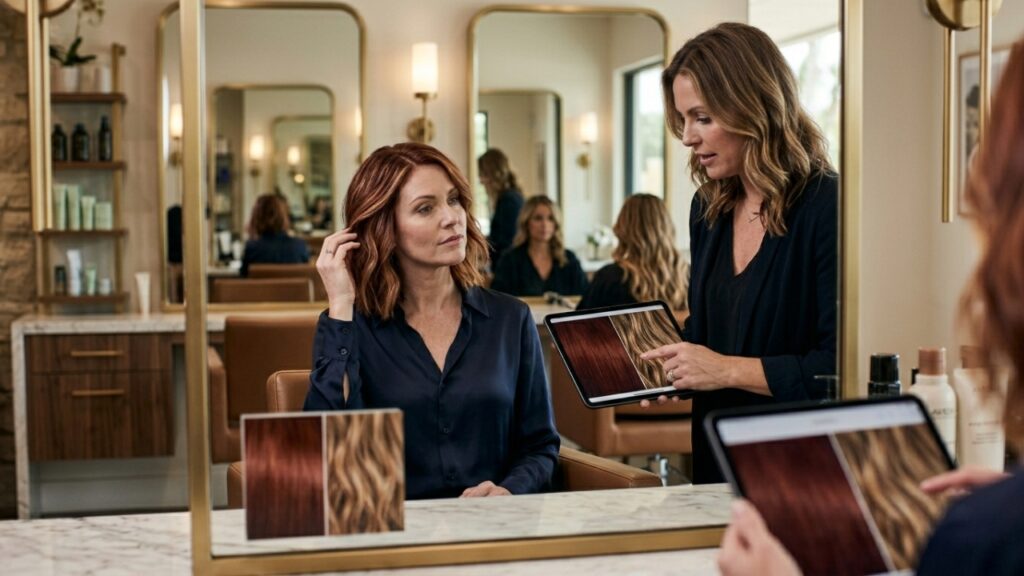
“Which service do you think is right for my hair and my goals – and why?” A great colorist will give you a specific, reasoned answer to this question rather than a vague “it depends.” They should be able to explain specifically why they are recommending one approach over another based on what they see in your hair and what you have told them about your goals.
“What will my hair look like in six months if I choose this service and maintain it as recommended?” Long-term thinking is one of the most valuable gifts a good colorist gives a client – helping them understand not just what the result looks like on appointment day but how it will evolve and what commitment it will require over the following months.
“What are the potential risks or challenges with my specific hair?” If there are aspects of your hair’s history or condition that could affect the outcome – previous color buildup, damage, an unexpected reaction to a previous service – a great colorist will tell you proactively rather than waiting for a problem to emerge.
“If I want to change my approach in the future – for example, if I am doing full color now and want to switch to highlights later – what would that transition look like?” Understanding the path forward from your current decision helps you make a choice that does not close doors you might want to walk through later.
What Our Color Specialists at Parlay Recommend – Real Guidance From Real Experts
At Parlay Hair and Beauty in Jensen Beach, Florida, our color specialists have developed specific recommendations based on years of experience creating both full color and highlight results for clients across Martin County and the Treasure Coast.
Here is what we genuinely believe and consistently tell our clients:
For most women who want natural-looking, beautiful color – highlights or balayage are the more satisfying long-term choice. The dimensional, light-catching, naturally complex quality of well-executed highlights creates results that look more beautiful in a wider range of lighting conditions, require less frequent maintenance than most clients anticipate, and grow out more gracefully than full color. The investment per appointment is typically higher, but the experience of wearing the color day to day is, for most clients, more satisfying.
For women with significant gray coverage needs – full color or a thoughtfully designed combination approach is typically the more effective solution. We have seen beautiful results from strategic gray blending through highlights on clients with moderate gray, but for clients with substantial gray who want consistent coverage, full color is the more reliable and more comprehensive solution.
For women who are changing their color significantly – particularly going darker – full color is the more effective tool. Highlights are a tool for brightening and adding dimension. Darkening is the domain of full color.
For women who are health-conscious about their hair and want to minimize chemical impact – partial highlights, balayage, or baby lights are the most conservative approach. These services lighten only specific sections, leave large portions of the hair untouched, and allow for longer maintenance intervals – all of which reduce overall chemical exposure relative to regular full color maintenance.
For any client who is uncertain – a consultation is always the right first step. The best color decision for your specific hair, your specific goals, and your specific life is one that is made by an experienced colorist looking at your actual hair and having a real conversation with you about what you want to achieve. No blog post or guide – including this one – can replace that conversation.
Maintaining Your Color – Regardless of Which You Choose
Whether you choose full color or highlights, the home care practices that protect your investment are largely the same:
Use Sulfate-Free, Color-Safe Products
Sulfates strip color from the hair with every wash – both the applied color of full hair color and the toner that gives highlighted hair its specific final tone. A gentle, sulfate-free shampoo and a color-safe conditioner are the foundation of any effective color maintenance routine and extend the life of your color significantly.
Wash Less Frequently
Every wash, even with the most color-protective shampoo, contributes to color fading. Washing every two to three days rather than daily extends the life of both full color and highlighted results meaningfully. Use dry shampoo between washes to refresh the roots and maintain volume without color stripping.
Use Purple or Toning Shampoo Weekly (For Blonde and Highlighted Hair)
For blonde full color and highlighted hair – particularly cool-toned blondes, ash results, and any lightened shade that tends to go warm over time – a weekly purple or violet toning shampoo is one of the most effective tools for maintaining the freshness and precision of the color between appointments. Use it for three to five minutes once or twice per week.
Protect From Jensen Beach’s Florida Sun Every Single Day
This deserves particular emphasis for Jensen Beach clients – the combination of UV intensity and outdoor lifestyle that characterizes life on the Treasure Coast creates more significant and more rapid color fading than most other environments. A UV-protecting hair product used daily is not optional for Jensen Beach color clients who want their color to look salon-fresh beyond the first week after their appointment.
Deep Condition Weekly
Color-treated hair – whether full color or highlighted – benefits enormously from regular deep conditioning. A weekly mask or treatment with a bond-repairing formula like K18 or a deeply nourishing professional conditioning treatment keeps color-treated hair moisturized, healthy, and luminous between appointments.
Schedule and Pre-Book Your Maintenance Appointments
The most effective way to maintain beautiful color of any kind is to schedule your next appointment before you leave the salon after your current one. Pre-booking guarantees your preferred appointment time, keeps your maintenance on a consistent schedule, and prevents the extended gap between appointments that allows color to deteriorate significantly before it is refreshed.
Conclusion: The Right Answer Is the One That Is Right for You
Full color versus highlights is not a question with a single correct answer – it is a question with a specific correct answer for each individual woman, based on her unique combination of hair, goals, lifestyle, and preferences.
What we hope this guide has given you is the understanding and the framework to identify what that specific correct answer is for you – so that when you sit down with a color specialist at Parlay Hair and Beauty in Jensen Beach, Florida, you can have a genuinely informed, genuinely productive conversation that leads to a color decision you feel completely confident about.
And if you are still not sure – that is exactly what consultations are for. Our color specialists are here to look at your hair, understand your vision, and help you make the decision that will give you the most beautiful, most manageable, most completely satisfying result. We have done this for hundreds of clients throughout Martin County and the Treasure Coast, and we would love to do it for you.
Come see us. Let’s talk about your color.
📍 2250 NE Dixie Hwy, Jensen Beach, FL 34957 📞 Call or Text: (772) 261-8116 🌐 Book Online: parlayhairandbeauty.com ⏰ Online Booking Available 24/7 via Vagaro
Parlay Hair and Beauty – Jensen Beach’s most trusted salon for full hair color, highlights, balayage, color correction, and complete color transformations. Serving Jensen Beach, Stuart, Palm City, Hobe Sound, Hutchinson Island, Port St. Lucie, and all of Martin County, Florida.