
The Complete Guide to Understanding Why Freehand Color Produces the Most Naturally Beautiful Results – From the Color Specialists at Parlay Hair and Beauty, Jensen Beach, Florida
The Highlight That Does Not Look Like a Highlight – And Why That Is Exactly the Point
There is a specific quality of light that exists in Jensen Beach in the late afternoon – when the sun is low enough over the Treasure Coast that everything it touches takes on a warmth and a luminosity that photographers spend their entire careers trying to recreate in studios. The way it moves through palm fronds. The way it turns the water into something that looks less like water and more like hammered copper and gold. The way it catches the hair of a woman walking on the beach or sitting at a waterfront restaurant and does something genuinely extraordinary to it – making the lighter pieces glow and the darker depth tones recede into shadow and the whole thing look like the most beautiful, most naturally complex hair color imaginable.
And here is the thing that most people do not realize when they see hair that looks that way in Jensen Beach’s beautiful light: nine times out of ten, what they are seeing is hand painted highlights. Not natural hair. Not hair that was simply born that way. Color that was deliberately, artistically, and expertly applied to create exactly the effect that Jensen Beach’s light is now illuminating so spectacularly.
But it does not look like highlights. And that is the entire point.
The distinction between hair color that looks like it was highlighted and hair color that simply looks extraordinary – the difference between hair that announces “I just got my highlights done” and hair that simply looks like the most beautiful natural version of itself – is, more often than not, the distinction between traditional foil highlights and hand painted highlights.
At Parlay Hair and Beauty in Jensen Beach, Florida, hand painted highlights are one of our most practiced, most artistically developed, and most deeply valued color services – and the reason is specifically tied to what makes this community, this environment, and this particular quality of coastal Florida light so uniquely suited to the freehand painting technique. This guide is the complete explanation of why hand painted highlights look more natural than traditional highlights, what makes the technique work the way it does, and why the specific conditions of Jensen Beach make this technique particularly spectacular in this place.
By the end of this guide, you will understand the difference not just conceptually but in a way that is immediately applicable to your own color decisions – and you will know why, if natural-looking highlights are what you are after, hand painting is the technique that genuinely delivers.
The Fundamental Difference – Understanding What Each Technique Actually Does to the Hair
Traditional Foil Highlights – The Technique, the Result, and the Visual Signature
To understand why hand painted highlights look more natural, we first need to understand precisely what traditional foil highlights do – and what specific qualities of the foil technique create the result that distinguishes foil highlights from freehand work.
Traditional foil highlights are applied by taking a defined section of hair – typically using a weaving or slicing technique – placing it on a piece of aluminum foil, applying lightener or color to that section, and folding the foil to enclose the section. The foil creates a sealed, controlled environment in which the lightener processes in isolation from the surrounding hair, at maximum intensity, developing to a consistent brightness throughout the entire enclosed section.
What the foil environment specifically creates:
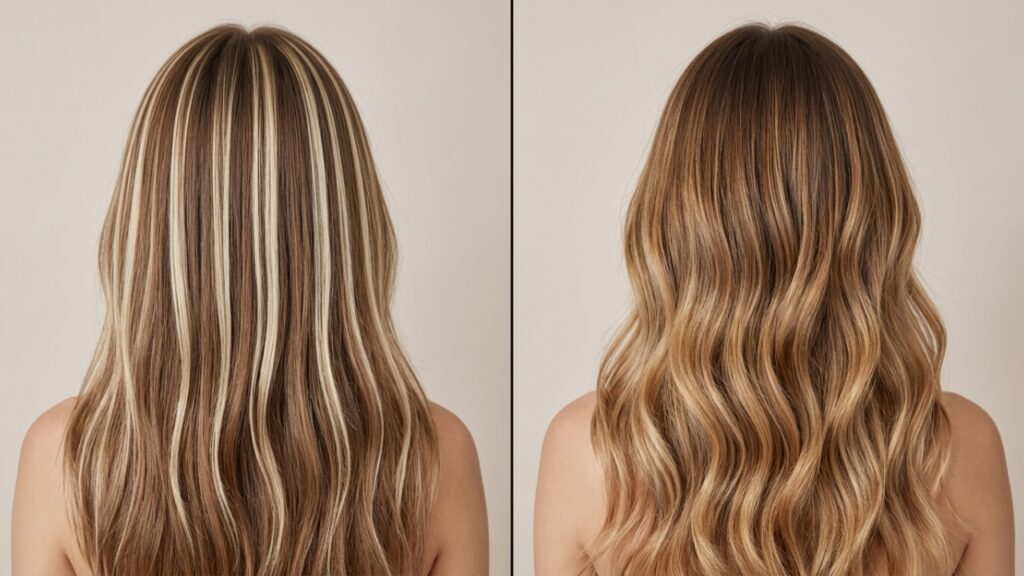
Uniform development throughout the section. Because the lightened hair is isolated within the foil and the lightener has access to every part of the enclosed section equally, the development is consistent from root to end within each foil. There is no gradient, no variation, no lighter-at-the-end-and-darker-at-the-root quality that natural sun lightening produces. The entire section lifts to approximately the same level from where the foil starts to where it ends.
Defined edges. The foil creates a precise boundary between the lightened section and the surrounding natural hair. The lightener does not feather or blend into the surrounding hair – it stops where the foil edge begins, creating a clear, defined line of transition between the highlighted section and the natural hair on either side of it.
Maximum lift. The sealed foil environment traps the heat generated by the lightener’s chemical process, accelerating and intensifying the development. Foil highlights typically achieve more lift – more lightness – than an equivalent lightener applied without foils, because the foil creates conditions that maximize the lightener’s effectiveness.
Consistent color from highlight to highlight. When a skilled colorist applies foil highlights with consistent timing and consistent formula, the result is highlights that are approximately the same shade across the entire head – a uniform brightness that is part of what gives traditional foil highlights their specific visual signature.
The visual signature of traditional foil highlights: The sum of these characteristics – the uniform brightness, the defined edges, the consistent shade from highlight to highlight – creates a specific visual quality that is beautiful in its own right but is unmistakably identified as highlights by the trained and untrained eye alike. The defined edges create a clear visual line where each highlighted section begins and ends. The uniform brightness means that every highlighted section reflects the same amount of light in the same way. The consistency from highlight to highlight means there is a visible pattern to the placement – the regular distribution of equally bright sections that says, clearly and unambiguously, “these were put here.”
Hand Painted Highlights – The Technique, the Result, and Why It Looks Different
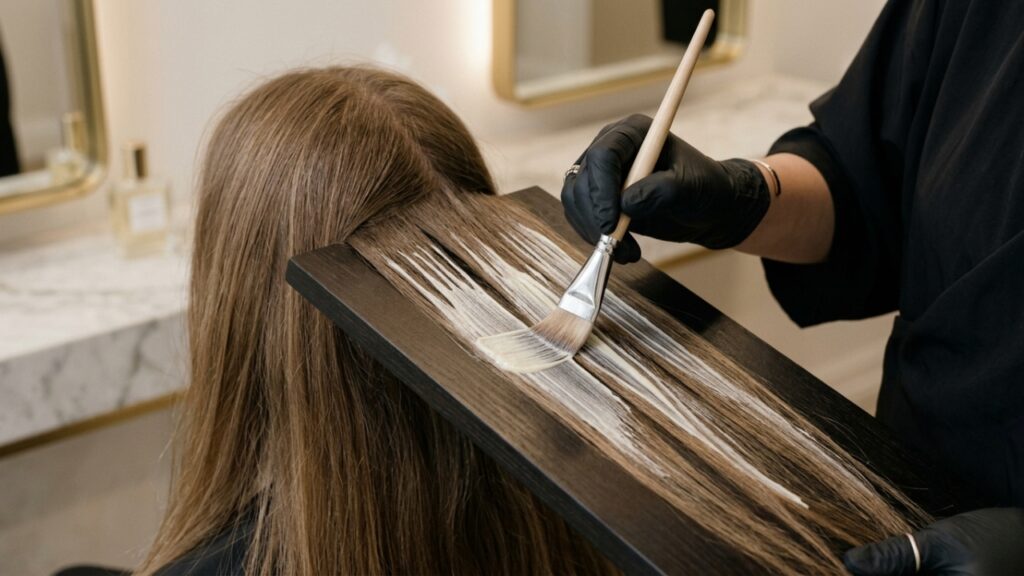
Hand painted highlights – balayage, freehand color, hand painting – use a brush to apply lightener or color directly to sections of hair without any foil enclosure. The lightener is painted onto the surface of selected strands in a sweeping, deliberate motion that the colorist controls entirely through the pressure of the brush, the amount of product applied, and the length of each stroke.
Without the foil’s sealed environment, the lightener develops differently – and these differences are precisely what create the more natural quality that hand painted highlights produce.
What the absence of foil specifically creates:
A natural gradient from root to end. When lightener is painted onto a section of hair without foil, it develops most intensely at the mid-length and end of the section – where the most product was applied and where the development is most concentrated – and progressively less intensely toward the root of the painted section, where the product feathers out. This root-to-end gradient is one of the most important contributors to the natural appearance of hand painted highlights, because it replicates exactly the gradient that natural sun lightening produces. Sunlight does not lighten hair uniformly from root to end – it lightens the ends most (they have been exposed the longest), the mid-lengths moderately, and the roots least. Hand painting replicates this natural pattern with an accuracy that foils cannot achieve.
Soft, feathered edges. Without the foil’s defined boundary, the edges of each painted section are not crisp and defined – they feather naturally into the surrounding hair. The lightener at the edge of each painted section has less product and develops less completely than the center of the section, creating a soft, graduated transition from lightened to natural rather than the clear, defined line that foil edges create. This feathered edge quality is one of the most immediately impactful contributors to the natural appearance of hand painted highlights – because natural sun lightening never creates defined edges, and the feathered transition of hand painting mimics the sun’s natural blending effect.
Variable development based on product application. The colorist’s control over how much product is applied to each section – through brush pressure, product load, and stroke length – creates natural variation in how much each section lifts. More product means more lift; less product means less lift. A skilled hand painting colorist uses this control deliberately to create variation between sections – some lifting more completely than others, in a pattern that creates the organic variation of natural sun-lightened hair rather than the consistent uniformity of foil highlights.
Open-air development. Without the foil’s heat-trapping environment, hand painted lightener develops at a more moderate pace and achieves a typically lower degree of lift than foil highlights. This more moderate lift often produces tones that are closer to the natural hair’s color – warmer, softer, less dramatically lightened – which contributes to the natural, sun-kissed quality that hand painting achieves.
The Side-by-Side Comparison – What Each Looks Like in Jensen Beach’s Light
This is where the practical impact of the technical differences becomes immediately visible and immediately significant for Jensen Beach clients specifically.
Imagine two women walking on the Jensen Beach waterfront in the late afternoon. Both have had highlights applied to similar natural bases. Woman A has traditional foil highlights. Woman B has hand painted highlights. Jensen Beach’s warm, directional afternoon light is illuminating both.
Woman A with foil highlights: The light hits the highlighted sections and illuminates them brightly – they are clearly, obviously lighter than the natural hair around them, with defined edges that are visible even from a moderate distance. The distribution of highlighted sections has a visible pattern – the regular, organized placement of equally bright sections. The contrast between the highlighted and natural sections is strong and immediate. It looks beautiful. It looks like she has highlights.
Woman B with hand painted highlights: The light hits the hair and creates something more complex – lighter pieces that catch the most direct light, slightly darker pieces in the shadow, a variation in the degree of lightness from section to section that looks completely organic. The edges of the lighter sections blend softly into the surrounding hair. The distribution of lighter tones follows the natural pattern of sun lightening – more concentrated at the surface and the face-framing sections, less present in the deeper underlayers. It looks extraordinary. It does not look like highlights. It looks like the most beautiful hair imaginable in Jensen Beach’s afternoon sun.
This is the distinction that matters. Both results are achieved through professional highlighting services. Only one of them looks like a professional highlighting service.
The Science of Why Hand Painting Mimics Natural Sun Lightening
How the Sun Actually Lightens Hair – And Why Hand Painting Replicates It
To truly understand why hand painted highlights look so much more natural than foil highlights, it helps to understand how natural sun lightening actually works – because the naturalness of hand painting comes precisely from how accurately it replicates the sun’s process.
The physics of sun lightening:
Sunlight contains ultraviolet radiation – UV light – that causes a photochemical reaction in the melanin molecules within the hair shaft. This reaction oxidizes and breaks down the melanin, progressively lightening the hair. The degree of lightening that occurs in any given hair strand depends on several factors:
Exposure duration. The ends of the hair have been growing for the longest time and have therefore been exposed to the sun for the most cumulative hours – which is why naturally sun-lightened hair is almost always lightest at the ends and progressively darker toward the root.
Direct vs. indirect exposure. The surface of the hair – the strands that are on the outermost layer of the head, in the most direct contact with the sun – receive the most UV exposure and therefore lighten the most. The underlayers, protected by the hair above them, receive less direct exposure and lighten less or not at all.
Face-framing sections. The sections of hair that fall forward to frame the face receive more exposure than the sections at the back of the head – because they are not shaded by the rest of the hair and are in more direct, consistent contact with the sun. This is why naturally sun-lightened hair is almost always lighter around the face than at the back.
Concentration of the lighter tones. Because the sun’s lightening effect is most concentrated at the surface, the ends, and the face-framing sections, and absent or minimal in the underlayers, the natural roots, and the deep back sections – the distribution of natural sun-lightened tones is organic, uneven, and follows the logic of the sun’s access patterns rather than any human-designed pattern.
This is precisely what hand painted highlights replicate – and it is precisely what foil highlights do not replicate. Hand painting places more lightener at the ends than the roots (because the brush stroke sweeps from mid-length to end, mirroring the sun’s end-focused lightening). Hand painting concentrates lightened sections at the surface and in the face-framing sections (because a skilled colorist reads the hair the way the sun reads it and paints where the sun would paint). Hand painting creates organic, uneven distribution with variable levels of lightness (because the brush applies variable amounts of product, just as the sun delivers variable amounts of UV depending on each section’s exposure).
Foil highlights apply lightener at a consistent starting point relative to the root, create consistent brightness throughout each foil section regardless of end-to-root variation, and are distributed according to the colorist’s weaving pattern rather than the sun’s access logic. The result is beautiful – but it is not the result that the sun would create.
The Colorist as Artist – Why Skill Determines the Difference Between Good and Extraordinary Hand Painting
Understanding the technique explains why hand painting has the potential to look more natural than foil highlights. But the potential of the technique is only realized through the skill of the person applying it – and this is the most important thing to understand about hand painted highlights before choosing a salon.
Foil highlights, while technically demanding, have a degree of built-in consistency that the foil itself creates. The foil standardizes the development. The foil creates the defined edge. The foil produces consistent brightness. A skilled colorist can improve the quality of foil highlights significantly – but the foil itself contributes to the consistency of the result.
Hand painting has no such safety net. Every decision – where each stroke starts and ends, how much product is loaded on the brush, what angle the brush sweeps at, how much pressure is applied, how the density varies from section to section across the head – is made entirely by the colorist’s eye and hand in real time. The quality of the result is a direct and complete reflection of the quality of those decisions.
This means that exceptional hand painted highlights require genuinely exceptional skill – the kind that is developed through years of practice, a genuine artistic education, and the specific, focused attention to the freehand painting technique that only comes from treating it as a specialty rather than an incidental service.
It also means that poor hand painted highlights are immediately and completely visible – because the lack of structure that makes hand painting capable of producing the most natural results when done well also means that mistakes in placement, density, or application are not corrected or moderated by any mechanical process. What the brush puts on the hair is what the hair looks like – for better or for worse.
What Specifically Trained Hand Painting Looks Like at Parlay
At Parlay Hair and Beauty in Jensen Beach, Florida, hand painted highlights are a genuine specialty – not one of many services offered with approximately equal emphasis, but a technique that our colorists have developed genuine, practiced expertise in through dedicated training and extensive real-world application.
Our colorists’ approach to hand painting is characterized by the specific artistic philosophy that produces the most natural results:
They read the hair before they paint it. Before a single stroke is applied, a Parlay colorist studies the client’s hair – its natural movement, the direction of growth, the sections that receive the most direct light when the hair is styled, the face-framing sections that have the most impact on the overall appearance. They read the hair the way the sun would read it – identifying where light would naturally fall and where it would naturally be absent – and they paint accordingly.
They think about how the hair moves, not just how it sits. Hair that is still in the salon chair moves differently once the client is living her life – blowing in Jensen Beach’s coastal breeze, falling into a ponytail, being tucked behind an ear. Parlay’s hand painting colorists think about the full range of positions and movements the hair goes through and place the color in sections that look natural in all of them, not just the position they happen to be in when the brush touches the hair.
They vary the density deliberately and organically. The distribution of hand painted sections across the head is never uniform at Parlay – it is deliberately varied, with more density at the surface and face-framing areas, less in the underlayers and back sections, and organic variation throughout that mirrors the pattern the sun would create. This deliberate variation is one of the most important contributors to the natural quality of the result.
They think about grow-out before they paint. How the hand painted sections will look as the hair grows out is part of the placement decision – painting in a way that the grow-out enhances rather than disrupts the natural quality of the result. A section painted to start where the root shadow naturally ends will grow out seamlessly. A section that starts too close to the scalp will create a defined grow-out line. These decisions are made before the brush moves.
Jensen Beach’s Specific Environment and Why It Makes Hand Painting Even More Compelling
The Jensen Beach Light Factor – Why This Environment Illuminates Hand Painting So Specifically
We established at the opening of this guide that Jensen Beach’s specific quality of light creates an extraordinary environment for dimensional, natural-looking hair color. Now let us get more specific about why.
Jensen Beach’s outdoor light has specific characteristics that interact particularly beautifully with hand painted highlights:
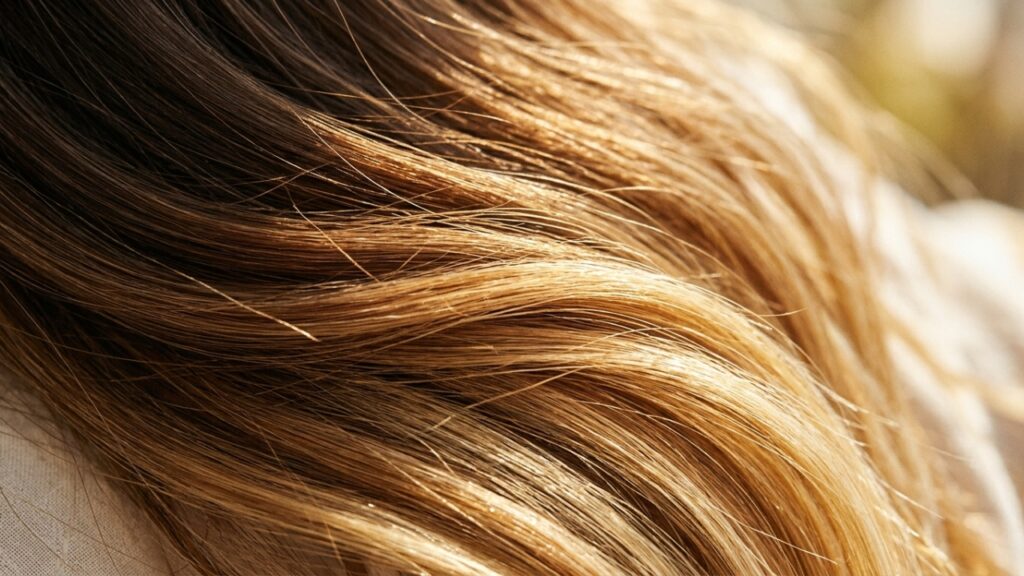
The directional quality of Jensen Beach’s sunshine. Jensen Beach’s sun is not the diffuse, even, omnidirectional light of an overcast day or an indoor environment. It is directional, warm, and specific – coming from a clear angle that creates genuine shadow and genuine highlight on three-dimensional objects. This directional quality is exactly what makes dimensional color look so extraordinary here – because directional light illuminates the surface-placed hand painted sections and allows the depth tones to recede into shadow in a way that diffuse light does not create.
The warmth of Jensen Beach’s light. The warm, golden quality of Jensen Beach’s sunshine interacts with hair color in specific ways – warming the tones, enhancing the golden and honey qualities of lighter sections, and creating a luminosity in natural-looking dimensional color that the same color would not have in cooler, bluer light. This warmth is particularly harmonious with the warm tones that hand painted highlights often produce – the honey, caramel, and golden sections that interact with Jensen Beach’s light in the specific way that creates the beautiful, sun-kissed impression.
The frequency of outdoor light exposure in Jensen Beach. Jensen Beach’s lifestyle is an outdoor lifestyle – the beach, the boat, the waterfront restaurants, the weekend markets, the morning walks on the Riverwalk. Hair in Jensen Beach is regularly illuminated by natural light in a way that hair in more indoor-focused urban environments is not. This means that the color’s behavior in natural light matters more here than almost anywhere else – because natural light is the primary context in which most Jensen Beach women’s hair is seen and experienced.
Hand painted highlights, designed specifically to look natural in directional outdoor light – because they replicate the patterns created by directional outdoor light – are therefore specifically and particularly suited to Jensen Beach’s light-rich, outdoor-focused lifestyle in a way that no other highlighting technique matches.
H2: The Jensen Beach Lifestyle Factor – Why Low-Maintenance Natural Color Is the Most Practical Choice Here
Jensen Beach’s lifestyle is active, spontaneous, and beautifully demanding of hair that can keep pace with it. The ocean swimming, the boat days, the morning beach walks, the afternoon paddleboarding – these are not occasional activities for Jensen Beach residents. They are the fabric of daily life. And they create a specific practical requirement for hair color: it needs to look genuinely good in the real conditions of an active, outdoor, coastal lifestyle – not just in the controlled conditions of a salon or a carefully managed photoshoot.
Hand painted highlights fulfill this practical requirement more completely than any other highlighting technique for several specific reasons:
The grow-out is genuinely forgiving. This is perhaps the most practically significant advantage of hand painting for Jensen Beach’s active lifestyle – because in a community where salon appointments sometimes get pushed back by boat trips and beach days and the beautiful spontaneity of Treasure Coast living, hair that looks beautiful as it grows out is dramatically more practical than hair that announces its grow-out within three weeks of the last appointment.
Traditional foil highlights create a defined root line as the hair grows – a clear visual boundary between the lightened highlighted sections and the natural root growth that becomes more obvious and more obviously neglected-looking with every passing week. At the three-week mark, a foil highlight client can often see the grow-out. At six weeks, it is clearly, noticeably overdue. At eight or ten weeks – the point at which some Jensen Beach clients’ salon visits are happening – it can look significantly grown out.
Hand painted highlights do not create this defined root line – because hand painting does not start at the root. The root is intentionally left at its natural color, and the painted sections begin at the mid-length in a way that mimics the natural pattern of sun lightening. As the natural root grows in, it simply adds to the existing natural depth at the root that was always part of the hand painted result. The grow-out does not announce itself as neglected color. It looks like the natural deepening of the root that was always part of the design.
The look after salt water and sun is actually beautiful. Here is something genuinely interesting that Jensen Beach hand painted highlight clients discover: their hair often looks better after a day at the beach than before it. The combination of the salt water’s slight lightening effect, the sun’s ongoing lightening action on the already-lightened hand painted sections, and the natural texture created by ocean swimming creates a genuinely stunning beach-wave, sun-kissed result that is exactly the aesthetic that hand painting was designed to create. The technique’s design and the environment’s effect are so perfectly aligned that the beach actively enhances the color rather than compromising it.
This is almost never the experience of traditional foil highlight clients in Jensen Beach – because the salt water and UV exposure can fade the toner from foil highlights quickly, creating brassiness in the defined highlighted sections that makes them look dull and neglected rather than beautiful and sun-kissed.
The Jensen Beach Humidity Factor – Why Natural-Looking Color Behaves Better in Humidity
Jensen Beach’s humidity creates a specific styling challenge – and it creates it differently for different types of hair color. Understanding how humidity interacts with both foil highlights and hand painted highlights reveals another dimension of why hand painting is particularly suited to this environment.
Traditional foil highlights, when they are at their best, have a specific polished brightness that depends on a certain amount of styling – blowdrying, heat styling, the smooth, reflective surface that the lightened sections present when they are freshly styled. When humidity enters the equation, that styling is challenged – the smoothed hair swells, expands, and develops the texture that Jensen Beach’s humidity reliably produces.
The visual effect of humidity on a fresh, precisely toned foil highlight result is that the defined, bright sections now exist within a textured, expanded hair backdrop rather than the smooth, styled backdrop they were designed for – and the contrast between the defined brightness of the highlights and the textured natural hair can sometimes look more obviously artificial in the humidity-textured hair than it did in the freshly styled version.
Hand painted highlights, by contrast, are designed to look natural in any hair state – including the textured, wave-enhanced, humidity-influenced state that Jensen Beach creates. The organic variation, the soft edges, the natural gradient from root to end – all of these qualities look just as beautiful in textured, naturally moving hair as they do in freshly blowdried, smooth hair. The naturalness of hand painted highlights does not depend on a specific styling context to be maintained. It exists in the color’s design and is visible regardless of how the hair is wearing itself on any given Jensen Beach morning.

What Hand Painted Highlights Look Like Through the Maintenance Cycle
The Week-by-Week Comparison – How Each Technique Ages Over Time
One of the most practical ways to understand the difference between foil highlights and hand painted highlights in Jensen Beach’s environment is to follow each technique through its maintenance cycle – looking at what each result looks like not just on appointment day but at two weeks, four weeks, eight weeks, and twelve weeks.
Traditional Foil Highlights in Jensen Beach:
Appointment day: Beautifully bright, precisely toned, the defined highlighted sections at their most crisp and most luminous. The color is at its very best.
Week 2: The toner is beginning to fade from Jensen Beach’s UV exposure and washing. The cool or neutral quality of the toned highlights is warming slightly. The root growth is beginning to show – a subtle line at the scalp.
Week 4: The toner has faded significantly in Jensen Beach’s environment. The highlights are noticeably warmer than they were at appointment day – the brassiness that Jensen Beach’s UV drives is becoming apparent. The root growth is clearly visible.
Week 6: The toner is largely faded. The highlighted sections are warm and brassy rather than the precise, polished blonde of appointment day. The root growth is obvious – a clear, defined line between the natural color and the highlighted lengths. The color needs attention.
Week 8-10: The color is clearly in need of a salon visit. The root growth is significant. The highlighted sections have drifted far from their appointment-day tone. It is difficult to call this color genuinely beautiful in the way it was on appointment day.
Hand Painted Highlights in Jensen Beach:
Appointment day: Beautifully dimensional, naturally sun-kissed, the painted sections luminous and seamlessly blended. The toner gives the lighter sections their specific, polished final character.
Week 2: The toner is beginning to fade slightly from Jensen Beach’s UV exposure. The color is warming very subtly – but the warm tones that emerge as the toner fades are harmonious with the warm hand painted aesthetic rather than creating the jarring brassiness of toner-faded foil highlights.
Week 4: The toner has faded to a warmer quality. The hand painted sections now have a honey, warm golden quality that – rather than looking like neglected highlights – looks like the most beautiful warm, sun-kissed version of the color. The root is growing in naturally, adding seamlessly to the depth tone that was always part of the design. The color still looks genuinely beautiful.
Week 8: The color continues to look naturally dimensional and genuinely beautiful – perhaps even more natural than it did at appointment day, as the grown-in root depth and the warmly faded painted sections have settled into an organic harmony that mirrors the most natural sun-lightened hair. A toner refresh at this point would restore the precision of the tone while the placement continues to look naturally grown.
Week 12: The hand painted sections are growing with the hair – moving gradually toward the mid-length as the hair grows. The color still looks naturally dimensional. A refresh appointment at this point restores the full luminosity of the result, adds fresh painted sections to the new growth area, and refreshes the toner – and the client has gone twelve weeks looking genuinely beautiful rather than six weeks looking good and six weeks looking grown out.
The Toning Relationship – How Each Technique Ages With Jensen Beach’s Environmental Factors
The most significant factor in how highlights age in Jensen Beach’s specific environment is the relationship between the toner applied after lightening and the UV radiation, salt water, and pool chemicals that the toner is exposed to in the weeks following the appointment.
Traditional foil highlights are typically toned to a specific, precise cool, neutral, or warm shade after the lightening process – and the precision of that toner is one of the most important qualities of the fresh result. In Jensen Beach’s environment, that toner fades from UV exposure, from washing, and from water activity with a speed that most clients find frustrating. The fresh, polished quality of the toned foil highlights is therefore relatively short-lived – a matter of weeks before the brassiness of toner fade creates a result that looks meaningfully different from the appointment-day result.
Hand painted highlights are also toned – but the toner’s relationship with the hand painted result is different from its relationship with the foil result. The natural-looking, warm, sun-kissed quality of hand painted highlights is not entirely dependent on the toner maintaining its precise coolness or neutrality. The design of hand painted highlights – the root depth, the gradient from mid-length to end, the organic variation in the painted sections – creates a result that has inherent naturalness regardless of the toner’s exact current state. As the toner fades and the painted sections become warmer, the result reads not as “neglected highlights” but as “naturally sun-kissed hair in Jensen Beach’s warm light” – which is exactly what hand painting was designed to look like.
The Color Philosophy Behind Natural-Looking Highlights at Parlay
Why We Believe Natural Color Is the Most Beautiful Color
At Parlay, our entire approach to color is built on a philosophy that sounds simple but has profound implications for every decision we make in a color appointment: the most beautiful hair color is the kind that looks like it was never applied.
Not because we think natural hair is inherently more beautiful than colored hair. Not because we think everyone should avoid the salon. But because the kind of beauty that makes people look twice – the kind of hair that earns genuine compliments, the kind of color that creates the double-take in Jensen Beach’s afternoon light – is always the kind of color that looks like it belongs on the person wearing it rather than like something that was done to them.
And the technique that most completely realizes this philosophy – the technique that most reliably creates the impression of color that simply grew that way, that was there from the beginning, that belongs – is hand painting.
Every hand painting appointment at Parlay begins with this philosophy as its foundation. Every stroke of the brush is in service of the result that looks most natural, most dimensional, and most specifically right for the individual in the chair. Not the most obviously highlighted. Not the most dramatically transformed. The most beautifully, authentically, completely natural-looking.
In Jensen Beach’s extraordinary light – with its warmth, its direction, its ability to illuminate dimensional hair in a way that makes everything else step back – this philosophy produces results that are genuinely, breathtakingly beautiful. And they look that way not because of anything dramatic. But because they look like they simply, always, naturally were.
Our Hand Painting Specialists – The Artists Behind the Natural Results
Ashley, our owner and master colorist, has been hand painting hair at the highest level for over 17 years – developing the specific artistic knowledge, the practiced technique, and the genuine passion for freehand color that produces results that her clients consistently describe as the most natural, most beautiful, most “this is my hair” color they have ever had.
Savannah, our lead stylist, has built her following in Jensen Beach specifically on the strength of her hand painted work – the seamless, natural, perfectly sun-kissed results that her clients follow her between salons and refer their friends for.
Avery specializes in dimensional hand painted highlights and custom blonding – thinking in terms of depth and light and how color behaves in natural outdoor lighting in a way that makes her work particularly spectacular in Jensen Beach’s specific environment.
Kloe brings a creative, deeply individualized approach to every hand painting appointment – creating results that feel completely personal and completely authentic to the specific person in her chair.
Conclusion: The Light Is Already There. Let Us Give Your Hair What It Deserves to Look Like in It.
Jensen Beach has one of the most beautiful natural lighting environments in the country. The warm, directional, generous sunshine that characterizes life on the Treasure Coast is one of the most extraordinary features of living here – and it creates a specific, spectacular opportunity for hair color that is dimensional, natural-looking, and designed to interact with that light in the most beautiful way possible.
Hand painted highlights are the technique that most completely realizes that opportunity. The freehand painting technique, with its root-to-end gradient, its soft feathered edges, its organic distribution, and its inherently natural quality in directional outdoor light – creates the hair color that looks most extraordinary in Jensen Beach’s specific environment. Not because it is the most dramatic. Because it is the most natural. And in Jensen Beach’s beautiful light, natural dimensional color is the most beautiful thing a head of hair can be.
Come to Parlay Hair and Beauty in Jensen Beach, Florida. Let us paint your highlights the way the sun would paint them. And then step outside into the afternoon light and see what happens.
📍 2250 NE Dixie Hwy, Jensen Beach, FL 34957 📞 Call or Text: (772) 261-8116 🌐 Book Online: parlayhairandbeauty.com ⏰ Online Booking Available 24/7 via Vagaro
Parlay Hair and Beauty – Jensen Beach’s most trusted hand painted highlights salon. Balayage, freehand color, dimensional highlights, and natural-looking color by expert hand painting specialists. Serving Jensen Beach, Stuart, Palm City, Hobe Sound, Hutchinson Island, Port St. Lucie, and all of Martin County, Florida.