
From the Specialists at Parlay Hair and Beauty, Jensen Beach, Florida
Curly hair is not difficult hair. It is misunderstood hair – and the misunderstanding is almost always the result of applying a straight-hair approach to a texture that operates on completely different principles.
The curly-hair client who has spent years fighting the frizz, the undefined curl, the morning routine that produces something between a wave and a tangle and calls neither one intentional – is almost never dealing with bad hair. They are dealing with the wrong approach applied consistently to hair that needs something genuinely different.
In Jensen Beach specifically – where the subtropical humidity, the salt air, the outdoor lifestyle, and the year-round UV exposure create conditions that affect curly hair in ways that most mainstream hair care guidance does not account for – understanding what curly hair actually needs and why it needs it differently is the most directly life-improving hair knowledge available for the significant portion of this community whose natural texture is anything other than straight.
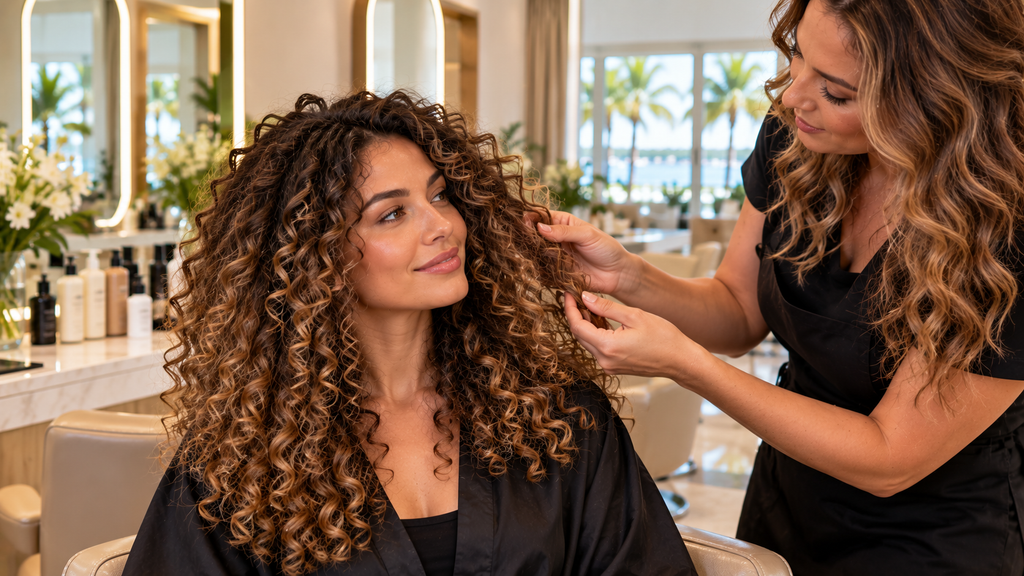
Why Curly Hair Is Structurally Different
The difference between curly and straight hair is not just visual. It is structural – and the structural differences explain every specific care and styling distinction that follows.
The follicle shape determines the curl. Straight hair grows from a round follicle. Curly hair grows from an oval or elliptical follicle – the more elliptical, the tighter the curl. This follicle shape creates a hair strand that is not uniformly round in cross-section but slightly flattened, which is why curly hair behaves so differently under tension, under heat, and under the moisture conditions Jensen Beach creates constantly.
The cuticle is naturally more open. The curl’s shape means the cuticle scales do not lie as flat as they do on straight hair – the curves and bends of the strand creating points where the cuticle is naturally more lifted. This is why curly hair absorbs moisture from the atmosphere so readily – including Jensen Beach’s humidity – and why it loses internal moisture more quickly than straight hair. The naturally more open cuticle is both the source of the curl’s responsiveness to the environment and its most significant care challenge.
Scalp oil travels differently. The sebum that the scalp produces travels down the hair shaft by gravity and by the shaft’s surface. On straight hair, it travels relatively efficiently from root to end, providing natural conditioning throughout the length. On curly hair, the coils and bends of the strand interrupt this travel – the oil accumulating at the scalp and the mid-lengths and ends receiving progressively less natural conditioning. This is the specific biological reason curly hair tends toward dryness at the ends regardless of how frequently it is conditioned – the scalp’s natural conditioning mechanism is less effective for the curl pattern than for straight hair.
The Straight-Hair Mistakes That Curly Hair Pays For
Most of the curly hair problems that Jensen Beach clients describe – the frizz, the undefined curl, the unpredictable styling results, the hair that looks beautiful on wash day and loses its shape within forty-eight hours – trace back to one or more of the following straight-hair approaches applied to a curl that needs something different.
Sulfate shampoo used too frequently. Sulfate shampoos strip the natural oils that straight hair produces in excess and that curly hair produces in inadequate supply for the length it needs to condition. The frequency and the formula that is correct for an oily straight scalp is actively damaging to the already-moisture-deficient curly length. Sulfate-free shampoo used every two to three days – or the co-wash approach that uses conditioner to cleanse rather than shampoo – is the most appropriate washing protocol for most curl patterns. The scalp stays clean. The length retains the moisture it cannot replace from scalp oil the way straight hair can.
Towel rubbing. The terry cloth towel rubbed through wet curly hair is among the most consistently damaging daily practices available for the curl pattern. The rough loop texture of terry cloth against the naturally more open curly cuticle creates friction that roughens the surface, separates the curl clumps that define the pattern, and creates the specific fluffy, undefined, frizzy result that most curly-hair clients associate with air drying gone wrong. A microfiber towel used with a gentle scrunching motion – pressing out excess water without disrupting the curl’s natural clumping – preserves the curl pattern through the drying process rather than destroying it before drying has even begun.
Brushing dry. Brushing curly hair when dry separates the individual strands that the curl’s structure groups into defined clumps – creating the volume and the frizz of separated strands rather than the definition of grouped ones. Curly hair is detangled when wet, with conditioner providing slip, using a wide-tooth comb or the fingers rather than a brush. Once dry, the curl is not brushed. It is refreshed, scrunched, or left alone.
Applying products to dry hair. Most styling products for curly hair – curl creams, gels, leave-in conditioners – are designed to be applied to soaking wet hair immediately after washing, before any drying begins. Applied to dry or even damp-but-not-wet hair, these products cannot distribute through the curl pattern evenly, cannot create the cast that holds the definition through drying, and cannot prevent the frizz that the drying process creates when the curl is not adequately protected through it. The application timing is as important as the product choice.
What Curly Hair Actually Needs
Deep moisture as a consistent priority.
Given the structural moisture challenges described above – the naturally more open cuticle that loses internal moisture readily and the scalp oil that does not travel the full length efficiently – curly hair needs more deliberate, more consistent moisture maintenance than straight hair of the same density and length.
The weekly deep conditioning mask is not optional for curly hair in Jensen Beach. The monthly chelating shampoo that removes the hard water mineral deposits accumulating on the cuticle – deposits that block moisture penetration regardless of how generously the conditioner is applied – is equally important. And the professional deep conditioning treatment at Parlay every four to six weeks creates the cortex-level hydration that the at-home mask supplements but does not fully replicate.
The right cut – designed for the curl, not imposed on it.
This is the single most impactful professional decision for curly hair – and the one most commonly made incorrectly when the cutting technique used is the straight-hair approach applied to a curl.
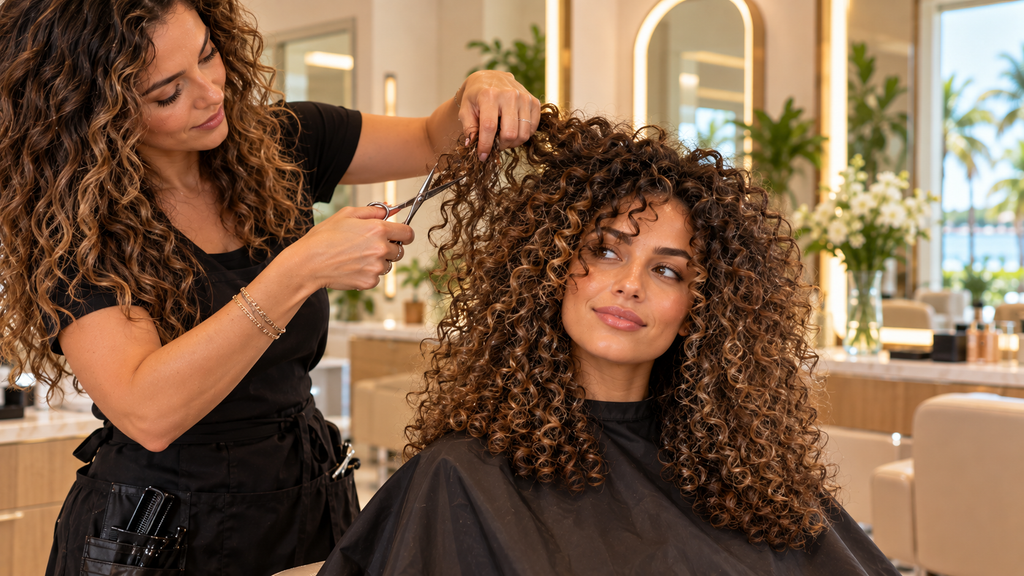
The curly hair cut at Parlay is performed on dry hair in its natural state – not on wet, stretched, temporarily straightened hair that dries back to a completely different shape than the cutting position suggested. Cutting curly hair wet creates a result that the stylist cannot accurately see until the client is home and the hair is dry – which is often when the client discovers the cut does not look right.
Cutting dry allows the specialist to see the curl’s natural spring, its natural volume distribution, its natural face-framing behavior, and its specific response to the length removal at each point. The cut designed around the curl as it actually exists is the cut that looks most intentional, most flattering, and most genuinely beautiful in Jensen Beach’s humid outdoor conditions.
The specific curl-cutting techniques – the Deva cut approach, the dusting of individual curls rather than the blunt perimeter cut, the layering that releases volume rather than adding it – create structure within the curl that the straight-hair cutting approach cannot create because it is not designed for the texture it is being applied to.
Products chosen for the curl pattern, not for the marketing.
The curly hair product market is one of the most crowded and the most marketing-intensive in professional beauty. The straightforward principles beneath the product noise:
Leave-in conditioner applied to soaking wet hair immediately after washing provides the moisture base. A curl cream or styling gel applied over the leave-in while the hair is still soaking wet – not damp, soaking wet – defines the curl pattern and creates the flexible hold that the curl maintains through drying. Scrunching upward toward the scalp rather than pulling downward encourages the curl’s natural clumping rather than disrupting it.
In Jensen Beach’s humidity specifically – the humidity that most curly hair clients experience as the primary frizz driver – a gel with a stronger hold creates a protective cast around the curl that the atmospheric moisture cannot penetrate. The cast that the dried gel creates is scrunched out gently once the hair is completely dry – releasing the soft, defined curl from within the protective hold. This technique, called the “hard cast scrunch out,” is the single most effective frizz-prevention technique available for Jensen Beach’s most humidity-challenged curly hair.
Minimal heat – and the right technique when heat is necessary.
Curly hair benefits from air drying more than any other texture – the natural drying process allowing the curl to form in its most authentic, most defined, most specifically beautiful state without the disruption of heat tool contact. In Jensen Beach’s warm climate, air drying is practical year-round in a way it is not in most other communities – which makes it the most specifically appropriate and the most genuinely accessible drying method for this community’s curly hair clients.
When heat is necessary – for specific occasions, for the client who chooses a stretched or smooth style – a diffuser attachment on a low-heat, low-speed blowdryer is the most curl-preserving heat application available. The diffuser distributes heat evenly around the curl rather than blowing it in a direction that disrupts the curl pattern. Moroccanoil Treatment applied before any diffuser use provides the UV protection, the cuticle sealing, and the heat protection that curly hair needs in Jensen Beach’s outdoor environment regardless of whether the styling approach is heat or no-heat.
The Jensen Beach Specific Considerations
Jensen Beach’s humidity is the curly hair factor that most specifically differentiates this community’s experience from the mainstream curly hair guidance written for drier climates.
The humidity that most straight and wavy hair clients experience as the enemy of their styling routine is – with the right approach – the curly hair client’s most powerful styling asset. Curly hair that is properly moisturized, properly product-applied, and properly protected through the drying process absorbs Jensen Beach’s humidity as an enhancement rather than a disruption. The atmospheric moisture that keeps the curl hydrated and defined through the outdoor day is the same moisture that creates frizz in hair that arrived at the humidity without adequate protection and without adequate internal moisture.
The distinction is not the humidity. It is the preparation that either makes the humidity work for the curl or against it.
UV protection is equally specific for curly hair in Jensen Beach. The naturally more open cuticle of curly hair absorbs UV damage more readily than the flatter cuticle of straight hair – the photo-oxidation that Jensen Beach’s year-round extreme UV drives creating progressive color fade and progressive protein damage in curly hair more quickly than in straight hair of the same exposure level. Daily Moroccanoil Treatment before outdoor exposure is the most important single daily protective habit for curly hair in this community.
The Curly Hair Consultation at Parlay
The most important first step for any curly hair client who has been managing the texture without a specifically curly approach is the hair consultation with a Parlay specialist who understands the curl.
The consultation that assesses the specific curl pattern, the porosity, the density, the current product routine, and the specific Jensen Beach lifestyle factors – and that designs the most appropriate cut, the most appropriate product approach, and the most appropriate professional service plan for this specific curl in this specific environment – is the most directly, most immediately life-improving appointment available for curly hair clients who have been working harder than they should be for results that are less than they should be.
Your curl is not the problem. Come in and let us show you what it looks like when it is working properly.
- 2250 NE Dixie Hwy, Jensen Beach, FL 34957
- (772) 261-8116
- parlayhairandbeauty.com
- Online Booking Available 24/7 via Vagaro
Serving Jensen Beach, Stuart, Palm City, Hobe Sound, Hutchinson Island, Port St. Lucie, and all of Martin County, Florida.