
What Every Woman Needs to Know Before Attempting a Dramatic Color Change – From the Color Correction Specialists at Parlay Hair and Beauty, Jensen Beach, Florida
The Dream, The Reality, and Everything Nobody Tells You
You have been staring at the same dark hair in the mirror for years. Maybe it is your natural color. Maybe it is the result of years of box dye faithfully applied every six weeks in the bathroom of your Jensen Beach home. Maybe you went dark intentionally a few years ago and now, looking at those photos of the lighter-haired version of yourself, you wonder why you ever left.
Whatever the reason, the desire is the same: you want to be blonde. Not just a little lighter – genuinely, beautifully, head-turningly blonde. The kind of blonde that catches Jensen Beach’s golden afternoon light and makes your eyes look brighter and your skin look more radiant and your whole face look like the best possible version of itself.
And so you do what most women in this situation do. You Google “how to go from dark to blonde.” You watch YouTube videos. You read forums. Maybe you visit a few salons and ask about pricing. And somewhere in that process, you encounter a range of information so wildly inconsistent that you end up more confused than when you started.
Some sources tell you it can be done in one appointment. Others say it takes six months minimum. Some say box dye removal is straightforward. Others say it is the most complicated thing in the entire color world. Some stylists quote you a price that seems almost too reasonable. Others give you a number that makes your eyes water.
What is the truth?
The truth – the complete, honest, unvarnished truth about going from dark to blonde – is what this guide is about. Not the comfortable version of the truth that tells you what you want to hear, and not the alarmist version that makes the whole process sound impossible. The real truth, from the experienced color correction specialists at Parlay Hair and Beauty in Jensen Beach, Florida, who have guided hundreds of women through this journey and know exactly what it involves.
This is the guide we wish every woman who wants to go from dark to blonde could read before she takes a single step toward that goal. Because the women who approach this process with accurate information and realistic expectations achieve results that are genuinely extraordinary – beautiful, healthy, transformative blonde that they love wearing every day. And the women who approach it without that information often find themselves in difficult situations that are expensive, time-consuming, and hard on their hair.
Read this. Share it with every woman you know who is thinking about going blonde. And when you are ready to start your own journey, come see us. We will take the very best possible care of your hair along the way.
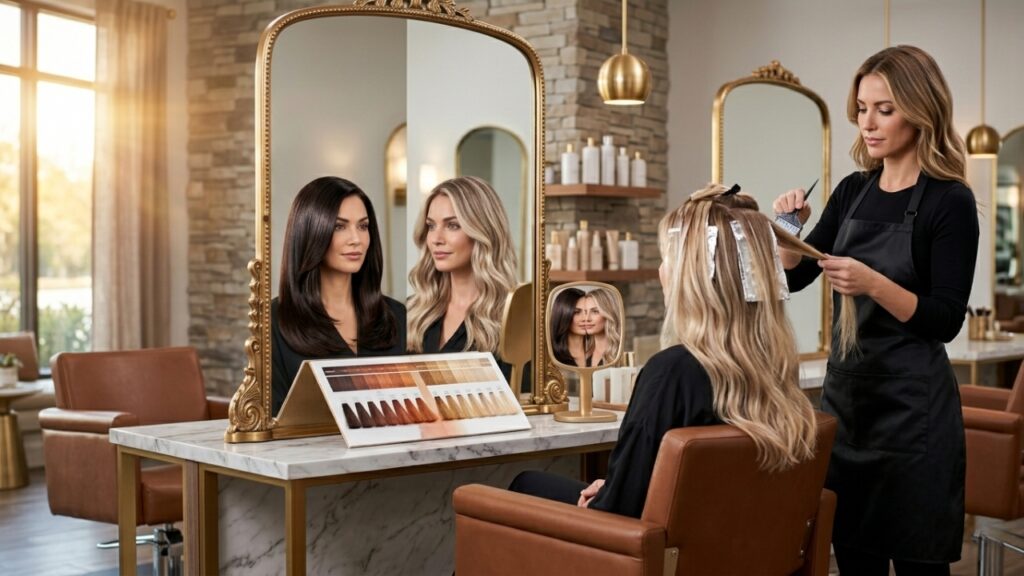
The Science You Need to Understand – Why Dark to Blonde Is Complicated
To understand why going from dark to blonde is one of the most technically challenging color transformations available – and why it cannot simply be rushed without consequences – you need to understand something about what is actually happening inside your hair during the lightening process.
What Hair Color Actually Is – Inside the Hair Shaft
Your hair gets its color from pigment molecules called melanin, which are produced by cells called melanocytes in the hair follicle and deposited into the hair shaft as it grows. There are two types of melanin that together create every possible natural hair color:
Eumelanin is the dark pigment responsible for black and brown tones. High concentrations of eumelanin produce very dark hair. Lower concentrations produce medium and light brown shades.
Pheomelanin is the warm, reddish pigment responsible for red, orange, and yellow tones. It is present in virtually all natural hair colors – even very dark ones – and is significantly more resistant to chemical breakdown than eumelanin.
The specific combination and ratio of these two pigments – along with the overall density of pigment in the hair shaft – determines your natural hair color. Dark brown and black hair have high concentrations of both, with eumelanin dominant. Blonde hair has very low overall pigment concentration. Red hair has high pheomelanin relative to eumelanin.
Understanding this is the foundation of understanding why going from dark to blonde is complex – because lightening the hair does not simply remove color. It destroys the melanin molecules in a specific, staged sequence that cannot be skipped or accelerated without consequences.
What Bleaching Actually Does to Your Hair
When a lightener – bleach – is applied to dark hair, it works by oxidizing and destroying the melanin molecules within the hair shaft. This oxidation process happens in stages, and the hair passes through a specific, predictable sequence of color stages as the melanin is progressively destroyed:
Stage 1 – Black (starting point for very dark hair) Stage 2 – Dark brown Stage 3 – Medium brown Stage 4 – Light brown Stage 5 – Dark blonde / Reddish brown Stage 6 – Medium blonde / Copper / Orange Stage 7 – Light blonde / Yellow-orange Stage 8 – Very light blonde / Yellow Stage 9 – Pale yellow Stage 10 – Near white / Platinum
This sequence is not a choice or a technique variation – it is the chemistry of melanin oxidation. Every head of dark hair must pass through stages 5, 6, and 7 – the orange, copper, and yellow stages – on the way to blonde. There is no way to skip them.
This is the source of the brassiness that is the most common complaint in dark-to-blonde transitions – and understanding that it is a chemical inevitability rather than a styling mistake is important. The orange and yellow stages are not the final result of a failed bleaching attempt. They are intermediate stages on a journey that requires careful management rather than despair.
What bleaching does to the hair structure:
Beyond destroying pigment, bleaching also affects the structural proteins of the hair shaft – particularly the disulfide bonds in the hair’s keratin structure. These bonds are what give the hair its strength and elasticity. As bleaching progressively oxidizes the melanin, it also disrupts these bonds to varying degrees – which is why over-processed hair feels weak, stretchy when wet, and prone to breakage.
The degree of structural damage from bleaching is directly related to the degree of lift achieved – more lift requires more disruption of the hair’s structural bonds. This is why achieving significant lift in a single session risks more structural damage than the same degree of lift achieved safely over multiple sessions, with bond-repair treatments incorporated throughout.
The Problem With Box Dye History
If the dark hair you are starting with is the result of natural color, the journey to blonde – while still complex – is relatively predictable. Natural dark hair behaves consistently during the lifting process, and an experienced colorist can assess its likely response quite accurately.
If the dark hair you are starting with is the result of box dye – even many years of box dye – the journey to blonde becomes significantly more complicated, less predictable, and potentially more damaging. Here is why:
Box dye contains metallic salts and unpredictable artificial pigments. These compounds bond to the hair shaft in ways that professional color does not, and they react to bleach in ways that are difficult to predict. Metallic salts in particular can react with the hydrogen peroxide in bleach to generate heat – a reaction that can cause severe damage to the hair and, in extreme cases, hair breakage or even scalp burns. This is not a theoretical risk – it is a well-documented chemical interaction that experienced colorists are trained to screen for before applying any lightener to previously box-dyed hair.
Box dye deposits unevenly. Over time, box dye accumulates in the hair – more heavily on the lengths and ends where each application has been layered over the last, more lightly on the newer growth near the root. This uneven buildup means that when bleach is applied over box-dyed hair, it lifts unevenly – creating the banding and patchy result that is one of the most common problems in dark-to-blonde transitions on box-dyed hair.
Box dye history is often unknown or incomplete. Most women who have been using box dye for years have not kept careful records of every shade applied, every brand used, or the timing of each application. This makes assessment – and therefore planning – more difficult for the colorist, and it increases the unpredictability of the lifting process.
The Dark-to-Blonde Journey – What It Actually Looks Like
How Many Appointments Does It Really Take?
This is the question at the top of every dark-to-blonde client’s list – and the honest answer is: it depends.
Specifically, it depends on:
- How dark your starting point is
- Whether your dark color is natural or from box dye or professional color
- How light your target blonde is
- The current health and condition of your hair
- The degree of lift achievable in each session without compromising your hair’s integrity
Here is an honest breakdown by starting point and target:
Starting from natural dark blonde / light brown, targeting medium to light blonde: Often achievable in one carefully managed appointment for clients with healthy, virgin hair. The lift required is moderate and the risk of excessive damage is lower. Still requires professional formulation, careful monitoring, and appropriate toning.
Starting from natural medium brown, targeting a lighter blonde: Typically requires one to two appointments. The underlying warmth of medium brown hair means a single lifting session will likely leave the hair in the orange-to-yellow range, requiring either a second lifting session or a carefully selected toner that works with the achieved level.
Starting from natural dark brown, targeting any shade of blonde: Typically requires two to three appointments spaced six to eight weeks apart. Dark brown hair contains enough eumelanin that a single safe session will likely achieve a lift to the orange or copper stage – beautiful when toned as a warm caramel, but requiring at least one additional session to reach a lighter blonde target.
Starting from natural black or very dark brown hair, targeting any blonde: This is the most involved journey – typically three to four or more appointments spaced appropriately to allow the hair recovery time between sessions. Attempting to reach blonde from true black hair in fewer sessions almost inevitably compromises the hair’s structural integrity.
Starting from box-dyed dark hair, targeting blonde: Add at least one to two additional sessions to any of the above estimates, depending on the history and degree of box dye buildup. A strand test and porosity assessment before planning is essential.
Starting from professionally colored dark hair, targeting blonde: The timeline depends heavily on what the professional color formula contained and how many sessions of color are layered in the hair. An honest consultation with an assessment of the hair’s color history is the only way to accurately plan.
The Stages of the Journey – What Your Hair Will Look Like at Each Step
Understanding what your hair will look like at each stage of the dark-to-blonde journey prepares you for the process and prevents the panic that many clients experience when they see their hair in an intermediate stage and think something has gone wrong.
After Session 1 (from very dark starting point): Your hair will likely be in the copper to reddish-orange range – lifted significantly from its starting point but still far from blonde. This is completely normal and expected. A skilled colorist will apply a toning treatment after the first session to make this stage as beautiful and wearable as possible – typically a warm caramel or bronze tone that makes the intermediate result look intentional and lovely while the hair rests and prepares for the next session.
After Session 2: The hair should lift to the orange-to-yellow range – closer to the blonde spectrum but still requiring further work for most blonde targets. Again, a toning treatment makes this intermediate stage as beautiful as possible. For some starting points and some target blondes, the result after Session 2 may already be within toning distance of the target.
After Session 3 (and beyond if needed): Progressive lifting sessions bring the hair closer to the pale yellow stage that is the prerequisite for most true blonde results. The specific toner applied after each lifting session determines the interim color result – warm, cool, neutral, or any specific shade within the achievable range.
Final toning appointment: Once the hair has been lifted to the pale yellow or platinum stage – the prerequisite for cool, icy, or true blonde tones – a final toning appointment deposits the specific shade you have been working toward. This is often the most exciting appointment of the whole journey – the moment when the blonde you have been imagining for months finally becomes reality.
The Role of Bond-Repair Treatments in a Safe Journey
This is the element of dark-to-blonde transformations that has changed most dramatically in recent years – and it is one of the most important reasons that the journey is genuinely safer and more achievable today than it was ten years ago.
Bond-repair treatments – of which K18 is one of the most advanced and most effective available – work by penetrating the hair shaft and repairing the disulfide bonds that bleaching breaks down. Unlike surface conditioners that coat the outside of the hair and provide temporary softness, bond-repair treatments like K18 actually rebuild the hair’s internal structure from within – reconnecting broken polypeptide chains and restoring the hair’s natural strength and elasticity.
When K18 is incorporated into the lightening process – added directly to the bleach formula or applied immediately after each lifting session – it protects the hair’s structural integrity during the most chemically intensive part of the process. The result is hair that arrives at each subsequent session in significantly better condition than it would without the treatment – hair that can safely handle more lifting sessions, more overall chemical exposure, and ultimately achieve a more dramatic final result than would be safely possible without bond protection.
At Parlay Hair and Beauty, K18 bond repair treatment is incorporated into every dark-to-blonde appointment as a standard, non-negotiable part of the process. We believe that the safety and health of your hair is never negotiable – and that the most beautiful blonde journey is one that ends with hair that looks extraordinary and feels extraordinary because it has been genuinely protected throughout.
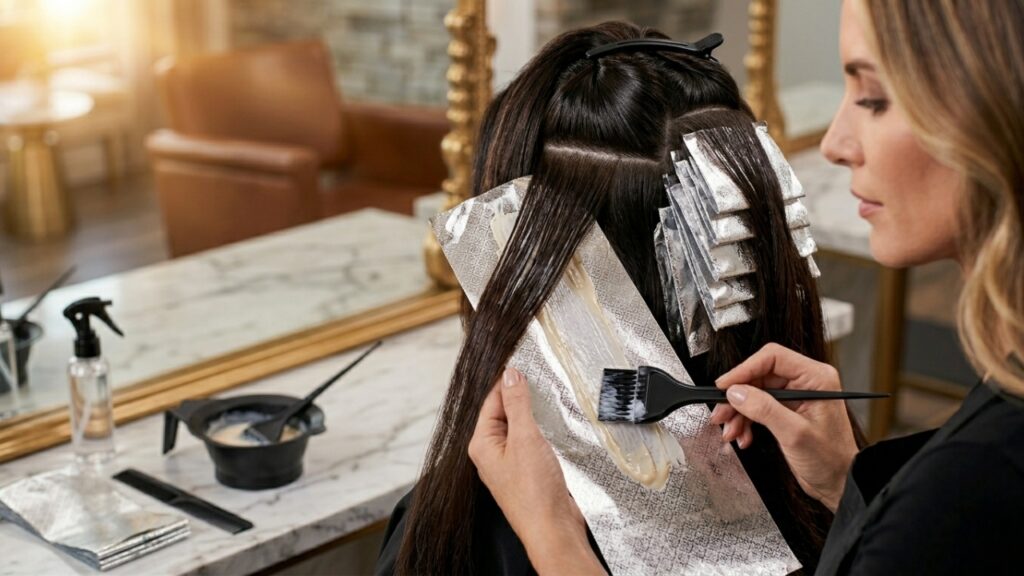
The Box Dye Problem – Everything You Need to Know
Why Box Dye Is the Biggest Complication in Color Correction
Of all the factors that complicate a dark-to-blonde journey, box dye history is the most significant – and the one most likely to extend the timeline, increase the cost, and require the most careful management.
We genuinely understand why women use box dye. It is accessible. It is affordable. It is available at every drugstore in Jensen Beach and beyond. And for simple maintenance of an existing color, it does the job in a way that is understandable.
But for women who have been using box dye for years and now want to go blonde, the honest truth is this: the box dye in your hair is the primary obstacle between you and the blonde you want, and removing it safely takes time, expertise, and patience.
Here is what you are dealing with specifically:
Multiple layers of artificial pigment. Each box dye application has deposited a layer of artificial color molecules into the hair shaft. Over months and years, these layers accumulate – creating a dense buildup of artificial pigment that is significantly more resistant to lifting than natural melanin. Your colorist is not just lifting natural dark pigment. They are lifting through layers of applied color before they can even begin to address the natural pigment underneath.
Metallic salt residue. Many box dye formulas contain metallic salts that bond to the hair shaft and persist long after the color itself has faded. These salts react unpredictably with professional lighteners – potentially causing uneven lifting, heat generation, or severe damage. Before any lightener is applied to box-dyed hair, a responsible colorist performs strand tests specifically designed to identify the presence of metallic salts and assess how the hair will respond.
Uneven color distribution throughout the hair. Box dye typically deposits more heavily on porous, previously colored lengths and ends than on newer root growth – creating density variations that make even, consistent lifting across the full length of the hair genuinely challenging. The result, without careful management, is hair that lifts much faster at the roots (where the natural hair is less saturated with color) than at the ends (where the color has been repeatedly layered) – creating an uneven gradient rather than a consistent lift.
Unknown formulation history. Without a record of exactly which box dye products have been used – their specific formulations, developer strengths, and timing – the colorist is working with incomplete information about what is actually in the hair. This uncertainty increases the importance of strand testing and conservative, staged lifting approaches.
Color Removal – When It Is Needed and What It Involves
For clients with significant box dye history, a color removal or color stripper treatment is sometimes the appropriate first step before any lightening begins – particularly when the hair is very dark, when the box dye history is extensive, or when strand tests indicate that the hair will not lift evenly with direct bleach application.
What color removal does:
Color removal products work through a chemical process called reduction – the reverse of the oxidation process that deposits color into the hair. They shrink the artificial color molecules and allow them to be rinsed out of the hair shaft without using the oxidizing chemistry of bleach. The result is a removal of artificial pigment that exposes more of the natural hair’s underlying color – which, in many cases, is significantly lighter than the box-dyed color suggested.
What color removal does not do:
Color removal does not lighten the hair beyond its natural color level. It removes the artificial pigment but leaves the natural melanin intact. It also does not remove metallic salt buildup. And the result of color removal is often not clean or predictable – the hair may come out patchy, uneven, or a surprising shade that reflects the complex layering of previous color applications.
Why color removal is not the complete solution:
Many clients hear about color removal and assume that it is the first step in a simple two-step process – remove the box dye, then tone to blonde. The reality is that color removal is typically the beginning of a longer process. After removal, the hair usually needs at least one or more lightening sessions to reach a blonde target – because the natural base color exposed by the removal is typically still a medium to dark shade that needs lifting.
The Strand Test – Why It Is Non-Negotiable for Box-Dyed Hair
A strand test is a small-scale trial of the proposed treatment applied to a hidden section of the client’s hair before the full service begins. For clients with box dye history, a strand test is not optional – it is the responsible, professional, essential first step that tells the colorist exactly how the hair will respond to the lightening process before that process is applied to the entire head.
Here is what a strand test reveals:
How quickly the hair lifts. Some hair lifts very quickly; some resists. Knowing this allows the colorist to calibrate processing time accurately.
How evenly the hair lifts. Uneven lifting – different sections responding differently – is an important signal that requires adjustment of the approach.
How the hair’s integrity responds. The strand test reveals whether the hair has the structural strength to handle the proposed lightening safely – whether it remains strong and elastic after processing or shows signs of significant damage.
Whether metallic salts are present. Excessive heat during the strand test, extreme frizzing, or dramatic changes in texture are warning signs of metallic salt content that requires a different approach.
At Parlay Hair and Beauty, strand testing for dark-to-blonde transitions on previously colored hair is standard practice – not an extra step but an essential part of responsible color correction work.
The Biggest Mistakes – And How to Avoid Them
Mistake 1 – Attempting Dark-to-Blonde at Home
This is the mistake with the most serious potential consequences – and the one we see the results of most frequently in color correction consultations at Parlay. Women who attempt a dark-to-blonde transformation at home with bleach kits or lightening products available from beauty supply stores typically encounter one or more of the following:
Severely uneven results. Without professional knowledge of sectioning, timing, and application technique, home bleach applications frequently produce dramatically uneven results – much lighter in some areas than others, orange in some sections and yellow in others, with visible lines between sections processed for different amounts of time.
Significant structural damage. Over-processing from extended development times, incorrect developer strength, or repeated same-day applications causes protein bond breakdown that results in extreme hair weakness – hair that stretches like taffy when wet, snaps when dry, and may experience significant breakage.
Dangerous reactions over box dye. Applying bleach over box-dyed hair at home without strand testing is genuinely risky – the metallic salt reaction can generate significant heat and cause hair damage that is severe and in some cases irreversible.
A result that is extremely expensive to correct. Severely damaged hair from a failed home bleach attempt often requires cutting, significant restorative treatment, and a much longer and more expensive correction journey than a professionally managed dark-to-blonde transition would have required from the start.
The money saved by attempting this at home is almost never worth it – and in many cases, the attempted saving results in spending significantly more on professional correction work than the original professional service would have cost.
Mistake 2 – Choosing a Salon Based on Price Rather Than Expertise
Dark-to-blonde color correction is a specialist service. It requires specific knowledge, specific skills, and significant experience with complex lightening work. A salon or stylist who quotes a dramatically lower price for this service than others are quoting is not necessarily a better deal – they may simply be less experienced, less careful, or less invested in the long-term health of your hair.
The questions to ask when evaluating a salon for this service are not primarily about price – they are about expertise. How many dark-to-blonde transformations has this colorist performed? What is their specific approach to assessment and strand testing? What bond-repair treatments do they use throughout the process? How do they handle the situation if the hair does not respond as expected?
At Parlay Hair and Beauty, our color specialists have the experience, the training, and the genuine commitment to hair health that this category of service requires. We are transparent about pricing, honest about timelines, and meticulous about every step of the process – because the result that our clients walk out with and wear every day is a direct reflection of the care we put into the work.
Mistake 3 – Expecting One Appointment to Do It All
The desire to achieve a complete dark-to-blonde transformation in a single appointment is completely understandable – and it is one of the most common sources of disappointment and damage in this category of color work. The science of melanin oxidation cannot be rushed. The chemistry does not accelerate because you want it to. The hair’s structural tolerance for bleaching does not increase because you are in a hurry.
Colorists who promise to take very dark hair to platinum blonde in a single appointment either do not fully understand what they are agreeing to or are not fully invested in the long-term health of your hair. A single session of extreme bleaching – the kind required to take dark hair to platinum in one sitting – causes the kind of structural damage that results in significant breakage, the complete loss of elasticity, and hair that feels like cotton candy and snaps at the slightest tension.
A staged process – two, three, or four carefully managed sessions with appropriate time between them – produces results that are not only healthier but genuinely more beautiful. Hair that arrives at blonde safely has a luminosity, a movement, and a strength that over-processed, rushed hair simply cannot achieve.
Mistake 4 – Skipping the Consultation
No color specialist can accurately plan a dark-to-blonde journey without seeing your hair in person. Online consultations, photo-based assessments, or conversations over the phone can provide a general outline – but the specific formulation, the honest timeline, the accurate pricing, and the detailed plan for your specific hair can only be created from a direct, in-person assessment.
Skipping the consultation – booking a full service appointment at a new salon without first having your hair assessed – is a risk that experienced color specialists always recommend against for complex transformations. The consultation is the foundation of a successful result, and it is time well invested.
At Parlay, consultations for dark-to-blonde and complex color correction work are not rushed. We take the time to look at your hair thoroughly, discuss your complete color history, perform strand tests where appropriate, give you a completely honest assessment of the timeline and investment, and create a plan that you fully understand and fully agree to before any lightener touches your hair.
Mistake 5 – Neglecting Home Care Between Sessions
The condition your hair is in when it arrives at each subsequent session directly affects what can safely be accomplished in that session. Hair that has been well-maintained between sessions – deeply conditioned, protected from the sun and salt water and pool chlorine, treated with bond-repair products, washed with gentle color-safe formulas – is significantly healthier and more responsive to lifting than hair that has been neglected or subjected to additional damage between appointments.
In Jensen Beach’s specific environment – with its powerful Florida sunshine, salt air, ocean water, and pool chlorine – maintaining hair health between dark-to-blonde sessions requires particular diligence. Your colorist will give you a specific home care protocol at each appointment – the right products, the right practices, the things to avoid – and following that protocol faithfully is one of the most important things you can do to support the success of your overall transformation.
What the Final Result Looks Like – And How to Maintain It
Choosing Your Target Blonde
Part of the early consultation process is establishing a realistic target for the blonde you want to achieve – and understanding how that target relates to your specific starting point and the journey required to get there.
Not all blondes are created equal, and the specific blonde that will look most beautiful on you depends on your skin tone, your eye color, your lifestyle, and how much maintenance you are willing to commit to long-term.
Warm blondes (honey, golden, champagne, butterscotch): These warm-toned blonde shades are typically the most achievable from dark starting points because they require less overall lift than cool-toned blondes. They are also among the most naturally flattering – particularly for women with warm or neutral skin tones – and are characteristic of Jensen Beach’s sun-kissed coastal aesthetic.
Cool blondes (ash, beige, sandy, pearl): Cool-toned blondes require more complete neutralization of the underlying warm pigment exposed during lifting – which means either more lifting sessions to achieve a pale enough base for cool toning or a toner selection that works with the warmth rather than trying to neutralize it completely. They are extraordinarily beautiful when achieved properly and are particularly flattering on cool skin tones.
Platinum blonde: The most demanding and most maintenance-intensive target – requiring the most complete lifting and the most regular toning maintenance. Achievable from dark hair with patience and expertise, but representing the longest journey and the most significant ongoing commitment.
Lived-in or dimensional blonde: Rather than a single uniform shade, a lived-in blonde combines warmth at the roots with progressive lightening toward the ends – creating a result that is more natural-looking, more forgiving in its grow-out, and often more beautiful in the way it catches the light. This is frequently one of the most satisfying targets for dark-to-blonde clients because it is both achievable and genuinely gorgeous.
The Toning Appointment – Where the Magic Happens
The toning appointment – the final session in which the lifted hair is toned to its target blonde shade – is genuinely one of the most transformative moments in the entire dark-to-blonde journey. It is the appointment where the orange and yellow intermediate stages are finally resolved into the specific, beautiful blonde that has been the goal of every previous session.
At this appointment, your colorist selects a professional toner – customized to your specific lifted hair’s starting point and your target blonde – and applies it to achieve the final shade. The selection of the right toner for the specific state of your lifted hair is an expertise in itself. Too cool and the result can look muddy or greenish on hair that was not lifted quite pale enough. Too warm and the result may not achieve the specific cool or neutral quality you were aiming for. The colorist’s knowledge of color theory and their ability to read the lifted hair’s specific state are what make this final step produce the result you have been working toward.
Maintaining Your New Blonde in Jensen Beach, Florida
After the journey – after the sessions, the patience, the treatments, and the careful management – you have arrived at your blonde. Now the work shifts from transformation to maintenance, and in Jensen Beach’s specific environment, that maintenance requires particular attention.
Purple shampoo is your most important tool. The toner that gives your blonde its specific shade fades over time – and as it fades, the underlying warmth of the lifted hair begins to show through, creating the brassiness that is the most common blonde maintenance complaint. A professional purple or violet toning shampoo used once or twice a week – left on for three to five minutes before rinsing – neutralizes developing warmth and keeps your blonde cool, fresh, and polished between toner refresh appointments.
Toner refresh appointments every four to eight weeks. For most blondes, a standalone toner or gloss refresh appointment every four to eight weeks – depending on your washing frequency, your specific toner, and how quickly your color fades – is the most important maintenance service for keeping the blonde looking its best. This is a relatively quick and relatively affordable appointment compared to the full maintenance services, but its impact on the quality of the color is enormous.
Daily UV protection is non-negotiable. Jensen Beach’s Florida sunshine is one of the most powerful forces for fading and yellowing blonde hair – UV radiation oxidizes the toner and the lightened hair’s remaining pigment in ways that create warmth and dullness over time. A professional UV-protecting hair product applied daily is the single most impactful protective measure for maintaining beautiful blonde in Jensen Beach’s climate.
Ocean and pool protection every time. Salt water opens the hair cuticle and causes both toner fading and moisture loss. Chlorine can cause a green or brassy tint in lightened hair through a chemical reaction with the copper in pool water. Before every ocean or pool swim, apply a protective leave-in oil, rinse with fresh water immediately before and after swimming, and follow with a deep conditioning treatment. In Jensen Beach’s water-centric lifestyle, this protection routine is genuinely essential for maintaining the health and color of blonde hair.
K18 maintenance at home. The same bond-repair technology that protected your hair throughout the lightening process continues to be valuable in home maintenance. A K18 leave-in molecular repair treatment used regularly at home rebuilds the bonds that everyday styling, environmental exposure, and washing gradually break down – keeping your blonde feeling as strong and healthy as it looks.
Sulfate-free everything. Every wash with a sulfate-containing shampoo strips color from the hair – fading both the toner and the general warmth that keeps blonde looking vibrant. A gentle, sulfate-free formula for every wash, every day, is one of the most foundational home care habits for any color-treated hair and particularly important for blonde.
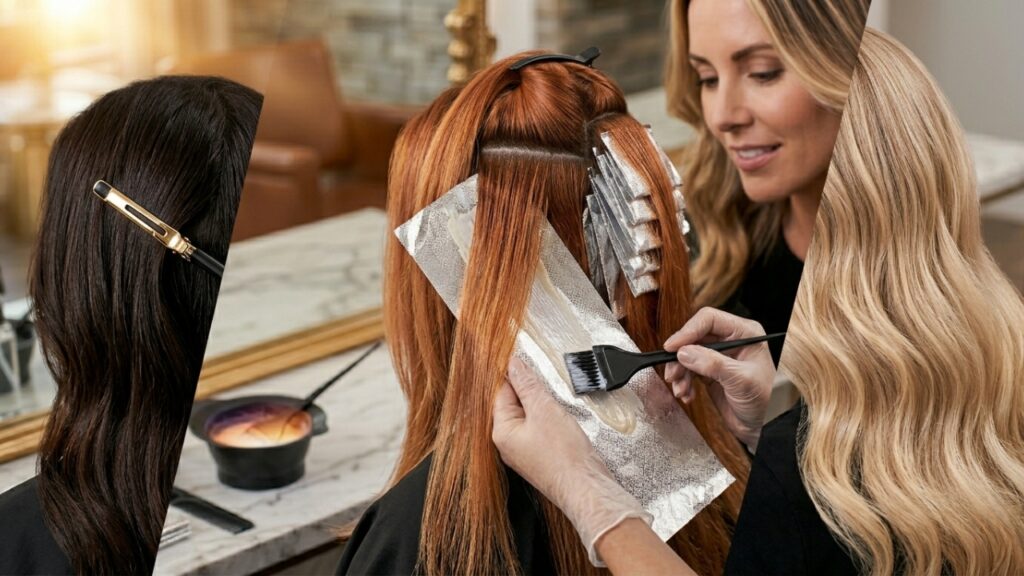
Real Client Journeys – What to Realistically Expect
The Client Starting From Natural Dark Brown Hair
One of the most common dark-to-blonde journeys we see at Parlay begins with a client who has natural dark brown hair – perhaps a level 3 or 4 on the professional color scale – who wants to achieve a medium to light blonde result.
Realistic timeline: Two to three appointments spaced six to eight weeks apart, plus a final toning appointment.
Session 1: Lightening session to lift the natural dark brown to approximately a level 6 to 7 – copper to orange-gold range. K18 bond repair treatment incorporated throughout. Toning after lifting to make the intermediate stage as beautiful and wearable as possible – typically a warm caramel or bronze that makes the hair look intentional rather than in-progress.
Session 2 (6-8 weeks later): Second lightening session to lift from the current level to approximately a level 8 to 9 – the yellow to pale yellow range. K18 treatment incorporated. Toning after lifting to the best possible interim shade.
Final toning appointment (4-6 weeks after Session 2): Toner applied to achieve the specific target blonde – whether that is a cool ash, a warm honey, a creamy beige, or any other specific shade within the achievable range. This is the appointment where the transformation is complete.
Total timeline: Approximately 3 to 4 months from start to finish, with the hair arriving at each session in excellent condition because of the K18 protection and home care protocol between sessions.
The Client Starting From Years of Box Dye
This is the most challenging category of dark-to-blonde journey – and the one that requires the most realistic expectation-setting at the consultation.
Realistic timeline: Three to five or more appointments depending on the extent and history of the box dye, spaced appropriately to allow the hair recovery time between sessions.
Pre-treatment (if indicated by strand test): Color removal treatment to remove as much artificial pigment as possible before any lightening begins. Assessment of the hair’s condition and response after removal to plan the lightening approach.
Session 1: Careful, conservative lightening with close monitoring – the box dye history means the lifting is likely to be uneven, and the first session prioritizes assessment and safety over dramatic lift. K18 treatment throughout.
Sessions 2 through 4 (as needed): Progressive lifting toward the target level, with thorough strand assessment before each session to determine the next appropriate step. K18 treatment at every session. Toning between sessions to keep the interim results as beautiful and wearable as possible.
Final toning: Target blonde achieved. Celebration warranted.
Total timeline: Potentially four to eight months for significant box dye history, with the final result genuinely worth every session.
Why Parlay Hair and Beauty Is the Right Choice for Your Dark-to-Blonde Journey
We Tell You the Truth – Even When It Is Not What You Want to Hear
The most important quality in a color correction specialist for a dark-to-blonde journey is honesty – and it is one of the qualities our clients at Parlay most consistently appreciate and most frequently mention in their reviews and feedback.
We will not tell you that your journey will take two sessions when we assess your hair and determine it will take four. We will not tell you that your current box dye history is no problem when a strand test tells us it requires a specific, careful approach. We will not minimize the investment – in time, in appointments, in money – that your specific transformation genuinely requires.
What we will tell you is the truth – complete, clear, kind, and actionable. We will tell you exactly what we see in your hair, exactly what the process involves, exactly what the timeline and investment look like, and exactly what results are realistically achievable. And then we will give you the absolute best professional guidance available to help you make a genuinely informed decision about how and when and whether to proceed.
Our Color Specialists Have the Expertise This Work Requires
Going from dark to blonde at the highest level of safety and beauty requires a specific, deep knowledge of color chemistry, lightening technique, bond-repair science, and toning artistry that comes only from genuine experience with complex color transformation work.
Ashley, our owner and master colorist, has spent over 17 years developing exactly this expertise – working through every variation of dark-to-blonde journey that exists and building the knowledge and intuition that allows her to assess a client’s hair, develop a realistic plan, and execute each session with the precision and care the process demands. Her color correction work is among the most valued services at Parlay, and her ability to guide clients through the dark-to-blonde journey safely and beautifully is one of the things her clients mention most consistently.
Savannah, Kloe, and Avery bring their own expertise, training, and passion for color work to every service they perform – contributing to a team that is genuinely skilled across the full range of blonding and color correction work.
We Use the Best Products Available – Because Your Hair Deserves Them
Every dark-to-blonde transformation at Parlay is supported by the highest quality professional products available – L’Oréal Professional and Schwarzkopf Professional lightening and toning systems, K18 biomimetic peptide bond repair treatment incorporated throughout every lightening session, and Moroccanoil conditioning care at every appointment. These are not marketing claims – they are the specific tools that allow us to achieve the most beautiful, safest, most hair-health-conscious results possible.
Conclusion: The Blonde You Want Is Achievable – With the Right Approach
Going from dark to blonde is genuinely one of the most transformative things you can do for your appearance. When it is done well – staged carefully, managed expertly, supported by proper bond-repair treatments and thorough home care – the result is extraordinary. Hair that catches the Jensen Beach sunlight like nothing else. A brightness and luminosity that makes your face look more radiant and your features more beautiful. A confidence that comes from finally wearing the hair you have been imagining.
The journey requires patience. It requires investment. It requires trusting a specialist who tells you the truth and takes the time to do things right. But it is absolutely, completely, genuinely worth it.
At Parlay Hair and Beauty in Jensen Beach, Florida, we are here to guide every step of that journey – from the first honest consultation through every lifting session, every toning appointment, and every home care recommendation – with the expertise, the products, and the genuine care for your hair and your experience that this transformation deserves.
Come in for a consultation. Let us look at your hair, understand your vision, and tell you exactly what your specific blonde journey looks like. We cannot wait to show you what is possible.
📍 2250 NE Dixie Hwy, Jensen Beach, FL 34957 📞 Call or Text: (772) 261-8116 🌐 Book Online: parlayhairandbeauty.com ⏰ Online Booking Available 24/7 via Vagaro
Parlay Hair and Beauty – Jensen Beach’s most trusted color correction salon. Dark to blonde transformations, box dye removal, blonding specialists, and complete color correction. Serving Jensen Beach, Stuart, Palm City, Hobe Sound, Hutchinson Island, Port St. Lucie, and all of Martin County, Florida.