
The Complete, Honest Guide to Beautiful Grey Coverage That Protects Hair Health – From the Color Specialists at Parlay Hair and Beauty, Jensen Beach, Florida
The Grey Coverage Question That Deserves a More Complete Answer Than Most Women Receive
The decision to cover grey hair is one of the most universally experienced and most personally significant color decisions a woman makes – and it is also one of the decisions that is most frequently made with incomplete information about what the options actually are, what each option actually does to the hair, and what the genuine difference is between covering grey in a way that maintains the hair’s health and covering it in a way that progressively compromises it.
Most women who are covering grey hair are doing it one of two ways: either at home with box dye – the most accessible, the most immediately affordable, and the most structurally damaging approach to grey coverage available – or at a professional salon with a single-process permanent color application that covers the grey completely but creates a flat, uniform, obviously-colored result and a demanding maintenance cycle of root touch-ups every four to six weeks for the rest of their hair-coloring life.
Both of these approaches work in the narrow sense that they reduce the visibility of grey. Neither of them represents the most flattering, the most hair-healthy, the most natural-looking, or the most lifestyle-compatible approach to grey coverage available – and for the many Jensen Beach women who have been doing one or the other and feeling like something is slightly off about the result, the reason is almost certainly that there is a better option they simply have not encountered yet.
This guide is the complete, honest, expert explanation of the full range of grey coverage approaches available – from the most conventional to the most innovative, from the most complete to the most subtle, and from the most hair-healthy to the approaches that deserve to be reconsidered. It is the guide that our color specialists at Parlay Hair and Beauty in Jensen Beach, Florida wish every woman covering grey hair could read before making her next color appointment – because the decisions made at that appointment affect not just how the grey looks but how the hair feels, how manageable the maintenance is, and how genuinely beautiful the result is in Jensen Beach’s specific, revealing outdoor light.
By the end of this guide, you will understand grey coverage in a way that most women who have been covering grey for years still do not – and you will be equipped to make the most informed, the most flattering, and the most hair-healthy grey coverage decision available for your specific hair, your specific lifestyle, and your specific life in this extraordinary community on Florida’s Treasure Coast.
Understanding Grey Hair – What It Actually Is and Why It Matters for Coverage
The Biology of Grey Hair – Why Your Hair Turned Grey and What That Means for Coverage
Before we can discuss how to cover grey hair in the most effective, the most natural-looking, and the most hair-healthy way, it helps to understand what grey hair actually is – because the biology of grey hair directly affects how coverage interacts with it and why some coverage approaches work better than others.
What causes grey hair:
Hair gets its color from pigment-producing cells called melanocytes that live in the hair follicle and inject melanin pigment into each hair shaft as it grows. When these melanocytes slow their pigment production – due to genetic programming, age, hormonal changes, or occasionally stress or nutritional factors – the hair shaft that grows from that follicle contains progressively less melanin, eventually producing a hair shaft with no pigment at all. Without pigment, the hair appears white. The mixture of white, non-pigmented strands with remaining pigmented strands creates the salt-and-pepper or grey appearance that most people experience.
What grey hair is structurally:
Grey hair is not simply natural hair without pigment – it has structural characteristics that differ meaningfully from pigmented natural hair. Grey hair tends to be coarser in texture – the absence of melanin is accompanied by structural changes in the hair’s protein organization that create a coarser, often more wiry quality. Grey hair tends to be more resistant to color absorption – the structural changes that accompany depigmentation create a denser, more tightly packed cuticle in many grey strands that requires more processing to allow color molecules to penetrate. And grey hair tends to be more porous once its cuticle has been opened by chemical processing – meaning it absorbs color rapidly but also releases it rapidly, contributing to the faster fading that grey coverage clients often experience.
What this means for coverage:
Understanding grey hair’s specific characteristics directly informs the most effective coverage approaches. The coarser texture and the resistant cuticle of grey hair means that achieving lasting, even coverage requires a formula that can penetrate resistant grey effectively – which has implications for developer strength, processing time, and formula selection. The increased porosity of previously processed grey hair means that the ongoing maintenance of grey coverage requires specific protective practices to extend the life of each application.

The Grey Coverage Spectrum – From Complete Coverage to Natural Enhancement
One of the most important concepts for any woman who is considering or reconsidering her approach to grey coverage is the grey coverage spectrum – the range of approaches from complete, comprehensive, uniform grey coverage at one end to subtle grey enhancement that improves the grey’s quality without attempting to cover it at the other, with a rich and varied middle ground of approaches that address different degrees of grey and different aesthetic and maintenance goals.
Understanding that this spectrum exists – and that there is no single “grey coverage” that all women must choose – is the foundation of the more informed, the more personalized, and the more hair-healthy approach to grey management that this guide is about.
Complete grey coverage: Every grey strand covered completely with a single, uniform color formula. Maximum grey reduction. Most obvious grow-out line. Most frequent maintenance requirement. Most flat, most uniform result aesthetically.
Grey blending: Grey reduction without complete coverage – using color formulas and application techniques that soften the contrast between grey and natural hair without attempting to eliminate the grey entirely. More natural-looking. More forgiving grow-out. Less frequent maintenance. Most appropriate for moderate grey percentages.
Grey softening and toning: Using semi-permanent or demi-permanent formulas to add warmth, richness, or tone to grey hair without any permanent chemical commitment – improving the quality and the vitality of the grey rather than attempting to cover it. No grow-out line. No permanent commitment. Hair-health preserving.
Strategic highlighting to blend grey: Using highlights and balayage to distribute lighter tones through the hair in a way that makes grey less visible – blending the grey into a dimensional color result rather than covering it with a uniform formula.
Grey embracing with enhancement: Accepting the grey as a feature and using professional treatments and toning to make the grey as beautiful, as luminous, and as dimensional as it can be – the approach for women who have chosen to lean into their natural grey evolution rather than fight it.
Each of these approaches is legitimate. Each serves different women at different stages of their grey evolution with different aesthetic goals and different maintenance tolerances. The most important thing is choosing the approach that is genuinely most appropriate for the individual woman – her specific percentage of grey, her specific hair’s health, her specific lifestyle and maintenance tolerance, and her specific aesthetic vision.
The Damage Problem – Why Most Grey Coverage Hurts Hair and What to Do Instead
How Conventional Grey Coverage Damages Hair – The Honest Science
The most important thing that most grey coverage guides do not discuss with sufficient honesty is the damage that conventional grey coverage approaches create in the hair – and specifically the way that the cumulative damage of regular, permanent grey coverage color accumulates over years of monthly root touch-ups into a progressive deterioration of the hair’s structural health.
The permanent color chemistry:
Permanent hair color – the category of color that covers grey most completely and most lastingly – works through an oxidation process that opens the hair’s cuticle, removes some of the existing pigment, and deposits new color molecules within the hair’s cortex. The developer used in this process – hydrogen peroxide – is responsible for both the cuticle opening and the oxidation that allows the permanent color to work.
Every application of permanent color to the hair creates some degree of structural change in the hair’s protein bonds – the disulfide bonds that give hair its strength and elasticity are disrupted by the oxidation process, creating a progressive weakening of the hair’s structural integrity with each application.
For grey coverage clients who apply permanent root touch-up color every four to six weeks – which is the maintenance interval that complete grey coverage requires – this structural disruption happens regularly and repeatedly over months and years. The cumulative effect is the progressive structural compromise that grey coverage clients often describe as hair that gets progressively drier, progressively more brittle, progressively harder to manage, and progressively less beautiful over the years of coverage – even as the grey is being successfully covered.
The box dye additional damage:
For women covering grey at home with box dye, the damage profile is even more significant – because box dye formulas are designed for the mass consumer market rather than for the specific, individual hair characteristics of each user. They typically use higher-volume developers than a professional would use for the same color result – creating more structural disruption per application than professional-grade formulas with appropriate developer selection. They contain metallic salts that bond to the hair in ways that can interfere with future professional color services and that react unpredictably with lightening chemicals. And they are applied from root to end with every application – creating the buildup of repeated color applications through the lengths and ends that creates the progressively heavy, flat, lifeless quality of over-colored hair.
The Hair-Healthy Grey Coverage Approach – The Four Principles That Make the Difference
Covering grey hair in a way that genuinely, specifically, consistently protects the hair’s health requires following four specific principles that distinguish hair-healthy grey coverage from conventional grey coverage. These principles are not abstract ideals – they are specific, actionable practices that our color specialists at Parlay apply to every grey coverage appointment.

Principle One – Use the Lowest Effective Developer Volume
Developer volume – the concentration of hydrogen peroxide in the developer used to process color – is the most direct determinant of how much structural disruption a color application creates. Higher developer volume creates more cuticle opening, more bond disruption, and more structural change per application. Lower developer volume creates less of all of these – while still achieving effective color deposition when the formula and the application time are appropriate.
The conventional approach to grey coverage uses twenty volume developer – the most common developer strength for permanent color – regardless of whether a lower volume would achieve effective coverage for the specific grey percentage and the specific hair’s characteristics. This default to twenty volume prioritizes consistency and coverage efficiency over structural consideration.
The hair-healthy approach to grey coverage uses the lowest developer volume that achieves effective coverage for the specific situation. For grey hair that is not highly resistant, ten volume developer – with appropriate formula selection and processing time – can achieve effective coverage with significantly less structural disruption than twenty volume. For resistant grey that genuinely requires more developer to achieve coverage, the twenty volume may be necessary – but it is selected because it is needed, not because it is the default.
At Parlay, developer volume is selected specifically for each client’s grey percentage, grey resistance, and hair condition – always with the question “what is the lowest volume that will achieve effective coverage?” rather than defaulting to a standard regardless of individual characteristics.
Principle Two – Protect the Lengths and Ends – Only Process What Actually Needs Processing
One of the most damaging aspects of conventional grey coverage maintenance – and the aspect that most directly creates the progressive over-processed quality of long-term grey coverage hair – is the regular application of permanent color from root to end at every touch-up appointment.
Grey grows at the root. The lengths and ends of the hair are not growing grey – they already have color on them from previous applications. Reapplying permanent color through the lengths and ends at every touch-up appointment is not necessary for grey coverage at those lengths. But it adds a fresh layer of chemical processing to hair that has already been processed – creating the buildup, the flatness, the brittleness, and the heavy, over-colored quality that long-term grey coverage hair frequently develops.
The hair-healthy approach to grey coverage applies fresh color only to the root area – the two to three inches of new growth where the grey is actually growing in – and uses a different strategy for the lengths and ends. This strategy might be a gloss or toning treatment to maintain the color’s freshness and richness without full permanent processing. It might be a conditioning treatment that enriches the color while restoring moisture rather than adding more permanent color chemistry. Or it might simply be the decision to leave the lengths and ends alone – allowing the professional color of previous applications to remain without additional processing until it genuinely needs refreshment.
At Parlay, every grey coverage maintenance appointment is specifically planned – the root area processed with the appropriate formula and developer, the lengths and ends treated with the most appropriate approach for their specific condition and needs rather than automatically re-colored at every visit.
Principle Three – Incorporate Bond Repair Into Every Color Appointment
The most significant advance in the protection of hair health during color processing in the past decade is the development of bond repair treatments that work during the color process – rebuilding the disulfide bonds that the developer disrupts before they can create lasting structural damage.
K18 is the most advanced of these technologies – a biomimetic peptide treatment that reconnects broken polypeptide chains in the hair’s cortex during and after chemical processing. Incorporated into the color formula or applied immediately after the color process, K18 repairs the structural damage that the developer creates in real time – allowing the color to work effectively while simultaneously protecting the hair’s structural integrity.
For grey coverage clients who apply permanent color every four to six weeks – the maintenance schedule that complete grey coverage requires – incorporating K18 bond repair into every color appointment is the most important single structural protection measure available. The cumulative bond damage of monthly permanent color applications without bond repair creates progressively more significant structural compromise over time. The same applications with K18 incorporated create dramatically less cumulative structural damage – allowing the hair to maintain its strength, its elasticity, and its overall health through years of grey coverage maintenance that without K18 would progressively degrade it.
At Parlay, K18 is incorporated into color services as a standard element of the most hair-health-conscious grey coverage approach – not an optional add-on but a genuine, important part of the protective service.
Principle Four – Consider Semi-Permanent and Demi-Permanent Formulas
Not every grey coverage situation requires permanent color – and for women whose grey percentage is low to moderate and whose primary concern is reducing the visibility of grey without the full commitment of permanent color, semi-permanent and demi-permanent formulas provide a genuinely hair-health-superior option.
Demi-permanent color uses a very low volume developer – typically five to ten volume – that opens the cuticle minimally and deposits color without permanently altering the hair’s melanin. It provides meaningful grey coverage for grey percentages up to approximately fifty percent, creates a result that fades gradually without a defined grow-out line, and creates significantly less structural disruption per application than permanent color.
Semi-permanent color uses no developer at all – depositing color molecules at and around the cuticle without any internal structural modification. It provides grey softening and toning rather than complete coverage, fades gradually without grow-out, and is the most structurally gentle color approach available for any grey management goal.
For Jensen Beach women whose grey percentage is low to moderate and whose primary concern is maintaining the vitality and richness of their natural color while reducing the grey’s visual impact – demi-permanent or semi-permanent formulas may be more appropriate than the permanent color that both provides more coverage than needed and creates more structural disruption than necessary.
At Parlay, the formula selection for every grey coverage appointment is made specifically for the individual’s grey percentage, hair condition, aesthetic goal, and maintenance preference – with the question “does this person genuinely need permanent color, or would a gentler formula achieve an equally satisfying result?” genuinely asked and genuinely answered.
The Natural-Looking Grey Coverage Approaches – Beyond Single-Process Color
Why Single-Process Color Is Often the Wrong Choice for Grey Coverage – And What to Do Instead
Single-process all-over color – the approach that applies a uniform formula from root to end to cover grey throughout the entire head – is the most conventional and the most widely used grey coverage approach. It is also, for many women, the approach that produces the most obviously colored, the most maintenance-demanding, and the most hair-health-compromising result available.
The specific problems with single-process grey coverage for most women:
The flatness problem. A single uniform color from root to end creates exactly that – a single, flat, uniform color with no variation, no dimension, and no natural complexity. Natural hair is never a single, flat color. The uniformity of single-process coverage is one of the most immediately identifying markers of obviously colored hair – it looks applied rather than grown.
The grow-out problem. Single-process permanent grey coverage creates the sharpest, the most visible, and the most rapidly-developing grow-out line of any grey coverage approach – because the uniform color creates a clear, defined boundary between the colored hair and the natural-colored root growth that appears within three to four weeks of each application and becomes increasingly visible and increasingly obviously-neglected-looking with every passing week until the next appointment.
The maintenance problem. The combination of the defined grow-out line and the permanent color’s fading creates a maintenance cycle that most women describe as relentless – the four to six week root touch-up that cannot be delayed without the hair looking obviously grown-out, repeated indefinitely for as long as grey is being covered.
The Superior Alternatives – Grey Coverage Approaches That Look More Natural and Damage Hair Less
Dimensional Grey Blending – The Most Beautiful Grey Coverage Available
Dimensional grey blending is the approach that our color specialists at Parlay most consistently recommend for women who want meaningful grey coverage without the flatness, the obvious grow-out, or the demanding maintenance of single-process color – and it is the approach that produces the most consistently beautiful, the most naturally complex, and the most genuinely flattering grey coverage result.
Rather than applying a single uniform formula throughout the hair, dimensional grey blending builds multiple tones – typically a warmer base tone that blends and enriches the natural hair color combined with lighter highlights or balayage sections that create dimension and visual interest throughout the hair. The grey is addressed not by covering it uniformly but by distributing it into a multi-tonal result where the grey strands become part of the natural variation rather than standing out as obvious grey against a uniform colored background.
The specific benefits of dimensional grey blending for Jensen Beach women:
The result looks natural. Because multiple tones are present rather than a single uniform color, the hair has the visual complexity of naturally beautiful hair rather than the obvious uniformity of applied color. Jensen Beach’s revealing outdoor light – the light that makes flat, uniform color look most obviously colored – makes dimensional grey blending look genuinely, specifically beautiful rather than obviously done.
The grow-out is forgiving. Because dimensional grey blending does not create a single, sharp color line at the root, the natural grey growing in at the root continues the dimensional quality of the result rather than creating a defined, obvious line. Most dimensional grey blending clients find that their maintenance interval can extend to eight to twelve weeks – significantly longer than the four to six weeks of single-process coverage.
The hair is healthier. Dimensional grey blending typically processes the root area with a lower-volume developer for the base tone application and uses balayage or highlighting techniques for the lightened sections – applying full permanent color chemistry to significantly less hair than single-process color would affect. The overall chemical exposure per appointment is lower, and the long-term structural health of the hair is correspondingly better maintained.

Balayage for Grey Blending – The Most Natural Grey Management
Balayage – the freehand painting technique that creates the most natural-looking dimensional color available – is one of the most effective and most naturally beautiful approaches to grey management for women who have partial grey and want the most authentic-looking result.
The way balayage addresses grey is specific and genuinely elegant: rather than covering the grey with a uniform darker formula, balayage adds lighter, sun-kissed sections throughout the hair that make the grey strands less visible by surrounding them with lighter, brighter tones rather than darker ones. The result is hair where the grey has been incorporated into a multi-tonal result that looks like natural variation – the grey strands reading as part of the dimensional color story rather than as obviously silver against a uniformly dark background.
For Jensen Beach women with thirty to fifty percent grey who want the most natural-looking, the most low-maintenance, and the most hair-health-preserving grey management available, balayage is often the most appropriate recommendation – particularly when the grey is distributed throughout the hair in a scattered rather than concentrated pattern.
The grow-out of grey balayage:
Because balayage does not create a uniform color line and because the grey growing in at the root continues the natural-looking dimensional quality of the overall result, balayage grey management has one of the most forgiving grow-outs of any color approach. Most balayage grey management clients find that the color continues to look beautiful for four to six months between full refresh appointments – a maintenance interval that is dramatically more manageable than single-process grey coverage’s four to six weeks.
Toning and Glossing for Grey Enhancement – The Most Hair-Healthy Option
For women whose percentage of grey is low – thirty percent or less – or who want to improve the quality and the appearance of their grey without attempting to cover it, professional toning and gloss treatments are the most hair-health-preserving and the most immediately beautiful grey management option available.
What toning does for grey hair is specific and immediately visible: it adds a professional color tone to the grey strands – a warm, cool, or neutral quality – that transforms the slightly harsh, slightly flat, slightly dull quality of raw grey into something richer, warmer, and genuinely more beautiful. A warm gloss applied to grey hair with natural brunette tones throughout creates a result that looks like the most beautiful, most richly toned natural hair – the grey softened and warmed into something that reads as natural complexity rather than obvious grey.
For women who are in the early stages of grey development and who have been wondering whether to start covering it, a toning or gloss treatment is the perfect entry-level grey management step – it improves the hair’s appearance without creating the permanent commitment of full coverage, it does not create a grow-out issue because it fades gradually, and it preserves the hair’s structural health completely because demi-permanent and semi-permanent formulas create no significant structural disruption.
Grey Softening with Low-Volume Demi-Permanent Color – Coverage Without Commitment
Demi-permanent grey softening is the approach that falls between toning – which improves grey without significantly covering it – and permanent coverage – which covers grey completely but with the structural cost of permanent chemistry. Demi-permanent color uses a very low volume developer that opens the cuticle minimally and deposits color without permanently altering the hair’s melanin – covering grey up to approximately sixty to seventy percent effectively while creating no defined grow-out line and significantly less structural disruption than permanent color.
For women with twenty to fifty percent grey who want meaningful grey reduction but are concerned about the damage of permanent color, the maintenance demand of complete coverage, or the grow-out line that permanent color creates, demi-permanent grey softening is often the most satisfying and the most hair-health-appropriate grey management approach.
At Parlay, demi-permanent grey softening is one of the approaches our specialists most actively discuss with grey coverage clients who are currently using permanent color for grey percentages that demi-permanent could address effectively – because the structural benefit of making this switch, compounded over months and years of regular applications, is genuinely significant.
Home Care That Protects Grey Coverage Hair in Jensen Beach’s Environment
The At-Home Protocol That Extends Coverage and Protects Hair Health
For Jensen Beach women covering grey hair, the specific environmental demands of the Treasure Coast’s climate – the UV intensity, the humidity, the salt water, the pool chemicals – create specific home care requirements that go beyond the standard grey coverage home care guidance.
Sulfate-Free Color-Safe Shampoo – The Foundation Requirement
For grey coverage hair, sulfate-containing shampoos are the most immediately damaging and the most coverage-shortening products in the bathroom. Sulfates strip color molecules from the hair with every wash – accelerating the fading that makes grey coverage look less beautiful between appointments and increasing the frequency at which full reapplication is needed.
For Jensen Beach grey coverage clients, the switch to sulfate-free, color-safe shampoo is the single most impactful home care change available – not just for the color’s longevity but for the hair’s overall structural health. A gentle sulfate-free formula cleans effectively without the aggressive stripping that sulfates create – preserving both the color’s freshness and the hair’s moisture and conditioning.
Daily UV Protection – Jensen Beach’s Most Essential Grey Coverage Maintenance Habit
Grey coverage color fades from UV exposure – the photo-oxidation driven by Jensen Beach’s powerful sunshine degrading the color molecules in the hair at a rate that is faster in this UV-intense environment than in most other places in the country. For grey coverage specifically, UV-driven color fade creates a specific problem: as the color fades, the grey’s warm undertones become progressively more visible – shifting the result from the specific, beautiful tone of the fresh application toward a warmer, brassy, faded quality that reads as obviously colored and obviously needs attention.
A UV-protecting leave-in product applied daily before any outdoor exposure is the most impactful single protective habit for maintaining the freshness of grey coverage color in Jensen Beach’s sunshine. Moroccanoil Treatment provides UV protection as one of its benefits – making it one of the most multifunctional daily protective products for Jensen Beach grey coverage clients.
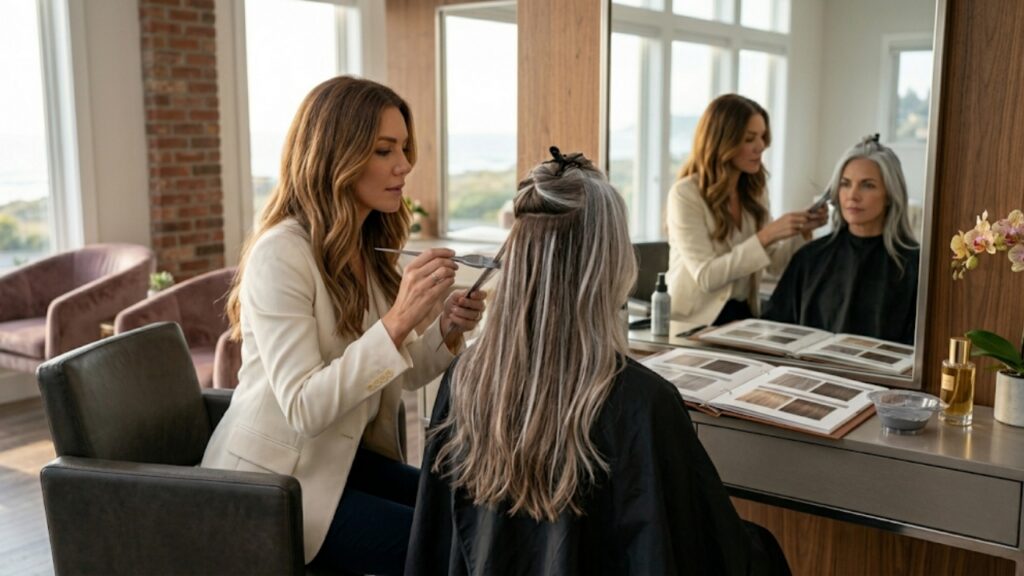
Weekly Deep Conditioning – Maintaining Hair Health Through Regular Processing
Grey coverage clients who receive permanent color every four to six weeks are subjecting their hair to regular chemical processing that creates ongoing moisture depletion and structural stress. In Jensen Beach’s environment – where UV exposure, salt water, and pool chemicals add additional structural and moisture stress on top of the chemical processing – maintaining adequate moisture and structural health through weekly deep conditioning is essential for keeping grey coverage hair looking genuinely beautiful rather than dry, flat, and over-processed.
The Moroccanoil Intense Hydrating Mask used weekly – ten to fifteen minutes on clean, damp hair – is one of the most effective and most consistently recommended deep conditioning options for Jensen Beach grey coverage clients. Its argan oil base provides deep moisture restoration while its cuticle-sealing effect maintains the smoothness and the shine that make grey coverage hair look its most beautiful.
K18 Home Treatment – Structural Maintenance Between Salon Appointments
For grey coverage clients, the structural maintenance provided by K18 leave-in molecular repair treatment used weekly at home extends the structural protection of in-salon K18 incorporation – rebuilding bonds that the color processing and Jensen Beach’s environmental stressors have broken between appointments.
The weekly K18 protocol: after shampooing and towel-drying, apply K18 leave-in throughout the hair and wait four minutes before styling. The K18 works as the styling foundation, requiring no rinse and adding no significant time to the morning routine. Over weeks and months of consistent use, the cumulative structural repair effect creates meaningfully healthier, stronger, and more beautiful hair than the same grey coverage maintenance without K18 would produce.
Swimming Protocols for Grey Coverage Hair in Jensen Beach
For Jensen Beach grey coverage clients who swim in the ocean or pool – which is most Jensen Beach clients to some degree – the specific swimming protocols that protect grey coverage color are among the most practically important home care guidance points.
Ocean swimming: Rinse with fresh water before entering the ocean to reduce salt water absorption. Apply Moroccanoil Treatment throughout the hair as a protective barrier. Rinse immediately and thoroughly with fresh water after swimming. Salt water accelerates grey coverage color fading by opening the cuticle and drawing color molecules from the hair – the protective protocol significantly reduces this effect.
Pool swimming: The chlorine in pool water is among the most aggressively color-stripping substances that grey coverage hair encounters in Jensen Beach’s lifestyle. The same fresh water rinse before entry, protective oil application, and immediate post-swim rinse protocol applies – followed by a chelating shampoo used weekly to remove chlorine and mineral buildup that regular shampoo does not fully address.
The Grey Embracing Option – When Coverage Is Not the Answer
The Growing Movement Toward Beautiful Grey – And When It Is the Right Choice
This guide is primarily about covering grey beautifully and with minimal hair damage – but it would be incomplete without an honest discussion of the alternative that a growing number of women in Jensen Beach and throughout the country are choosing: embracing the grey.
The grey embracing movement – sometimes called “going silver” or “silver liberation” – reflects a genuine cultural shift in how women of all ages are thinking about grey hair. The specific aesthetic of well-maintained, beautifully toned, genuinely luminous grey or silver hair is one of the most sophisticated and most contemporary of all hair aesthetics – and the women who have made peace with their grey and invested in making it as beautiful as possible are often among the most strikingly, the most distinctively beautiful-haired women in any room.
When grey embracing makes more sense than grey coverage:
For women with fifty percent or more grey whose coverage maintenance has become genuinely burdensome – monthly appointments, constant root management, the progressive structural damage of regular permanent color – the transition to embracing and enhancing the grey may be the most genuinely liberating hair decision available.
For women whose grey has a beautiful silver or white quality that is actually more striking than their natural pre-grey color – the transition to showcasing that quality rather than hiding it creates a genuinely more beautiful and more distinctive result than coverage.
For women whose hair’s structural health has been compromised by years of regular permanent grey coverage – who notice that their hair is dryer, more brittle, and less beautiful than it was before they started covering grey – a transition away from regular permanent color may be the most important step toward restoring the hair’s genuine health and beauty.
The grey transition at Parlay:
Transitioning from grey coverage to grey embracing is a process rather than a single appointment – and it is one that our specialists at Parlay approach with specific technique knowledge that makes the transition as graceful and as beautiful as possible rather than a difficult, awkward growing-out period.
The most effective grey transition approach uses highlights and balayage to distribute lightened sections through the colored lengths that blend the natural grey growing in with the existing color – creating the most seamless, the most naturally beautiful transition from covered grey to embraced grey. Rather than a sharp line of natural grey growing in against colored lengths, the highlighted transition creates a gradual, organic, genuinely beautiful evolution that reads as intentional rather than grow-out.
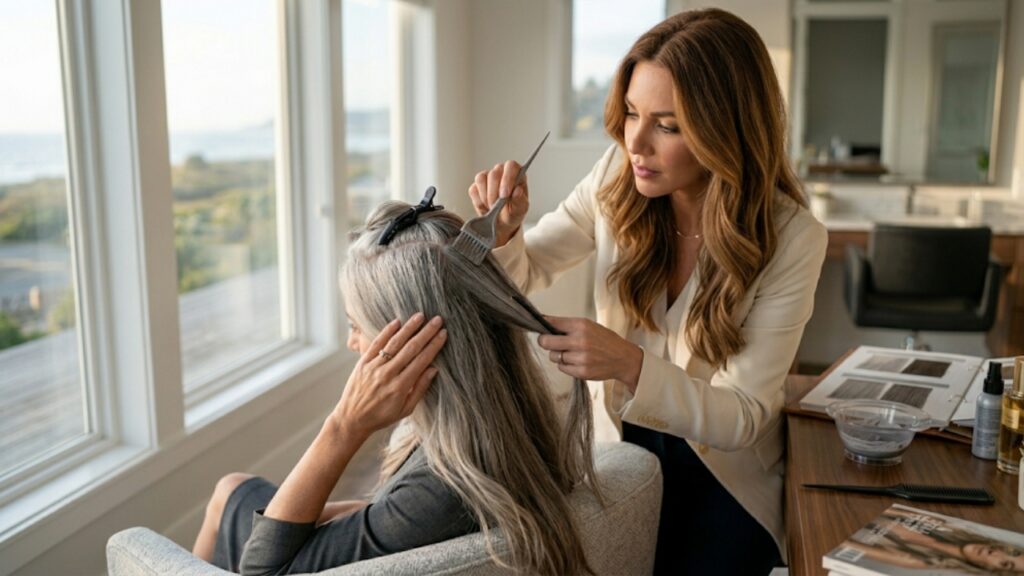
The Grey Coverage Consultation at Parlay – What to Expect
How Parlay’s Color Specialists Approach Grey Coverage Differently
At Parlay Hair and Beauty in Jensen Beach, every grey coverage consultation begins with a set of questions that most grey coverage appointments at other salons do not ask – because the most important decisions in grey coverage happen at the consultation rather than at the appointment.
The questions our specialists ask at a grey coverage consultation:
What percentage of your hair would you estimate is grey? The grey percentage is the most fundamental determinant of which approach is most appropriate – low grey responds well to toning and demi-permanent, high grey requires permanent coverage, moderate grey opens the widest range of options.
How long have you been covering your grey, and with what approach? The history of previous color affects the current state of the hair and the most appropriate next approach. Long-term permanent single-process coverage creates specific considerations about the hair’s condition that affect every subsequent decision.
How would you describe your current maintenance – is it manageable or does it feel burdensome? The maintenance tolerance question is as important as the coverage effectiveness question – the most coverage-effective approach that the client finds too demanding to maintain consistently is less valuable than a slightly less comprehensive approach that she can sustain comfortably.
What is your primary concern about your grey – the look of the grey itself, the way it photographs, the growth rate, or something else? Understanding the specific concern shapes the most targeted solution. The woman whose primary concern is the grey at the temples photographs differently than the woman whose primary concern is the overall dullness that grey has added.
What is the current condition of your hair? The hair’s structural condition directly affects which approaches are safe, which are appropriate, and which might need to be deferred while the hair’s health is restored first.
From these questions and a thorough visual assessment of the hair, Parlay’s color specialists develop the specific, individualized grey coverage plan – the approach that is most appropriate for this specific woman’s grey percentage, her hair’s health, her lifestyle in Jensen Beach, and her maintenance tolerance.
What Our Grey Coverage Clients Experience at Parlay
The consistent thread in our grey coverage clients’ feedback at Parlay is the specific satisfaction of finding an approach that feels genuinely right rather than one that was applied generically.
“Ashley is the best! Whether I’m getting a balayage, highlights, or a haircut, she always does an amazing job and I leave with my hair looking and feeling great. Wouldn’t go anywhere else for my hair!” – Kaite, Google Review
“Loved Ashley and her coloring was amazing. First time in 30 years I let someone else color and cut my hair. Couldn’t be more pleased!” – Deborah B., Google Review
“Savannah listens and offers realistic feedback! She took inspiration from my photos, and I feel very pretty in my new hair!” – Becky, Google Review
“Savannah has been my hair stylist for 2+ years now and when she started at Parlay, I followed her there! She and her team are extremely talented and offer so many services that meet every expectation and want!” – Dylan Page, Google Review
Frequently Asked Questions – Grey Coverage Without Damage
The Questions Jensen Beach Women Ask Most Often About Hair-Healthy Grey Coverage
Can grey hair be covered without damage? Complete damage elimination from any grey coverage that uses permanent color chemistry is not realistic – permanent color by definition creates some structural modification. What is realistic and genuinely achievable is meaningful damage reduction – through the lowest effective developer volume, the avoidance of unnecessary length and end processing, K18 bond repair incorporation, and the selection of demi-permanent or semi-permanent formulas where they are sufficient for the grey percentage being addressed. Grey coverage at Parlay is approached with every one of these damage-reducing principles applied consistently.
How often should I get grey coverage touch-ups? The appropriate interval depends entirely on the specific approach used. Single-process permanent coverage typically requires touch-ups every four to six weeks. Dimensional grey blending with highlights or balayage typically extends to eight to twelve weeks. Demi-permanent grey softening typically needs refreshing every six to eight weeks. Toning treatments typically need refreshing every four to six weeks as a lighter maintenance service. The most hair-health-appropriate approach for Jensen Beach grey coverage maintenance is the one with the longest interval that still achieves a satisfying result – minimizing the frequency of chemical processing while maintaining beautiful results.
Is box dye damaging for grey coverage? Yes – significantly more so than professional grey coverage with appropriate formulas and developer selection. Box dye creates the specific damage profile described earlier in this guide – higher developer volumes, metallic salt content, repeated root-to-end application, and no individual calibration for hair type or condition. The transition from box dye to professional grey coverage at Parlay is one of the most immediately and most consistently beneficial color transitions available.
How do I know if my grey coverage is damaging my hair? The most reliable indicators of progressive damage from grey coverage are: hair that feels progressively drier and more brittle than it did before starting coverage, hair that has lost elasticity – stretching too far and not returning when wet, hair that is experiencing more breakage than before coverage, and hair that has become progressively harder to style and manage despite using more products. If you are noticing any of these signs, a consultation at Parlay is the appropriate next step – to assess the current condition and develop the most appropriate restoration and maintenance approach.
Can I cover grey naturally with henna or other natural dyes? Henna and other plant-based dyes provide some degree of grey coverage for some hair types – though the coverage is typically partial rather than complete and the color range is limited. The more important consideration is the interaction between henna and professional color: henna deposits metallic compounds on the hair that can react unpredictably and potentially dangerously with professional color chemistry. If you have used henna, please tell your Parlay specialist before any professional color service – this information directly affects the safety of the service.
How much does grey coverage cost at Parlay? Grey coverage pricing at Parlay varies based on the specific approach used – from the most accessible toning and gloss services to comprehensive dimensional grey blending with highlights. Pricing is always discussed and confirmed at the consultation before any service begins – and our specialists always recommend the approach that is most appropriate for your hair and your goals rather than the most expensive option available. Call (772) 261-8116 for a specific quote or to schedule a consultation.
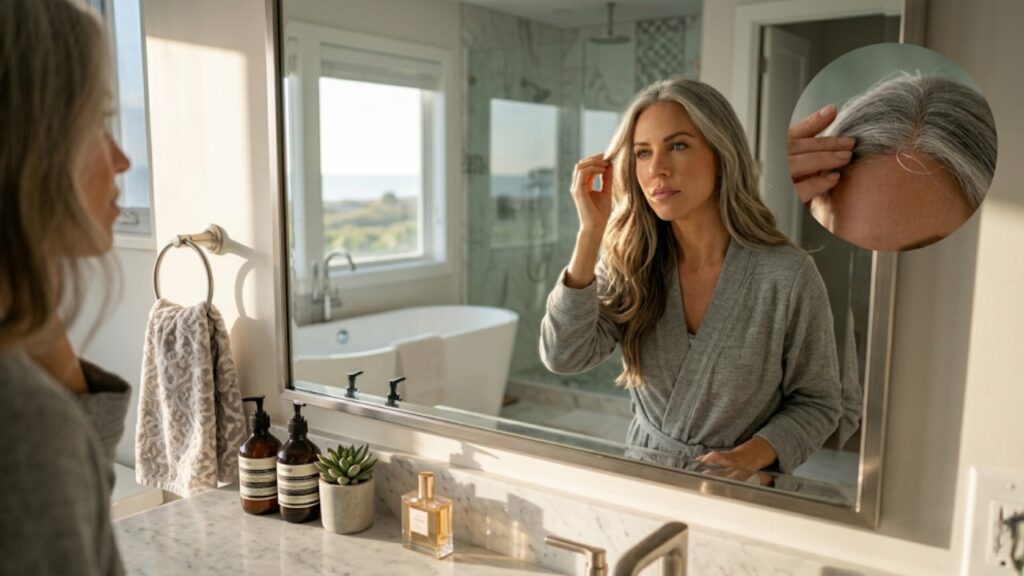
Conclusion: Grey Coverage That Is Beautiful, Natural-Looking, and Kind to Your Hair – It Exists
The most important thing to take away from this guide is that the choice between covering grey and having healthy hair is not the binary choice that conventional grey coverage approaches have made it seem. It is possible – with the right approach, the right products, the right techniques, and the right specialist – to cover grey in a way that looks genuinely natural, that maintains the hair’s structural health through years of regular maintenance, and that fits comfortably into Jensen Beach’s active, outdoor lifestyle without demanding a maintenance schedule that competes with everything else that makes life on the Treasure Coast so extraordinary.
At Parlay Hair and Beauty in Jensen Beach, Florida, every grey coverage consultation is an opportunity to find the specific approach that serves each individual woman’s grey, her hair’s health, and her life most genuinely well. Not the conventional approach. Not the most coverage-intensive approach. The most appropriate, the most beautiful, and the most hair-healthy approach for the specific person sitting in the chair.
Come see us. Bring your questions, your concerns, your history, and your vision. And let us show you what grey coverage looks like when it is done with genuine expertise and genuine care for the health of the hair it is transforming.
📍 2250 NE Dixie Hwy, Jensen Beach, FL 34957
📞 Call or Text: (772) 261-8116
🌐 Book Online: parlayhairandbeauty.com
⏰ Online Booking Available 24/7 via Vagaro
Parlay Hair and Beauty – Jensen Beach’s most trusted color salon. Grey coverage, grey blending, balayage, highlights, and complete hair color by expert color specialists. Serving Jensen Beach, Stuart, Palm City, Hobe Sound, Hutchinson Island, Port St. Lucie, and all of Martin County, Florida.