
The Complete, Honest Guide to the Daily Habits That Are Quietly Damaging Your Hair – And Exactly What to Do Instead – From the Hair Care Specialists at Parlay Hair and Beauty, Jensen Beach, Florida
The Damage That Happens Before You Even Leave the House
The most significant hair damage most women experience does not happen at the salon. It does not happen during a dramatic chemical transformation or an experimental color decision or a regrettable at-home bleaching attempt at eleven o’clock at night.
It happens in the bathroom. Every morning. Before the day has fully started.
It happens in the ten minutes between the shower and the front door – the routine that has been repeated so many times it has become completely automatic, executed without conscious attention, accepted as simply the way hair care works because it is the way hair care has always been done. The towel that goes on the head the moment the shower ends. The brush that goes through the wet hair immediately after. The heat tool that makes contact with hair that has not been protected. The elastic that gets twisted one more time because the ponytail is not quite right.
Each of these individual actions feels entirely benign in isolation. Each of them, repeated every single day for weeks and months and years, creates a specific, cumulative, entirely preventable pattern of damage that manifests as the dullness, the breakage, the frizz, the flatness, and the general sense that the hair is not living up to its potential that most women accept as simply the reality of their hair – not recognizing that it is actually the result of their routine.
At Parlay Hair and Beauty in Jensen Beach, Florida, our specialists see the results of these daily mistakes constantly – in the condition of the hair that comes through our door, in the specific patterns of damage that appear consistently across clients whose hair care histories are otherwise completely different, and in the genuinely dramatic improvement that follows when clients understand what is causing the damage and commit to changing the specific habits responsible.
This guide is the complete, honest, practically useful account of the biggest hair care mistakes women make every day – the specific habits that are quietly working against the hair’s health and beauty, the specific mechanism by which each one creates its damage, and the specific alternative that creates the better outcome. Written for Jensen Beach women specifically, because the combination of Florida’s UV radiation, subtropical humidity, salt water, and pool culture adds specific dimensions to each of these mistakes that make them more consequential here than in most other communities.
The Washing Mistakes
Mistake One – Washing Hair Too Frequently
The most deeply ingrained hair care misconception in most women’s daily routine is that clean hair requires daily washing – that the presence of any oiliness at the scalp is a problem to be immediately resolved, that anything less than freshly washed hair is somehow unacceptably dirty, and that the solution to almost any hair concern is another wash.
This misconception creates one of the most consistently and most cumulatively damaging daily hair care habits available – because washing the hair strips the scalp’s natural sebum (the oil produced by the sebaceous glands that moisturizes and protects the hair shaft) with every single wash. When the scalp is stripped daily, it responds by overproducing sebum to compensate – creating the cycle where the hair that is washed daily gets oily faster with each passing week, seeming to require daily washing to maintain any appearance of cleanliness while becoming progressively oilier and more dependent on that daily washing than it would have been with a more appropriate washing frequency.
For Jensen Beach women specifically, the daily washing habit is particularly damaging because Jensen Beach’s water is hard water – the mineral content of the municipal supply creating mineral deposits on the hair with every single wash that accumulate into the dull, cuticle-coating layer that is one of the most consistent causes of dull, lifeless hair in this community. Every additional unnecessary wash is an additional layer of mineral deposit and an additional stripping of natural protective oils.
The solution:
Extend the washing interval gradually – from daily to every other day, then to every two to three days as the scalp adjusts its sebum production to the new schedule. Use dry shampoo on non-wash days to manage any scalp oiliness at the root. Within four to six weeks of consistent extended-interval washing, most scalps genuinely reduce their sebum overproduction – the hair staying genuinely cleaner between washes rather than requiring daily intervention to manage the excess oil that daily washing created.
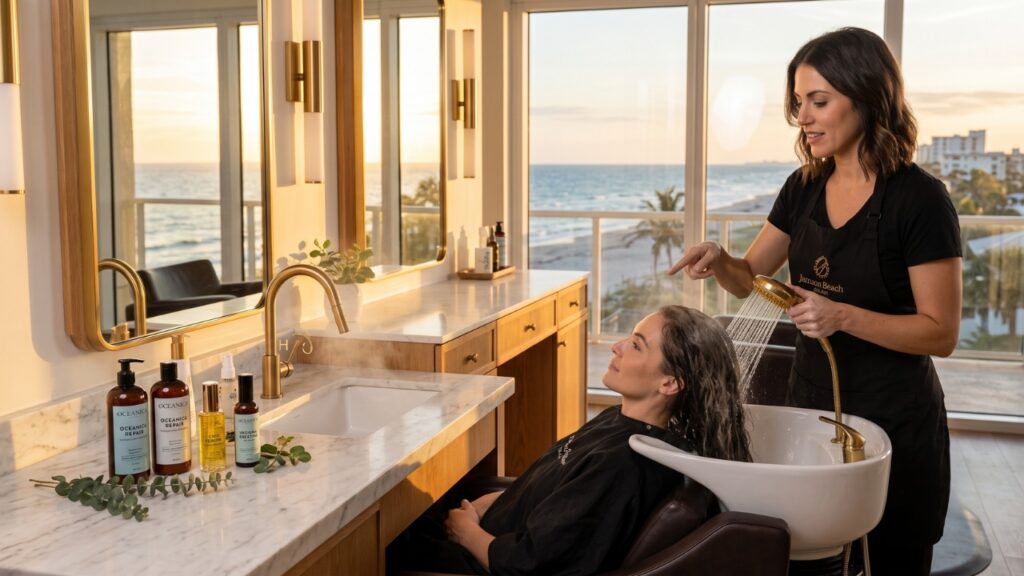
Mistake Two – Using Water That Is Too Hot
Hot water is one of the most universally used and the most universally underestimated sources of daily hair damage – because the damage it creates is invisible and gradual rather than immediate and dramatic, and because the comfort of a hot shower is one of the morning experiences most women are reluctant to compromise even when they understand the hair cost.
The mechanism is direct: hot water opens the hair’s cuticle – the overlapping scale-like cells that form the hair shaft’s protective outer layer – more aggressively than warm or cool water. An open cuticle is simultaneously more vulnerable to mechanical damage during washing and conditioning, more susceptible to losing the color molecules and conditioning agents that have been deposited within it, and less capable of reflecting light – creating the dullness that is the most visible daily consequence of consistent hot water washing.
For color-treated Jensen Beach clients – the significant proportion of Parlay’s client base whose balayage, highlights, or color represents a meaningful investment in both time and money – hot water washing is the single most damaging daily habit for color longevity. Hot water opens the cuticle and releases color molecules with every wash, creating the fading that most clients attribute to their shampoo or to the color service itself when it is actually a hot water problem.
The solution:
Wash with warm rather than hot water – cool enough to be comfortable rather than hot enough to create steam. Finish every wash with a cool water rinse specifically – the cool temperature actively sealing the cuticle at the end of the wash, locking in the conditioning agents that have been applied and maximizing both the shine and the color retention of every wash. This single finish-with-cool-water change creates measurable improvement in shine and color longevity within weeks of consistent practice.
Mistake Three – Using the Wrong Shampoo for the Hair Type and Color History
The shampoo aisle in any beauty retailer contains dozens of options – and the selection most women make from this array is rarely based on specific, accurate knowledge of which formula is most appropriate for their specific hair type, their specific color history, and their specific scalp’s needs. It is more often based on packaging, price, fragrance, or habit – the same shampoo used for years because it has always been used, regardless of whether the hair’s needs have changed significantly since the choice was first made.
The most consequential wrong shampoo choice for Jensen Beach’s color-treated community is the sulfate-containing shampoo used on professionally colored or highlighted hair. Sulfates – the aggressive cleansing agents that create the lather that most consumers associate with effective cleansing – strip color molecules from the hair shaft with every wash, creating the color fade that clients often attribute to the color service when it is actually a shampoo choice problem. A sulfate-free, color-protecting shampoo used consistently can extend the life of a professional color result by weeks – and in Jensen Beach’s UV-intensive environment, where the color is already being challenged by sun exposure, the additional protection of a sulfate-free formula is genuinely significant.
The second most consequential wrong shampoo choice is the heavy, highly conditioning shampoo used on fine hair – the formula whose density adds the weight that fine hair cannot afford and whose conditioning agents in the shampoo step create the buildup that makes fine hair progressively more limp, more flat, and more resistant to volume with every wash.
The solution:
At every Parlay appointment, our specialists recommend the specific shampoo formula most appropriate for each client’s specific hair type, color history, and Jensen Beach lifestyle – a recommendation that reflects genuine professional knowledge of which formulas perform most effectively for which specific situations rather than a generic suggestion that applies to any hair equally.
Mistake Four – Skipping Conditioner on Fine Hair
The fear of conditioner adding weight to fine hair is one of the most understandable and the most counterproductive of all hair care concerns – understandable because heavy, poorly formulated conditioner genuinely does weigh fine hair down, counterproductive because the response of skipping conditioner entirely leaves fine hair in the cuticle-open, rough-surfaced, more-vulnerable-to-damage state that the wrong conditioner creates without the temporary weight problem.
Fine hair without conditioner is fine hair with an unprotected cuticle – more susceptible to the mechanical damage of combing and styling, more susceptible to the environmental damage of Jensen Beach’s UV and water exposure, and more prone to the static and frizz that dry, unprotected fine hair develops in Jensen Beach’s humidity. The solution to conditioner adding weight is not eliminating conditioner – it is finding the right conditioner for fine hair and applying it correctly.
The solution:
A lightweight, fine-hair-appropriate conditioner – specifically formulated without the heavy silicones and occlusive agents that weigh fine hair down – provides the cuticle protection and the shine enhancement that conditioner is supposed to provide without the weight that wrong-formula conditioner creates. Apply conditioner only to the mid-lengths and ends of fine hair – avoiding the root section where conditioner adds the most undesirable weight – and rinse thoroughly. The combination of the right formula and the correct application technique creates conditioning without weight.
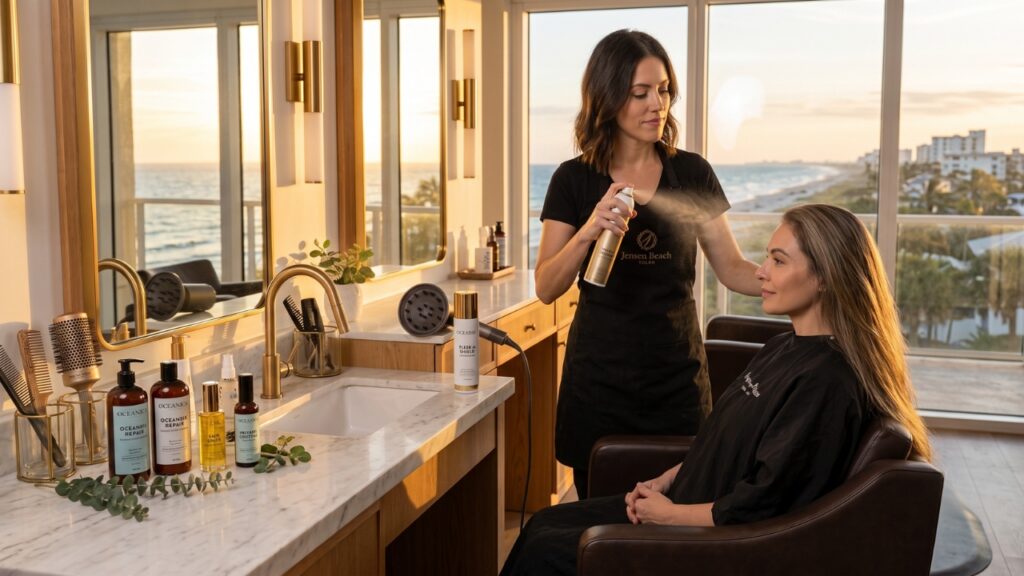
The Drying Mistakes
Mistake Five – Rough Towel Drying
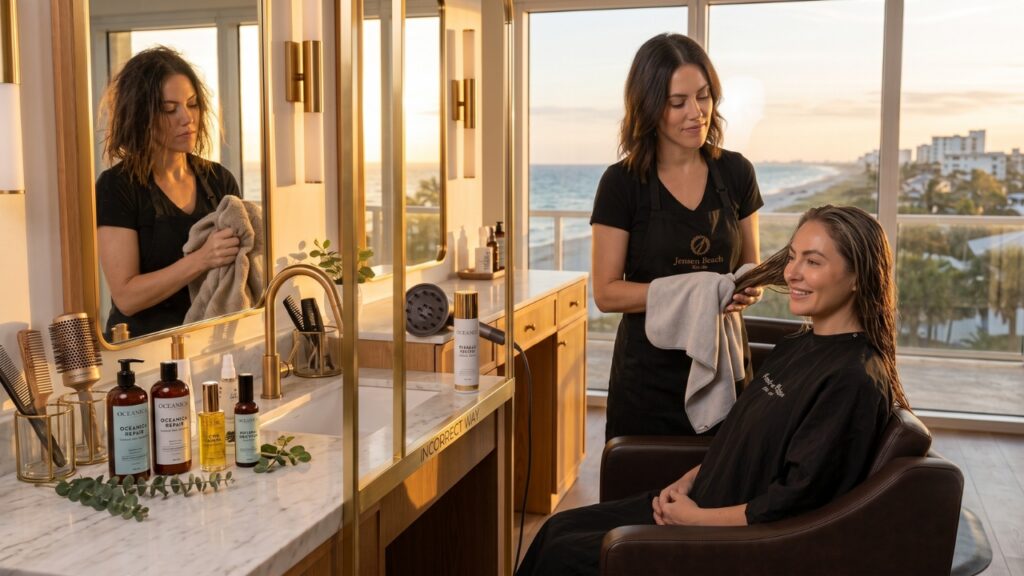
This is the most universally practiced and the most immediately damaging of all the daily hair care mistakes – the habit of vigorously rubbing the wet hair with a regular bath towel the moment the shower ends, treating the most vulnerable state the hair is ever in with the most mechanically aggressive tool regularly applied to it.
Wet hair is significantly more fragile than dry hair – the water that has penetrated the shaft swells the hair, softens the cuticle scales, and creates a state of vulnerability where the hydrogen bonds that maintain the hair’s normal structure are temporarily dissolved. In this vulnerable state, the mechanical friction of a rough terry cloth towel rubbing across the cuticle creates massive cuticle disruption – lifting and breaking cuticle scales, creating the micro-tears along the shaft that manifest as frizz, dullness, and long-term structural weakness.
For Jensen Beach women with color-treated hair, the rough towel dry is particularly costly – the friction that disrupts the already-sensitized post-color cuticle and the color molecules sitting within it contributing meaningfully to the color fade and dullness that follows color appointments faster than it should.
The solution:
Replace the rough towel with a microfiber towel or a soft cotton T-shirt for post-wash hair drying. Squeeze excess water from the hair gently – pressing sections of hair between the microfiber and releasing, rather than rubbing – before wrapping loosely to absorb remaining moisture. The microfiber’s smooth surface creates friction that is dramatically lower than terry cloth, protecting the cuticle during the most vulnerable drying stage and creating meaningfully less frizz, less breakage, and less dullness from the drying process alone.
Mistake Six – Brushing Wet Hair Immediately After Washing
Closely related to the towel-drying mistake – and equally universally practiced – is the habit of immediately brushing or combing the wet hair after washing, using a regular brush or fine-tooth comb that is not appropriate for the wet hair’s specific fragility.
Wet hair stretches significantly more than dry hair before breaking – its elasticity is temporarily increased by the water’s softening effect, but this elasticity has a limit. When a wet hair strand is stretched past that limit by the force of a brush or comb moving through tangles, it breaks rather than untangling – creating the breakage that accumulates in the brush as the most visible evidence of this daily mistake.
For Jensen Beach’s curly-haired clients specifically, brushing wet hair with the wrong tool is one of the most consistently frizz-creating practices available – the brush physically disrupting the curl pattern that wet hair is in the process of forming, creating the undefined, frizzy result that settles in as the hair dries rather than the defined, organized curl that careful wet-hair detangling preserves. Our curly hair cut clients at Parlay consistently benefit from specific guidance about wet hair detangling technique as part of the haircut consultation.
The solution:
Detangle wet hair with a wide-tooth comb or a wet-specific detangling brush – tools designed for the wet hair’s specific fragility. Work from the ends upward toward the root rather than from the root downward – untangling the lower sections first before working upward, which prevents the tangling of the root section from being dragged through the entire length. Apply a leave-in conditioner or a detangling product before combing if the hair tends to tangle significantly when wet.
Mistake Seven – Applying Heat Without Protection
Heat protectant is the most universally recommended and the most universally under-used product in the hair care toolkit – recommended by every hair professional at every appointment and ignored or forgotten by a significant proportion of the clients who receive the recommendation, because the consequences of missing a single heat-protectant application are not immediately visible enough to reinforce the habit.
The cumulative consequences, however, are very visible – and they are among the most consistently, most dramatically damaging of all the daily hair care mistakes. Heat tools – blowdryers, flat irons, curling irons – create temperatures between three hundred and four hundred-plus degrees Fahrenheit at the hair surface. At these temperatures, unprotected hair protein denatures – the keratin structure permanently changing in ways that manifest as the porous, rough, light-scattering surface of heat-damaged hair. The specific appearance: dullness, increased frizz, decreased elasticity, and the white or translucent appearance of heat-damaged cuticle bubbling that is one of the most severe expressions of accumulated heat damage.
In Jensen Beach’s climate, where the humidity that creates frizz drives most women toward heat styling more frequently than they would need to in a less humid environment, the heat damage accumulation happens faster than in drier climates – making consistent heat protectant use more important here than in most other communities.
The solution:
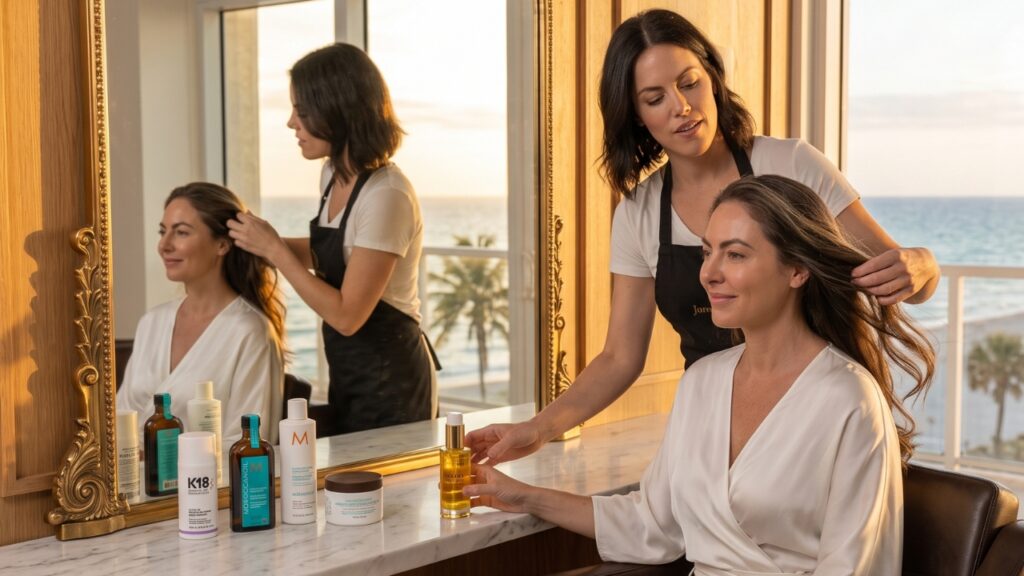
Apply a professional heat protectant throughout every section of the hair before any heat tool makes contact – not just the sections that will be directly styled but the entire head, since even incidental heat tool contact on unprotected sections creates damage. Moroccanoil Treatment applied to damp hair before blowdrying provides both heat protection and the cuticle-sealing shine enhancement that makes the blowout result more luminous – making it one of the most multifunctionally valuable pre-heat styling products available for Jensen Beach’s daily routine.
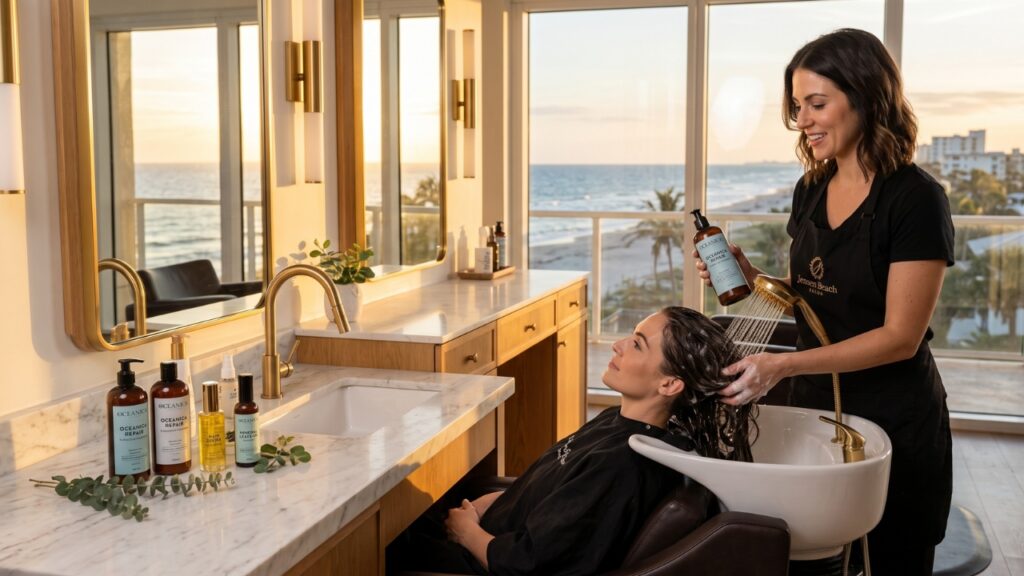
Mistake Eight – Using Heat Tools on the Highest Setting
Even women who use heat protectant consistently frequently make the companion mistake of using their heat tools at the highest available temperature setting – the assumption being that higher heat means faster styling, and faster styling means less total heat exposure. This logic is incorrect in the way that matters most: total heat exposure is less damaging than excessive heat concentration, and a lower temperature applied for a longer time creates less protein denaturation than a higher temperature applied briefly.
Professional hair stylists use the lowest effective temperature for each hair type – fine, fragile hair requiring the lowest settings and the most gentle approach, coarser, more resilient hair tolerating somewhat higher temperatures without the same degree of damage. Most consumer heat tools are set far higher than any professional would use on the same hair type – the maximum settings on retail flat irons frequently exceeding four hundred degrees, temperatures that are appropriate for no consumer hair type and that create meaningful protein denaturation with every single pass.
The solution:
Use the lowest heat setting that achieves the desired styling result. For fine hair, settings between two hundred and two hundred fifty degrees are appropriate. For medium hair, two hundred fifty to three hundred degrees. For thick or coarse hair, three hundred to three hundred twenty-five degrees maximum. A professional blowout at Parlay demonstrates the professional approach to heat styling temperature management – the specific settings and the specific techniques that achieve beautiful results with the minimum effective heat exposure.
Part Three: The Styling Mistakes
Mistake Nine – Tight Elastics and Damaging Hair Accessories
The elastic hair tie is the most consistently used and the most consistently damaging hair accessory in most women’s daily routine – not because elastic hair ties are inherently problematic but because the specific type most commonly used creates a specific, predictable pattern of mechanical damage at the precise point where the elastic contacts the hair.
Regular rubber or synthetic elastic hair ties create a combination of friction and tension at the contact point that breaks hair strands with every removal – the snapping of the elastic against the hair shaft creating immediate visible breakage and the prolonged tension of wearing the hair up creating the cumulative weakening that manifests as the halo of shorter, broken hairs that frame the face of women who wear tight ponytails or buns daily.
Tight styles – the very tight ponytail, the very tight bun, the very tight braid – add the tension component to the friction damage, creating traction on the hair follicle itself that can, over time, contribute to traction alopecia – the hairline thinning that results from sustained follicle tension and that is one of the more serious long-term consequences of consistently tight styling.
The solution:
Replace regular elastic hair ties with fabric-covered elastics, silk scrunchies, or spiral hair ties – all of which create significantly less friction and significantly less mechanical damage at the contact point. Vary the position of ponytails and buns rather than always wearing them at the same point – distributing the tension across different sections of the hair rather than always concentrating it at a single point. Wear styles loosely rather than extremely tightly – the style that holds without pulling is better for the hair and the follicle than the style pulled as tightly as possible for maximum hold.
Mistake Ten – Over-Brushing Dry Hair
The hundred-strokes-per-day brushing advice that circulated as grooming wisdom for generations has been thoroughly disproven – and yet the cultural residue of this advice persists in the form of excessive brushing that is one of the most consistent sources of mechanical hair damage in daily routines.
Brushing dry hair distributes the scalp’s natural oils from root to length – a genuinely beneficial effect when done moderately. But excessive brushing creates cumulative mechanical damage to the cuticle – each brush stroke creating friction along the hair shaft, lifting and roughening cuticle scales, and contributing to the dullness, the frizz, and the breakage that most women attribute to other causes while continuing the over-brushing that is creating them.
For Jensen Beach women with color-treated hair, over-brushing is particularly costly – the repeated friction of excess brushing accelerating the cuticle damage that leads to color fade and dullness, and contributing to the breakage that shortens the lifespan of professionally colored and treated hair.
The solution:
Brush only as much as necessary for styling – typically one to two passes through each section to detangle and smooth, not dozens of strokes for an abstract idea of benefit. Use a quality brush appropriate for the hair type – a boar-bristle brush for fine to medium hair that benefits from oil distribution, a paddle brush for detangling longer hair, a wide-tooth comb for curly hair that should not be brushed at all when dry. Hold the hair at the mid-length with one hand while brushing the lower sections – reducing the tension on the root and the follicle during the brushing process.
Mistake Eleven – Sleeping on Cotton Pillowcases
Eight hours of friction against a rough cotton pillowcase is one of the most consistent and the most completely unaddressed sources of daily hair damage – because it happens while the woman is asleep and therefore creates no immediate, consciously experienced evidence of its damage. The evidence appears in the morning: the frizz, the tangles, the roughened cuticle quality that requires styling effort to address – attributed to “how the hair slept” rather than to the specific, preventable friction of eight hours against rough cotton.
Cotton’s fiber structure creates significant friction against the hair’s cuticle – lifting and roughening the scales during the hours of movement during sleep and creating the roughened, frizz-prone surface that is the morning’s starting point. For Jensen Beach women with color-treated hair, this nightly friction is an additional cuticle-disruption factor that contributes to color fade and dullness alongside the daytime environmental challenges of UV, salt water, and humidity.
The solution:
Replace cotton pillowcases with silk or satin pillowcases – the smooth fiber surface creating dramatically less friction against the hair’s cuticle during sleep. The silk pillowcase is the single most impactful sleep-related hair care change available – creating a genuinely measurable reduction in morning frizz, cuticle roughness, and the tangling that rough cotton generates. A silk pillowcase also benefits the skin for the same smooth-surface-less-friction reason – making it one of the most multifunctionally valuable bedroom upgrades available.
Alternatively, wearing the hair in a loose, low bun or braid secured with a silk scrunchie during sleep protects the hair by containing it – reducing the surface area exposed to the pillowcase’s friction during the night.

Mistake Twelve – Using the Wrong Brush for the Hair Type
Not all brushes are appropriate for all hair types – and using the wrong brush for a specific hair type creates specific, predictable damage patterns that the right brush for the same type would not create.
The most common wrong-brush mistake is using a fine-tooth or paddle brush on naturally curly or wavy hair – tools that physically disrupt the curl or wave pattern, creating the puffiness, the frizz, and the undefined quality that is the enemy of genuinely beautiful natural curl or wave. For Jensen Beach’s naturally curly-haired clients – whose curls interact with the community’s coastal humidity in ways that can be either beautiful or frustrating depending entirely on how they are managed – using the wrong brush is one of the most immediately and most dramatically frizz-creating daily practices available. A curly hair cut consultation at Parlay always includes specific guidance about the right tools for the specific curl type.
The second most common wrong-brush mistake is using a boar-bristle brush on thick, coarse, or tightly textured hair – the soft boar bristles creating insufficient detangling for the hair’s density and breaking in the process rather than effectively moving through the hair.
The solution:
Match the brush to the hair type with the same specificity that other product choices deserve. Wide-tooth combs and finger detangling for curly and wavy hair. Paddle brushes for detangling straight and wavy hair. Boar-bristle or mixed-bristle brushes for smoothing and shine-enhancing fine to medium straight hair. Denman brushes for defining and setting curly patterns. At Parlay, every haircut consultation includes a specific tool recommendation – because the haircut and the tool need to work together as a system to produce the most beautiful daily result.
The Product Mistakes
Mistake Thirteen – Applying Products to the Roots on Fine Hair
This is the mistake that is most directly, most immediately responsible for the flat, heavy, volume-resistant quality that fine-haired women spend their mornings fighting – and it is a mistake that happens without conscious awareness in most cases, because the product application habit that most people use (applying from root to end as a default) is the exact opposite of what fine hair requires.
Heavy products at the fine hair root – whether conditioning agents from shampoo or conditioner, styling products from creams or serums, or treatments that are applied without attention to root-versus-length distinction – add weight at the most volume-critical point of fine hair. The root section of fine hair is where volume either exists or does not, and products that add weight there defeat the lifting that the right layered haircut or the right women’s haircut is trying to create.
The solution:
Establish a clear root-versus-length distinction in every product application. Conditioner: lengths and ends only. Styling creams and serums: lengths and ends only. Root spray and volumizing spray: roots only, specifically and intentionally targeted. This deliberate sectioning of product application creates the conditions for maximum root volume while still providing the conditioning and styling benefits that the lengths require.
Mistake Fourteen – Using Too Many Products Simultaneously
The hair care product market offers an ever-expanding range of products for every possible specific concern – and the natural response to having multiple concerns simultaneously is to use multiple products simultaneously. The result is almost always product overload – the combination of multiple products creating the buildup, the weight, and the dulling coating that makes the hair look worse than any of the individual concerns the products were trying to address.
This product overload problem is particularly acute in Jensen Beach’s environment, where the humidity creates frizz, the UV creates dullness, the salt water creates dryness, and the pool chemicals create their own specific concerns – creating the temptation to use a separate product for each concern simultaneously. The frizz-control serum plus the UV protectant plus the volumizing spray plus the anti-humidity spray plus the shine serum creates a layered product coating that weighs down and dulls the hair more significantly than any of the individual concerns it was intended to address.
The solution:
Choose multifunctional products that address multiple concerns simultaneously rather than single-function products that require layering. Moroccanoil Treatment is the best example of the multifunctional approach for Jensen Beach’s specific concerns – providing frizz control, UV protection, cuticle-sealing shine, and heat protection in a single, lightweight product rather than requiring a separate product for each benefit. A 30-minute salon service for healthier hair consultation at Parlay is one of the most efficient ways to simplify an overcomplicated product routine with professional guidance.
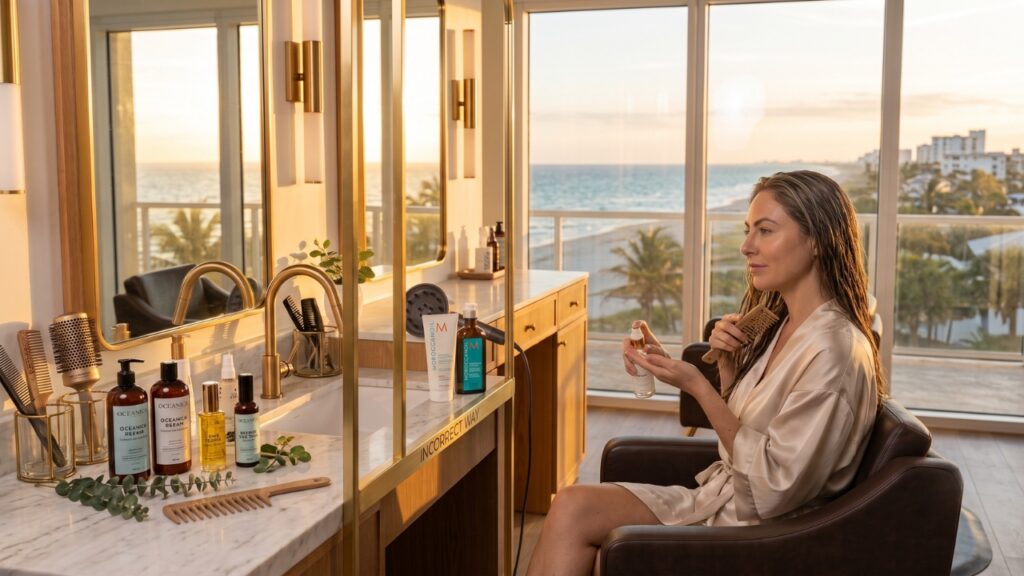
Mistake Fifteen – Ignoring Scalp Health
The scalp is the foundation from which every hair strand grows – and a scalp that is not healthy, not properly balanced in moisture and oil, and not effectively maintained produces hair that starts its life compromised before any external damage has even had the opportunity to affect it. Despite this fundamental relationship between scalp health and hair health, scalp care is the most consistently overlooked element of most women’s daily hair care routine.
The specific scalp concerns that most affect hair quality in Jensen Beach’s environment: scalp dryness from UV exposure and from the salt water and pool chemicals that strip the scalp’s natural oil balance; product buildup at the scalp from dry shampoos and styling products that are not thoroughly removed at each wash; and the humidity-related scalp concerns that Jensen Beach’s subtropical climate creates year-round.
The solution:
Include a deliberate scalp care step in the routine – whether a weekly scalp massage with a few drops of hair oil (stimulating circulation and distributing natural oils), a monthly scalp-focused clarifying treatment that removes buildup from the scalp surface without stripping the hair’s moisture, or a professional scalp treatment at Parlay that addresses specific scalp concerns with professional-grade products and techniques. The deep conditioning treatment at Parlay includes a scalp assessment and targeted scalp conditioning that is one of the most impactful single-appointment scalp health improvements available.
The Salon Appointment Mistakes
Mistake Sixteen – Waiting Too Long Between Appointments
This mistake sits at the intersection of the daily routine and the professional care calendar – and it is among the most common and the most cumulatively damaging of all the habits described in this guide. The logic that waiting longer between appointments preserves length is one of the most persistent and the most completely counterproductive beliefs in all of hair care, because the damage that accumulates between delayed appointments almost always requires more removal to address than regular maintenance would have.
Hair ends that have not been professionally trimmed for four, six, eight months accumulate the split ends, the UV damage, the mechanical wear, and the environmental stress of Jensen Beach’s climate into a level of damage at the perimeter that requires significant removal to restore healthy hair. The client who waited eight months to preserve length frequently leaves the appointment having lost more length than she would have lost with four regular trims over the same period – and has spent those eight months with progressively worse-looking hair.
Our complete guide on knowing when it’s time for a new haircut covers the specific signals that indicate a professional appointment is needed – a useful companion to this guide for establishing the most appropriate professional maintenance calendar for each individual’s hair type and style.
The solution:
Establish and maintain the appropriate professional appointment interval for the specific haircut and hair type – every four to six weeks for short styles like bob haircuts, every six to eight weeks for medium layered haircuts, every eight to twelve weeks for longer styles. Pre-book every appointment before leaving Parlay – the appointment already on the calendar is the appointment that gets kept.
Mistake Seventeen – Not Communicating Concerns at Appointments
This mistake is the professional appointment equivalent of the daily routine oversight – and its consequences are similarly avoidable with simply more deliberate, more honest communication. Many women arrive at their Parlay appointment with a specific concern – the hair that has been behaving differently since a recent color appointment, the increased shedding that has been worrying them, the scalp irritation that has developed, the chemical history they forgot to mention at the last consultation – and do not mention it. Not because they do not want to. Because the appointment begins and the conversation moves forward and the specific concern gets left behind.
The specialist who is not told about a concern cannot address it – regardless of how skilled and how attentive they are. The color history that is not disclosed affects the safety of the planned service. The scalp concern that is not mentioned remains unexamined. The hair behavior change that is not communicated remains unexplained.
The solution:
Before every appointment, take one minute to mentally review any hair concerns, any product or routine changes, any chemical history updates, and any changes in the hair’s behavior or the scalp’s condition since the last visit. Voice every one of these things at the beginning of the consultation – before the styling begins. Our specialists at Parlay genuinely want this information, specifically because it makes every service we provide more precisely appropriate for each client’s actual current needs.
The Jensen Beach-Specific Daily Mistakes
Mistake Eighteen – Going Into the Ocean or Pool Without Hair Protection
For Jensen Beach’s active, water-centric lifestyle, unprotected ocean and pool swimming is one of the most consistently damaging daily habits available – and one that is performed most consistently without adequate protective measures by women who understand in principle that salt water and chlorine are not good for their hair but have not established the specific protective routine that makes regular swimming compatible with genuinely beautiful, healthy hair.
The salt water mechanism: the ocean’s salt creates an osmotic effect that draws moisture from the hair shaft, opens the cuticle, and deposits mineral compounds on the surface. The pool chlorine mechanism: chlorine oxidizes the hair’s proteins, strips color molecules, and contributes to the cuticle damage that creates dullness and breakage. Both mechanisms, applied repeatedly without protection, create the specific, cumulative hair deterioration that Jensen Beach’s most active ocean and pool swimmers experience most consistently.
The solution:
Apply the complete pre-swim protection protocol before every ocean or pool session – fresh water rinse to saturate the hair before salt or chlorine contact, Moroccanoil Treatment or a protective oil applied throughout as a barrier, and a loose braid or bun to minimize the surface area exposed to the water. Rinse immediately and thoroughly with fresh water after every swim – before the salt or chlorine dries and concentrates on the hair shaft. A monthly chelating shampoo removes accumulated mineral and chemical deposits that regular shampooing cannot address. Our detailed guide on why waxing is perfect for beach life in Jensen Beach covers the full Jensen Beach outdoor lifestyle context – and the same understanding of lifestyle-compatible beauty care applies equally to hair.
Mistake Nineteen – Going Outdoors Without UV Hair Protection
This mistake is the most universally practiced of all the Jensen Beach-specific mistakes – because the cultural understanding of UV protection for skin is well established (most Jensen Beach women apply sunscreen to their skin consistently) while the same understanding of UV protection for hair remains significantly less developed.
Hair is damaged by UV radiation through the same photo-oxidation mechanism that damages skin – the UV energy breaking down the hair’s keratin proteins, degrading the cuticle, fading color, and creating the dullness and the structural compromise that are the hair equivalents of UV-damaged skin. In Jensen Beach’s UV environment – among the most intense in the country – this hair UV damage accumulates significantly faster than in most other communities.
The consequence: Jensen Beach women who consistently protect their skin from UV but leave their hair unprotected are accepting a specific, preventable, cumulative pattern of UV-driven hair damage that manifests as the dullness, the color fade, the increased porosity, and the general vitality loss that the hair develops after seasons of unprotected outdoor exposure.
The solution:
Apply a UV-protecting leave-in product to the hair before every outdoor exposure – every morning as a non-negotiable part of the pre-outdoors routine, with the same consistency that sunscreen application to the skin receives. A professional keratin treatment or Brazilian Blowout also provides meaningful UV resistance through the smoothed, sealed cuticle that it creates – making it one of the most comprehensively UV-protective professional services available for Jensen Beach’s outdoor lifestyle.
Mistake Twenty – Neglecting Color-Treated Hair’s Specific Needs in Jensen Beach’s Climate
The final mistake on this list – and one of the most consequential for the significant proportion of Jensen Beach women whose hair is professionally colored – is the treatment of color-treated hair as though its maintenance needs are identical to those of uncolored hair. Color-treated hair has fundamentally different porosity, fundamentally different cuticle state, and fundamentally different vulnerability to Jensen Beach’s environmental stressors than virgin hair – and the maintenance routine that is adequate for uncolored hair is significantly inadequate for the specific protection and care that color-treated hair requires in this specific environment.
The consequences of this mismatch are visible in the rapid color fade, the accelerated dullness, the increased porosity, and the progressive structural compromise that color-treated Jensen Beach hair develops when maintained with the same products and the same habits as uncolored hair – the specific investment in professional color deteriorating faster than it should because the daily maintenance is not calibrated for the color-treated hair’s specific needs.
The solution:
Approach color-treated hair maintenance as a specific, dedicated practice – with a dedicated sulfate-free shampoo, a dedicated color-protecting conditioner, a weekly deep conditioning treatment, a regular K18 or Olaplex bond repair treatment, daily UV protection, and the full swimming protection protocol for ocean and pool exposure. The 30-minute salon service for healthier hair guide at Parlay covers the most time-efficient professional maintenance approaches for color-treated hair in Jensen Beach’s environment.
The Complete Daily Hair Care Checklist for Jensen Beach Women
The Right Daily Routine – Building All the Correct Habits Into a Manageable Practice
The mistakes in this guide are not individually dramatic. They are individually small, collectively significant, and entirely replaceable with better habits that require no more time than the habits they replace – just more deliberate attention to the specific practices that create better outcomes.
The correct morning routine:
Wash hair only when genuinely needed – not daily unless the hair’s specific type and lifestyle genuinely requires it. Use warm rather than hot water – finishing with a cool rinse to seal the cuticle. Use the right shampoo for the specific hair type and color history. Apply conditioner to mid-lengths and ends only for fine hair, or throughout for medium to thick hair. Gently squeeze excess moisture with a microfiber towel – no rubbing. Detangle with a wide-tooth comb or appropriate brush, working from ends upward. Apply Moroccanoil Treatment or a UV-protecting leave-in to damp hair before any heat styling or outdoor exposure. Use the lowest effective heat setting with a professional heat protectant. Wear hair accessories that create minimal friction and tension.
The correct nighttime routine:
Sleep on a silk or satin pillowcase. Secure hair loosely in a low bun or braid with a silk scrunchie if the hair is long. Apply a small amount of protective oil to the ends before sleeping if the hair tends to dry out overnight.
The correct weekly routine:
Apply a deep conditioning mask once per week. Use a chelating or clarifying shampoo once per month. Use K18 or Olaplex bond repair once per week if the hair has been chemically processed or is regularly exposed to Jensen Beach’s environmental stressors.
Frequently Asked Questions
The Questions Jensen Beach Women Ask Most Often About Daily Hair Care
How do I know if my current routine is damaging my hair? The most reliable indicators are the specific physical signals described in our guide to knowing when it’s time for a new haircut – increased breakage, dullness, texture changes, and the sense that the hair is less healthy than it used to be despite consistent care. If these signals are present and the routine has not changed significantly, the routine itself is likely the cause rather than an external factor.
Is there a single most impactful change I can make to my daily routine? The single change with the broadest and most consistently impactful effect across all hair types in Jensen Beach’s environment is replacing the rough towel dry with a microfiber towel and switching to cool water for the final rinse. These two changes together address the cuticle disruption that is the root cause of most of the daily damage described in this guide – creating immediate and visible improvement in shine, frizz, and overall hair quality.
How do I know which products are right for my specific hair type? The most reliable answer comes from a professional consultation with a Parlay specialist who can assess the specific hair type, color history, and Jensen Beach lifestyle and recommend the specific products most appropriate for that combination. A women’s haircut appointment at Parlay always includes this product guidance as part of the consultation.
Can daily hair care mistakes cause permanent damage? Some of the mistakes in this guide – particularly consistent heat damage without protection and consistent traction from tight styles – can create damage that is genuinely more difficult to reverse than other forms of hair damage. The most significant heat damage creates protein denaturation that K18 and Olaplex can partially address but not completely reverse. Traction alopecia from consistent tight styling can create follicle damage that affects regrowth. These are genuinely worth preventing through the habit changes in this guide rather than waiting to address after the damage has accumulated.
How much does a damage-repair treatment cost at Parlay? K18 treatment and Olaplex treatment at Parlay are available as standalone services and as add-ons to any appointment. Deep conditioning treatment is available at accessible pricing as a standalone or add-on service. All pricing is confirmed before any service begins. Call (772) 261-8116 or book at parlayhairandbeauty.com for specific pricing and to schedule your appointment.
Conclusion: The Hair You Want Is the Hair You Already Have – With the Right Habits
Every mistake in this guide is a habit. And every habit can be changed.
The hair that is currently being quietly, consistently, invisibly damaged by the rough towel and the hot water and the elastic hair tie and the unprotected ocean swim is the same hair that will look meaningfully, genuinely, sometimes dramatically better after four weeks of the corrected habits. Not because the hair itself has changed. Because the daily treatment of the hair has changed – from the automatic repetition of practices that quietly work against its health and beauty to the deliberate application of practices that support and enhance what the hair is genuinely capable of.
At Parlay Hair and Beauty in Jensen Beach, Florida, we believe that the best hair care begins at home – in the daily routine that either supports or undermines everything the professional appointment creates. And we believe that the right information, honestly shared, is the most genuinely useful thing we can offer alongside the professional services that the daily routine maintains between appointments.
Come see us. Share your current routine. Ask the specific questions about the specific habits you are uncertain about. And let us give you the complete, specific, professionally informed guidance that makes the daily routine as genuinely effective as the professional appointment it supports.
📍 2250 NE Dixie Hwy, Jensen Beach, FL 34957 📞 Call or Text: (772) 261-8116 🌐 Book Online: parlayhairandbeauty.com ⏰ Online Booking Available 24/7 via Vagaro
Parlay Hair and Beauty – Jensen Beach’s most trusted salon for women’s haircuts, men’s haircuts, color, balayage, treatments, and complete hair services. Serving Jensen Beach, Stuart, Palm City, Hobe Sound, Hutchinson Island, Port St. Lucie, and all of Martin County, Florida.