
The Complete, Honest Guide to Understanding What You Are Actually Asking For – And How to Get Exactly What Your Hair Needs – From the Haircut Specialists at Parlay Hair and Beauty, Jensen Beach, Florida
The Most Common Miscommunication in Every Salon in the World
There is a conversation that happens in salons every single day – everywhere in the world, at every price point, with every combination of stylist and client – that produces more disappointment, more frustration, and more quietly unhappy exits from the salon chair than almost any other interaction in the professional beauty world.
It goes something like this.
The client sits down. The stylist asks what she is looking for. The client says – confidently, clearly, in what she believes is the most unambiguous possible language – “just a trim.” And then one of two things happens.
The first possibility: the stylist takes “just a trim” to mean the removal of approximately half an inch from the ends. The client was envisioning a fresh, rejuvenated version of her current style with some shape restored and some length removed. She leaves with the same style she came in with, slightly shorter at the bottom, with none of the shape refresh she was imagining. She feels vaguely disappointed but does not have clear language for why, because technically she got what she asked for.
The second possibility: the stylist takes “just a trim” as an opening for interpretation and removes two inches, adds face-framing layers, and does a significant perimeter refinement. The client wanted literally the minimum – the smallest possible removal of length with nothing changed. She leaves looking at the floor with the hair that just came off it, feeling that something went wrong that she cannot quite articulate clearly enough to address.
Both of these outcomes are the result of the same fundamental problem: the client used the word “trim” and the stylist heard something different – not because either of them was being careless or inattentive, but because “trim” and “haircut” are two of the most commonly used and the most inconsistently defined terms in the entire hair care vocabulary. They mean different things to different people, in different salons, in different professional traditions – and the gap between what the client means and what the stylist understands creates the specific, avoidable disappointment that this guide exists to eliminate.
At Parlay Hair and Beauty in Jensen Beach, Florida, we believe that every client who sits in our chair deserves to leave with exactly what they came in wanting – and that achieving this requires not just excellent technical execution but excellent communication. The most technically skilled stylist in the world cannot produce the result the client envisioned if the client and the stylist are not speaking precisely about what that result is.
This guide is the complete, specific, practically useful guide to understanding exactly what you mean – and exactly how to communicate it – when you want a trim, when you want a haircut, and when you want everything in between. By the end of this guide, every Jensen Beach woman reading it will have the vocabulary and the understanding to walk into any salon appointment and communicate her specific vision with the precision that produces the result she is actually looking for.
The Definitions – What a Trim and a Haircut Actually Mean
Defining “Trim” – The Word That Means Too Many Different Things
In the most technical, the most strictly defined sense of the term, a hair trim is the removal of a small amount of hair – typically a quarter of an inch to half an inch – from the ends of the hair for the purpose of maintaining the existing style, removing split ends, and restoring the freshness of the perimeter line without making any significant change to the overall shape, length, or structure of the haircut.
The operative words in that definition are “maintaining” and “without any significant change” – because a trim, in its purest professional meaning, is a conservative, maintenance-oriented service whose goal is to keep the hair looking like the current style at its most fresh and most beautiful, rather than to create something different from or better than what the current style is.
This is a genuinely valuable and genuinely necessary service. The hair that is trimmed at appropriate intervals – every six to eight weeks for most styles – maintains the freshness, the precision, and the health of the existing style in a way that untrimmed hair progressively loses. Split ends are removed before they travel up the hair shaft and create damage that requires more significant intervention. The perimeter line maintains its precision rather than growing into the uneven, slightly ragged quality that hair develops as it grows between professional appointments. The overall style looks intentional and maintained rather than grown-out and undefined.
But “trim” as it is used in the real world – in actual salon consultations, in actual client-stylist conversations, in the actual experience of Jensen Beach women sitting in the Parlay chair – means something significantly less precise than this definition. In practice, “trim” has come to mean almost anything from a literal quarter-inch removal to a very conservative haircut, and the specific meaning intended varies enormously from client to client.
What clients typically mean when they say “just a trim”:
“I do not want a dramatic change – please do not take off more than I am imagining.” This is the most common underlying intention of “just a trim” – a signal about magnitude rather than a specific technical instruction. The client is communicating that she wants conservative intervention, not that she wants literally the minimum possible removal.
“I want to maintain my current style without any significant length loss.” This is the maintenance intention – the desire to keep what she has rather than change it, expressed through the word “trim” as a shorthand for “conservative and change-minimizing.”
“Please just clean up the ends without doing anything else.” This is the most literal interpretation and the one that most closely matches the technical definition – the client who genuinely wants only the smallest possible removal and genuinely does not want any additional work done.
“I am not sure what I need, but I do not want anything drastic.” This is the uncertainty intention – the client who uses “just a trim” because she has not formulated a more specific vision and wants to signal that she is not asking for a dramatic change rather than specifying precisely what she is asking for.
Each of these intentions is genuinely different, and each requires a genuinely different approach. The communication gap between these different intentions – all expressed with the same two words – is the source of most trim-related salon disappointment.

Defining “Haircut” – The Broader, More Comprehensive Service
A haircut is a more comprehensive service than a trim – involving deliberate changes to the shape, the structure, the layers, or the length of the hair that go beyond the simple maintenance removal of a small amount from the ends.
A haircut might involve a significant length removal – three, four, five inches or more. It might involve the addition or modification of layers. It might involve a change to the overall shape – adding graduation, changing the perimeter angle, creating a different profile. It might involve the addition of bangs or face-framing sections that did not previously exist. It might involve a style change that makes the hair look meaningfully different from how it looked before the appointment.
But here is where the definition becomes complicated by the same problem that complicates “trim”: a haircut can also involve very conservative changes – a half-inch removal from the ends combined with a light refresh of existing layers and a minor reshaping of the face-framing sections. This is technically a haircut by the definition above – it involves deliberate shape and structure changes beyond simple end maintenance. But to many clients, it would feel and look and be described as “just a trim.”
The boundary between a trim and a haircut is therefore not a sharp, clearly defined line. It is a spectrum – with the most literal, the most minimal trim at one end and the most dramatic, the most shape-changing haircut at the other end, and a large, important middle ground where the most common and the most frequently miscommunicated requests live.
The Middle Ground – Where Most Confusion Lives
The most important part of the trim versus haircut conversation is not the extreme ends of the spectrum – the genuine quarter-inch maintenance trim and the dramatic style change are both clearly understood by most clients and most stylists. It is the large, important middle ground between these extremes that generates most of the miscommunication and most of the disappointment.
The shape refresh – a service that removes more than a trim’s conservative amount to restore the overall shape of the style, which grows out with repeated trims – is simultaneously a trim in the client’s mind and a haircut in the stylist’s. The client who says “just a trim, but can you also clean up the shape?” is describing a service that has elements of both.
The split end treatment – a service that addresses split ends throughout the hair rather than simply at the perimeter – requires selective removal that goes beyond a standard trim but does not constitute a haircut in the shape-changing sense. It is neither fully a trim nor fully a haircut.
The maintenance haircut – the professional’s term for the conservative, style-maintaining service that preserves the existing design with the necessary technical interventions – is what most experienced stylists understand a “trim” to involve when the context is a client with a well-established style coming in for regular maintenance. Most clients would call this a trim. Most stylists would recognize it as a haircut.
The specific services that live in this middle ground are where the most important communication happens – because getting this communication right is the difference between leaving the salon with exactly what you wanted and leaving with the quiet, difficult-to-articulate disappointment of not quite getting it.
The Technical Differences – What Actually Happens to the Hair
What Happens During a Trim – The Technical Process
A professional trim at Parlay involves the following specific steps – and understanding what actually happens during a trim helps clarify why the service is genuinely valuable and genuinely different from simply “getting less done” at a haircut.
The assessment:
Before any scissors touch the hair, your stylist assesses the current state of the ends – checking for split ends throughout the hair, assessing the overall evenness of the perimeter, and identifying any specific areas where the hair has grown unevenly or where the existing style’s shape has been compromised by growth. This assessment determines exactly what the trim needs to accomplish – and in some cases reveals that what the client came in calling a trim is actually in greater need of a shape refresh than a simple end removal.
The sectioning:
The hair is sectioned methodically – working through every section of the perimeter to ensure that the trim is applied evenly throughout the hair rather than being inconsistently applied in a way that creates unevenness. This systematic sectioning is one of the most important aspects of a professional trim – because the unevenness that develops in home trims or rushed professional trims is almost always the result of inadequate sectioning rather than a cutting error.
The cutting:
Each section is trimmed at the established length – the same amount removed from every section for a standard perimeter trim, or variable amounts where the growth has been uneven or where the style’s shape requires specific correction. The cutting technique – straight cut, point cut, or slide cut – is determined by the style and the desired finish of the perimeter.
The check cut:
After the initial cutting pass, the stylist checks the evenness of the perimeter from multiple angles – the front, the back, both profiles, and with the hair moved in different directions – to identify and correct any unevenness before the appointment is complete.
What Happens During a Haircut – The Technical Process
A professional haircut at Parlay encompasses everything in the trim process – the assessment, the sectioning, the cutting, the check – plus the additional technical work that distinguishes a haircut from a trim.
The consultation: The extended consultation that establishes the specific vision for the haircut – the desired length change, the desired shape change, the layers or structural modifications that will be added or adjusted, the specific result the client is envisioning – is the most important element of a haircut that is absent from a trim. A trim does not require this extended vision-setting conversation. A haircut does.
The structural work: The cutting decisions that establish or modify the hair’s shape, layers, graduation, and perimeter angle – the technical interventions that go beyond maintaining the existing structure and involve creating or changing it. This structural work is what makes a haircut more technically demanding, more time-intensive, and more consequential than a trim.
The layering and interior work: Any changes to the layers within the hair – adding layers where none existed, adjusting existing layers, removing layers or growing them out – are haircut work rather than trim work. The interior of the haircut is not addressed in a standard trim.
The face-framing: Changes to face-framing sections – adding new face-framing where it did not exist, modifying the length or the placement of existing face-framing, removing face-framing that has grown into the main body of the hair – are haircut decisions rather than trim decisions.
The Specific Differences That Matter Most in Practice
For the Jensen Beach woman planning her next salon appointment at Parlay, the most practically useful way to understand the trim versus haircut distinction is through the specific questions that reveal which service is most appropriate.
The length question: How much length do you want removed? A quarter-inch to half-inch – likely a trim. An inch or more – likely a haircut. This is not a hard rule, but length of removal is the most common practical differentiator.
The shape question: Do you want the overall shape of your hair to remain the same or to change? Same – likely a trim. Change – definitely a haircut.
The layers question: Are you happy with your current layers and simply want them maintained, or do you want new layers, modified layers, or removed layers? Maintained – potentially part of either a trim or a haircut. Changed – a haircut.
The face-framing question: Do you want new or modified face-framing sections? No – may be either. Yes – a haircut.
The style question: Do you want to leave looking like the most polished, most fresh version of your current style? Trim. Do you want to leave looking noticeably different from how you came in? Haircut.

When You Need a Trim vs. When You Need a Haircut
The Signs That You Need a Trim – The Checklist
The following signs indicate that your hair is ready for a professional trim rather than a full haircut:
Your ends are split or rough. Split ends are the most immediate and the most health-relevant sign that a trim is needed – the physical damage to the end of the hair shaft that creates the frayed, rough quality that is the most visible and the most structurally damaging consequence of going too long without maintenance. In Jensen Beach’s environment specifically – where UV radiation, salt water, pool chemicals, and the general environmental stress of the active coastal lifestyle create accelerated split end development – the trim interval is more important and more impactful than in less environmentally challenging locations.
Your hair is the right length and the right style, but it looks slightly dull or tired. This is the grow-out quality – not that anything is specifically wrong with the hair, but that the precision and the freshness of the style have gradually softened as the hair has grown past the designed length. A trim restores this freshness by returning the perimeter to its most precise, most polished expression.
The hair has grown past the ideal length for your style by a small amount. When the hair is one to two inches past where it looks most beautiful – long enough to have grown past the design but not long enough that the overall style has changed significantly – a trim is the most appropriate intervention.
You are in a maintenance phase between more significant haircut appointments. Regular trims between more significant haircut appointments are the professional approach to maintaining the most beautiful expression of a style between the appointments where the style is refreshed and refined.
H2: The Signs That You Need a Haircut – The Checklist
The following signs indicate that your hair has grown beyond what a trim can address and that a haircut is the more appropriate service:
The overall shape of your style has been significantly changed by growth. When the hair has grown to the point where the shape of the style is noticeably different from how it looked when it was last cut – layers that have grown out to one-length sections, face-framing that has grown into the main body of the hair, a bob that has grown into an undefined length – a trim cannot restore the shape. A haircut is needed.
You want to make a deliberate change. Any time the goal is to create something meaningfully different from the current style – shorter, more layered, differently shaped, with a new framing element – a haircut is what is needed.
The hair has been without professional cutting for more than eight to twelve weeks. After three to four months without professional cutting, most styles have grown far enough past their designed state that restoring the most beautiful expression of the style requires haircut-level intervention rather than trim-level maintenance.
The split ends are significant throughout the hair rather than simply at the perimeter. When damage has traveled up the hair shaft beyond the very ends – the consequence of going too long between trims in Jensen Beach’s challenging environment – a trim that addresses only the perimeter does not resolve the damage. A more significant length removal that takes the hair back to healthy, undamaged hair is needed.
You have been trying to grow your hair out but the ends have become thin, stringy, or unhealthy. The paradox of trying to grow hair without cutting it is that the damage that accumulates at the ends makes the growing hair progressively less beautiful rather than more. A haircut that removes the damaged ends – even while growing the overall length – creates healthier, more beautiful growing hair.
The Jensen Beach Factor – Why Your Trim and Haircut Schedule Matters More Here
How Jensen Beach’s Specific Environment Affects the Trim and Haircut Schedule
Jensen Beach’s specific combination of environmental factors creates specific implications for how frequently trims and haircuts are needed – implications that are more significant than the standard guidance designed for temperate, less UV-intensive, less salt-air-present environments.
UV Radiation and Split End Acceleration
Jensen Beach’s UV radiation is among the most intense in the country – and UV exposure accelerates split end development by degrading the keratin proteins at the hair’s ends, weakening the structural integrity of the tips and creating the fraying and splitting that split ends represent.
For Jensen Beach women whose hair is regularly exposed to direct, strong sunshine – which describes the majority of Jensen Beach’s outdoor-lifestyle residents – split ends develop faster than the standard guidance of every six to eight weeks would suggest. Many Jensen Beach clients find that a five to six week trim interval is more appropriate for maintaining genuinely healthy ends than the eight-week interval that is sufficient in lower-UV environments.
H3: Salt Water and the Structural Compromise of Hair Ends
The salt water exposure that is a regular feature of Jensen Beach’s beach lifestyle creates specific structural stress on the hair’s ends – the salt’s osmotic effect drawing moisture from the hair shaft and leaving the ends drier, more brittle, and more susceptible to the mechanical damage of brushing and styling that creates split ends.
For Jensen Beach’s regular ocean swimmers – the women whose morning swim is a consistent lifestyle feature rather than an occasional indulgence – the accumulated effect of regular salt water exposure on the hair’s ends creates a split end acceleration that is genuinely faster than standard guidance accounts for. The professional trim that removes the most damaged ends and restores healthy hair to the perimeter is one of the most important regular maintenance services for Jensen Beach ocean swimmers.

Humidity and the Hair’s Shape
Jensen Beach’s consistent high humidity affects not just the hair’s texture and manageability but its shape – the way the hair’s behavior in high humidity can gradually change the effectiveness of a haircut over time. Styles that rely on specific weight distribution or specific drying behavior to maintain their shape may need more frequent professional attention in Jensen Beach’s humidity than in drier environments – because the humidity’s effect on the hair’s natural behavior interacts with the cut in ways that accelerate the need for shape maintenance.
How to Communicate What You Want – The Vocabulary That Gets You the Result
The Most Useful Language for Getting Exactly What You Want at Every Appointment
The most valuable practical section of this guide – the specific vocabulary and the specific communication strategies that eliminate the trim versus haircut miscommunication and ensure that every Parlay appointment produces exactly the result the client envisioned.
Instead of “Just a Trim” – Try These More Specific Alternatives
“Please remove a quarter-inch / half-inch / one inch from the ends.”
Specifying the amount in inches is the most unambiguous way to communicate the desired length removal – it leaves no room for the interpretation that “just a trim” allows. If you do not know exactly how much you want removed in inches, you can specify it with a physical demonstration: hold your finger and thumb apart to show your stylist the maximum amount you are comfortable removing.
“I want to maintain my current length and style – please just clean up the ends.”
This formulation communicates both the maintenance intention and the conservative scope, making clear that the goal is freshness rather than change.
“I want to keep my current length but restore the shape – the style has grown out a bit.”
This formulation communicates the shape refresh intention – the desire for a service that is more than a simple end removal but that maintains the overall length and style direction.
“Please remove as little as possible while still addressing the split ends.”
This is the most conservative formulation available – communicating that the minimum effective removal is the goal and that split end removal is the specific purpose.
Instead of “A Haircut” – Be More Specific About What You Are Envisioning
Specify the length change: “I would like to remove about three inches” or “I would like to go from the middle of my back to just below my shoulders” gives your stylist a specific target rather than an interpretation problem.
Specify the shape intention: “I would like to keep the same shape but shorter” is very different from “I would like to change the shape” – communicating whether the haircut is a conservative or a transformative appointment.
Specify the layer intention: “I would like to add layers through the mid-lengths” or “I would like to keep the one-length style” or “I would like to remove the layers and grow them out” gives specific, actionable layer information.
Bring inspiration photos: The most universally useful communication tool for any haircut appointment – a photo of a result you love communicates more specific visual information than any verbal description can. Bring multiple photos if possible, and explain what specifically you love about each one rather than simply showing them.
The Questions to Ask Your Stylist at Every Appointment
“Before you begin – what do you see the hair needing?”
This question invites the stylist’s professional assessment of what the hair genuinely needs – which may confirm your own assessment or may reveal something you had not noticed. A stylist who says “I see significant split ends through the mid-lengths that a standard trim won’t address” is giving you valuable information that helps you make a more informed decision about the service.
“How much would you recommend removing to achieve the healthiest result?”
This question invites the stylist’s professional recommendation about the amount of removal that is most appropriate for the hair’s current condition – which gives you the professional perspective alongside your own length-preservation preference.
“Can you show me on my hair how much you are planning to remove before you begin?”
This is the single most anxiety-eliminating communication step available – asking the stylist to physically demonstrate the planned removal on the hair before cutting ensures that the client and the stylist are visually aligned before any irreversible cutting begins.
How Parlay Approaches the Trim and Haircut Consultation
The Parlay Communication Standard – Why Every Appointment Begins With a Genuine Conversation
At Parlay Hair and Beauty in Jensen Beach, every haircut appointment – whether the client identifies it as a trim, a haircut, or anything in between – begins with a genuine, unhurried consultation that establishes complete alignment between the client’s vision and the stylist’s planned approach before any cutting begins.
This is not a formality at Parlay. It is the most important part of every cutting appointment – because the most technically skilled haircut in the world does not produce the result the client envisioned if the client and the stylist were not aligned on what that result was.
The Parlay consultation standard for every cutting appointment:
What are you looking for today? The opening question that invites the client to express her vision in whatever vocabulary and with whatever level of specificity she is comfortable with – without judgment of whether she uses “trim” or “haircut” or something else entirely.
How much length would you like to maintain or remove? The clarifying question that translates the client’s intention into a specific, actionable length target – establishing the most fundamental parameter of any cutting appointment.
Are you happy with the current shape, or is there anything about the shape you want to change? The question that distinguishes a trim from a haircut in the most practically important way – establishing whether the appointment is maintenance-oriented or change-oriented.
When you last left the salon feeling like your hair looked its best, what was it about the result that you loved? This question establishes the positive reference point – the specific quality the client is trying to restore or maintain – which is more useful than asking what she wants to change.
Are there any concerns about today’s appointment – anything you definitely do not want? The question that gives the client permission to express concerns proactively rather than retrospectively – the most direct way to address the fear of “they always take too much off” or “they never take enough off” before it becomes a disappointment.
From these questions and a thorough visual assessment of the hair’s current state, Parlay’s stylists develop a complete, specific picture of what the appointment needs to accomplish – and confirm that picture with the client before beginning. This confirmation is the communication standard that turns trim versus haircut miscommunication from a common salon experience into something that simply does not happen at Parlay.
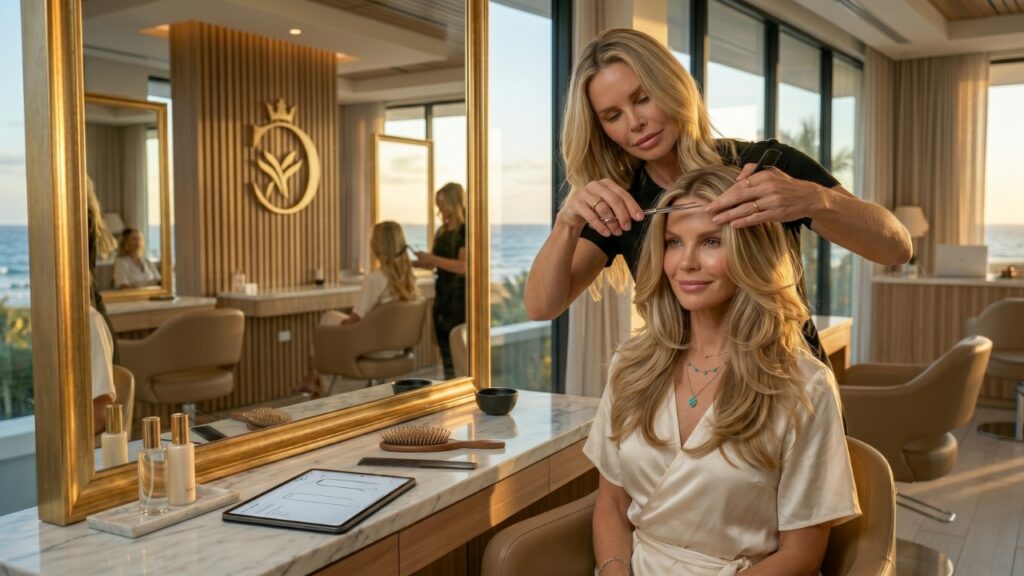
What Our Clients Experience at Parlay Cutting Appointments
“Ashley is the best! Whether I’m getting a balayage, highlights, or a haircut, she always does an amazing job and I leave with my hair looking and feeling great. Wouldn’t go anywhere else for my hair!” – Kaite, Google Review
“Savannah did my hair and she is a hair wizard!!! The highlights are seamless and the haircut is perfect. I love my hair and highly recommend!!” – Mattie, Google Review
“I’ve been seeing Ashley for about two years and she is absolutely amazing. Every haircut is perfect. She truly cares about hair health.” – Jennifer Adams, Google Review
“Savannah listens and offers realistic feedback! She took inspiration from my photos, and I feel very pretty in my new hair!” – Becky, Google Review
“Kloe gave me the best highlights I’ve ever had! The blend is flawless and her shampoo was top notch.” – Katina, Google Review
The thread that runs through every one of these reviews – “always,” “perfect,” “exactly what I asked for” – reflects something that goes beyond technical skill. It reflects the specific quality of communication and understanding that makes a salon appointment feel genuinely satisfying rather than simply competently executed.
The Trim and Haircut Schedule – How Often Is Often Enough?
The Complete Guide to Scheduling Trims and Haircuts for Every Hair Type and Style
One of the most commonly asked and the most inconsistently answered questions in hair care is how often to get a trim or a haircut. The honest answer is that the right frequency depends on the specific hair type, the specific style, and the specific environment – and that Jensen Beach’s specific environmental demands create schedules that are generally more frequent than standard guidance suggests.
Short Haircuts – The Most Maintenance-Intensive Schedule
Short haircuts – bobs, pixies, short layered cuts – require the most frequent professional maintenance of any hair length category. The grow-out of a short haircut is immediately visible in a way that the grow-out of longer hair is not – the specific shape that makes a short haircut beautiful becomes noticeably less defined within three to four weeks of the appointment, and significantly less defined by six weeks.
For most short haircut clients in Jensen Beach, a four to six week professional trim interval is the most appropriate for maintaining the sharpest, most beautiful expression of the style. This is more frequent than many short haircut clients expect when they first cut their hair short – but it is the reality of maintaining a short haircut at its most beautiful quality.
Medium-Length Haircuts – The Most Balanced Schedule
Medium-length haircuts – the bobs, the lobs, and the layered medium-length cuts that fall between the chin and the collarbone – typically require professional maintenance every six to eight weeks for the most well-maintained result. The grow-out at this length is meaningful but more gradual than at short lengths – the additional length providing more buffer between the designed end point and the grown-out version.
For Jensen Beach clients with medium-length styles, the six-week interval is more appropriate during periods of high environmental exposure – the summer months, periods of intensive beach and pool activity – when split end development is fastest.
Long Hair – The Most Forgiving Schedule With the Most Important Consequences of Skipping
Long hair is the most forgiving length category in terms of visible grow-out – the additional length providing the most buffer between appointments and making the difference between freshly trimmed and grown-out least immediately visible. Many long-hair clients in Jensen Beach successfully maintain their hair with eight to twelve week trim intervals.
However, long hair is the length category where the consequences of skipping trims are most significant over time – because the ends of long hair are the oldest, the most processed, and the most environmentally stressed part of the hair, and they accumulate damage faster than the roots and mid-lengths. Long-hair clients who skip trims for extended periods – six months, a year, or more – often discover that by the time they finally come in, the required removal to address the accumulated damage is significantly more than a trim. The irony of trying to grow long hair by skipping trims is that skipping trims often results in more significant length loss at the eventual appointment than regular trimming would have required.
For Jensen Beach long-hair clients with significant environmental exposure – the regular ocean swimmers, the outdoor enthusiasts, the pool users – an eight-week trim interval rather than the twelve-week maximum is more appropriate for maintaining genuinely healthy long hair.
Curly and Wavy Hair – The Most Variable Schedule
Curly and wavy hair creates the most variable trim schedule of any hair type – because the natural curl or wave creates an apparent length reduction that makes the grow-out less immediately visible than in straight hair. Curly hair that has grown two inches since the last trim may appear to have grown only one inch due to the curl’s spring and contraction.
For curly and wavy hair in Jensen Beach, the trim schedule is best determined not by time elapsed but by the appearance of the ends – when the ends begin to look thin, stringy, or scraggly rather than full and beautifully curled, it is time for a trim regardless of how recently the last one was. Most curly-haired Jensen Beach clients find that a ten to twelve week interval is appropriate for maintaining genuinely beautiful curl ends.
Frequently Asked Questions – Trim vs Haircut
The Questions Jensen Beach Women Ask Most Often
How do I know if I need a trim or a haircut? The most reliable test is the shape question: does the overall shape of your style still look intentional and polished, or has it grown out to the point where the shape is noticeably different from how it looked when it was designed? If the shape is maintained and only the ends need attention, a trim is most likely appropriate. If the shape has changed significantly from growth, a haircut is more appropriate. When in doubt, a consultation at Parlay provides a professional assessment at no obligation.
Can I ask for a trim at a haircut appointment? Yes – and you should be as specific as possible about what “trim” means to you at that appointment. “I would like a haircut but please keep the changes conservative – only about half an inch removed and no significant shape changes” communicates your intention more precisely than “just a trim” and gives your stylist the specific parameters to work within.
Why did my trim cost the same as a haircut? Professional cutting services are typically priced based on the time, skill, and professional expertise involved rather than on the amount of hair removed. A professional trim executed with proper sectioning, even cutting, and thorough check cutting involves the same professional expertise as a haircut – it simply takes less time. Many salons charge a standard haircut price regardless of the amount removed. At Parlay, all pricing is discussed at the consultation before any service begins.
My stylist always takes off more than I ask for – how do I prevent this? The most effective prevention is the pre-cutting confirmation described in this guide – asking your stylist to show you physically on the hair how much they are planning to remove before beginning. This visual confirmation eliminates the ambiguity that allows “more than expected” removal to happen. At Parlay, this confirmation is standard practice – your stylist always shows you the planned removal before cutting.
How much does a trim cost at Parlay? Trim and haircut pricing at Parlay starts at $55 for women and $35 for men. All pricing is discussed and confirmed before any service begins. Call (772) 261-8116 or book online at parlayhairandbeauty.com for a specific quote.
How long does a trim take at Parlay? A standard trim at Parlay typically takes twenty to forty minutes depending on the hair’s length and density. More comprehensive trims that include shape refreshing or detailed perimeter work may take up to sixty minutes. A blowout and styling after the trim adds additional time. Your stylist will give you an accurate time estimate at the beginning of the appointment.
Should I wash my hair before a trim appointment? Your stylist will shampoo and condition your hair at the beginning of the appointment – arriving with freshly washed hair from home is not necessary. For trim appointments specifically, arriving with clean, product-free hair is beneficial as heavy product application can affect the way the hair falls during cutting and the accuracy of the trim assessment.
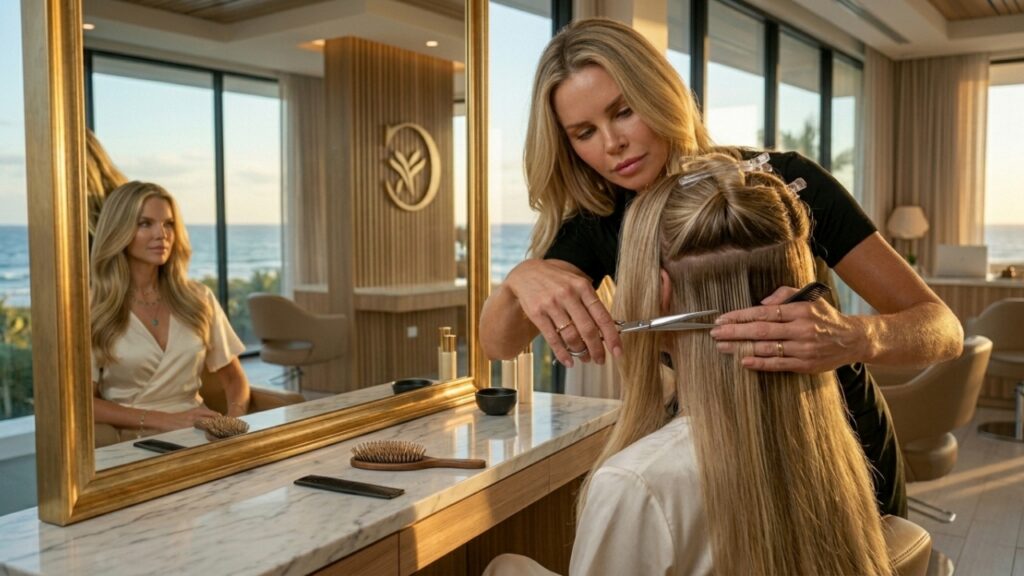
Conclusion: The Appointment That Gets You Exactly What You Want – Every Time
The trim versus haircut distinction is ultimately not about the words. It is about the communication – the specific, precise, mutually understood exchange of information between you and your stylist that ensures the result of the appointment is the result you were envisioning rather than a technically correct execution of a different result.
At Parlay Hair and Beauty in Jensen Beach, Florida, this communication is the foundation of every cutting appointment we perform. The consultation that asks the right questions. The confirmation before cutting begins. The professional assessment that adds the stylist’s expertise to the client’s vision. And the genuine commitment to understanding not just what the client asked for but what the client actually wants – and then delivering it with the technical skill and the genuine care that our clients describe as the most consistently satisfying part of the Parlay experience.
Bring your hair. Bring your vision. Bring your uncertainty if that is what you have. And let us figure out together – with the specific vocabulary and the honest conversation that this guide has given you – exactly what your hair needs and exactly how to make it happen.
📍 2250 NE Dixie Hwy, Jensen Beach, FL 34957
📞 Call or Text: (772) 261-8116
🌐 Book Online: parlayhairandbeauty.com
⏰ Online Booking Available 24/7 via Vagaro
Parlay Hair and Beauty – Jensen Beach’s most trusted salon for women’s haircuts, men’s haircuts, trims, color, balayage, extensions, and complete hair services. Serving Jensen Beach, Stuart, Palm City, Hobe Sound, Hutchinson Island, Port St. Lucie, and all of Martin County, Florida.